Shoulder Workout Machine Names: The Definitive Gym Guide
Walking onto the gym floor can feel like entering a cockpit without a flight manual. You see rows of chrome and leather, but identifying the specific equipment for your deltoids isn't always intuitive. Knowing the correct shoulder workout machine names is the first step to navigating the gym with confidence and building a 3D physique.
You don't need to guess which lever does what anymore. This guide breaks down the hardware essential for capping off those delts, explaining not just what they are called, but why they earn a spot in your routine.
Quick Summary: The Essential Machines
If you are looking for a quick reference list of the equipment discussed below, here are the core machines found in most commercial gyms:
- Seated Overhead Press Machine: The primary compound movement for overall mass.
- Lateral Raise Machine: An isolation tool for the side delts (medial deltoids).
- Reverse Pec Deck (Rear Delt Fly Machine): Targets the often-neglected rear delts.
- Smith Machine: A guided barbell system used for heavy overhead pressing.
- Cable Crossover / Functional Trainer: Versatile pulley systems for face pulls and raises.
- Viking Press: A plate-loaded lever machine often found in bodybuilding or strongman gyms.
The Mass Builders: Compound Pressing Machines
When hypertrophy (muscle growth) is the goal, you need to move heavy loads. Compound machines allow you to do this safely without the stability demands of free weights.
The Seated Overhead Press Machine
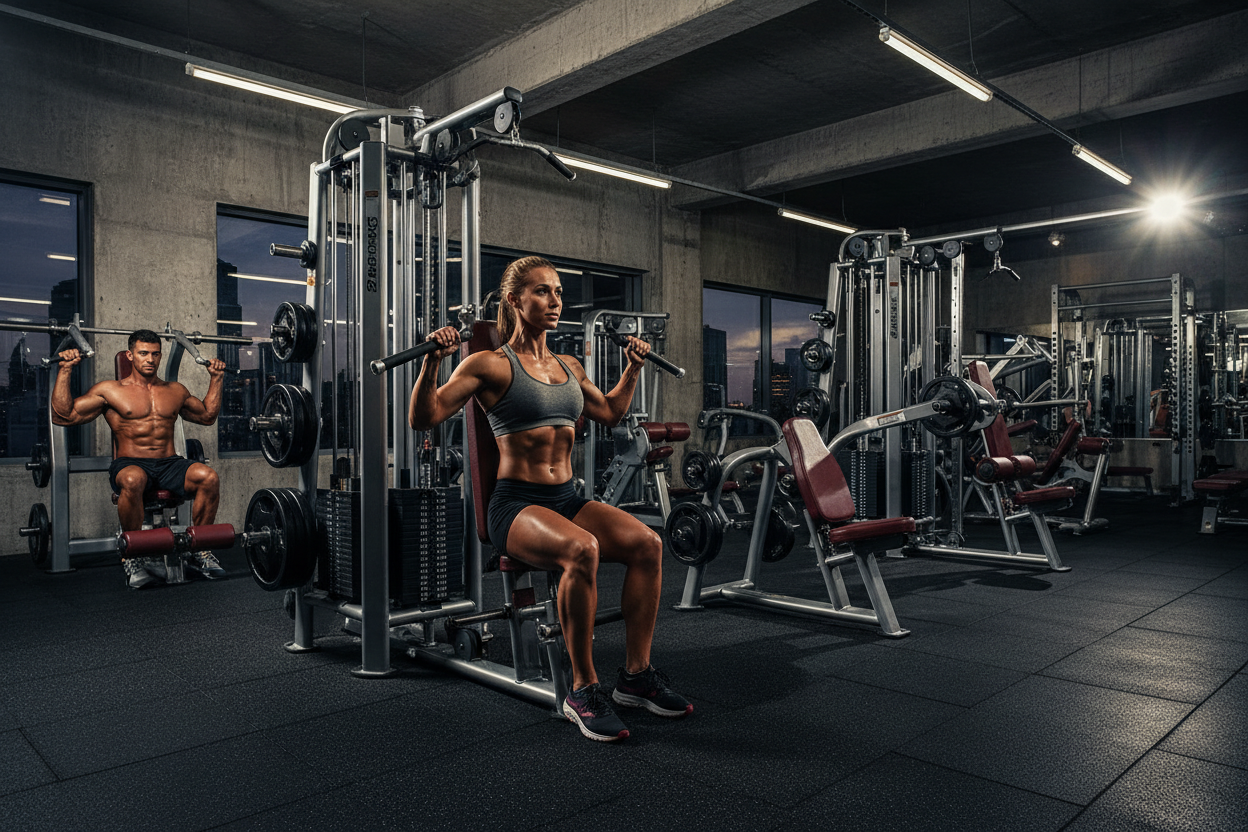
This is the cornerstone of machine-based shoulder training. Depending on the brand (Hammer Strength, Cybex, Matrix), it might be plate-loaded or selectorized (using a pin and weight stack). The movement mimics a barbell military press but locks you into a fixed path of motion.
Why use it? It removes the need to stabilize the weight. This allows you to focus purely on the pushing output of the front deltoids. If you have lower back issues, the back support here is a game-changer compared to standing barbell presses.
The Smith Machine
While not exclusively a shoulder machine name, the Smith Machine is a staple for overhead work. It consists of a barbell fixed within steel rails, allowing only vertical movement.
Many lifters prefer this for overhead presses because you can rack the weight easily at any point if muscle failure sets in. It allows for a slightly different angle than a standard machine press, and you can adjust the bench to hit the front delts more accurately.
The Sculptors: Isolation Machines
Compound lifts build the size, but isolation machines create the width and the "pop." These machines target specific heads of the deltoid muscle.
The Lateral Raise Machine
If you have trouble feeling your side delts working with dumbbells, this machine is the solution. It usually features padded arms that you push outward and upward.
The Mechanics: Dumbbells lose tension at the bottom of the movement (when your arms are at your sides). The Lateral Raise Machine provides a distinct mechanical advantage: it maintains constant tension on the muscle throughout the entire range of motion, even at the very bottom.
The Reverse Pec Deck (Rear Delt Fly)
Often labeled as a "Pec Fly" machine, most modern versions have a dual function. By facing the pad and adjusting the arms backward, this becomes the premier shoulder exercise machine name for the posterior (rear) deltoids.
Rear delts are essential for shoulder health and posture. This machine forces you to isolate the small muscles on the back of the shoulder without allowing the bigger back muscles (lats) to take over, which often happens with dumbbell rows.
The Versatile Options: Cable Systems
The Cable Crossover / Functional Trainer
While technically a multi-purpose unit, the cable tower is vital for shoulders. You will often see this listed when searching for a shoulder machine name because of its versatility.
Using the rope attachment allows for Face Pulls, arguably the best exercise for rotator cuff health and rear delt development. Furthermore, single-arm cable lateral raises allow you to train the shoulder across the body, a range of motion impossible to replicate with dumbbells or fixed machines.
My Training Log: Real Talk
Let's drop the textbook definitions for a second. I want to talk about the specific grit of using the Plate-Loaded Lateral Raise Machine. I remember the first time I used an old-school Hammer Strength model at a warehouse gym in Ohio. It wasn't smooth like the digital electric machines you see today.
The pivot point is everything. On that specific machine, if I didn't line my shoulder joint up exactly with the machine's axis (the red dot usually), the pad would grind halfway up my tricep, and my traps would instantly take over the lift. I learned the hard way that "machine" doesn't mean "autopilot." I had to physically scoot the seat down two notches lower than I thought necessary. The moment I did, the burn shifted entirely to the side delt cap. It felt like someone held a lighter to my shoulder. That specific mechanical friction—the slight drag of the metal arm—actually helped me control the negative (eccentric) portion better than any frictionless new cable machine ever has.
Conclusion
Understanding the gym layout shouldn't be a workout in itself. Whether you are jumping on the Overhead Press for mass or the Reverse Pec Deck for posture, knowing the correct shoulder workout machine names empowers you to build a complete program. Stop wandering aimlessly; find the right tool for the job and start pressing.
Frequently Asked Questions
What is the best shoulder machine for mass?
The Seated Overhead Press machine (often plate-loaded) is generally considered the best for mass. It allows you to load the heaviest weight safely without taxing your stabilizers, directing maximum tension to the front deltoids.
What is the machine called where you push up?
This is typically called a Shoulder Press Machine or an Overhead Press Machine. Variations include the Military Press Machine or the Viking Press, but they all involve a vertical pushing motion.
Are shoulder machines better than free weights?
Not necessarily better, but different. Free weights require more stabilization and engage more muscle fibers overall. Machines, however, are superior for isolating the muscle safely, maintaining constant tension (especially for lateral raises), and training to failure without a spotter.