
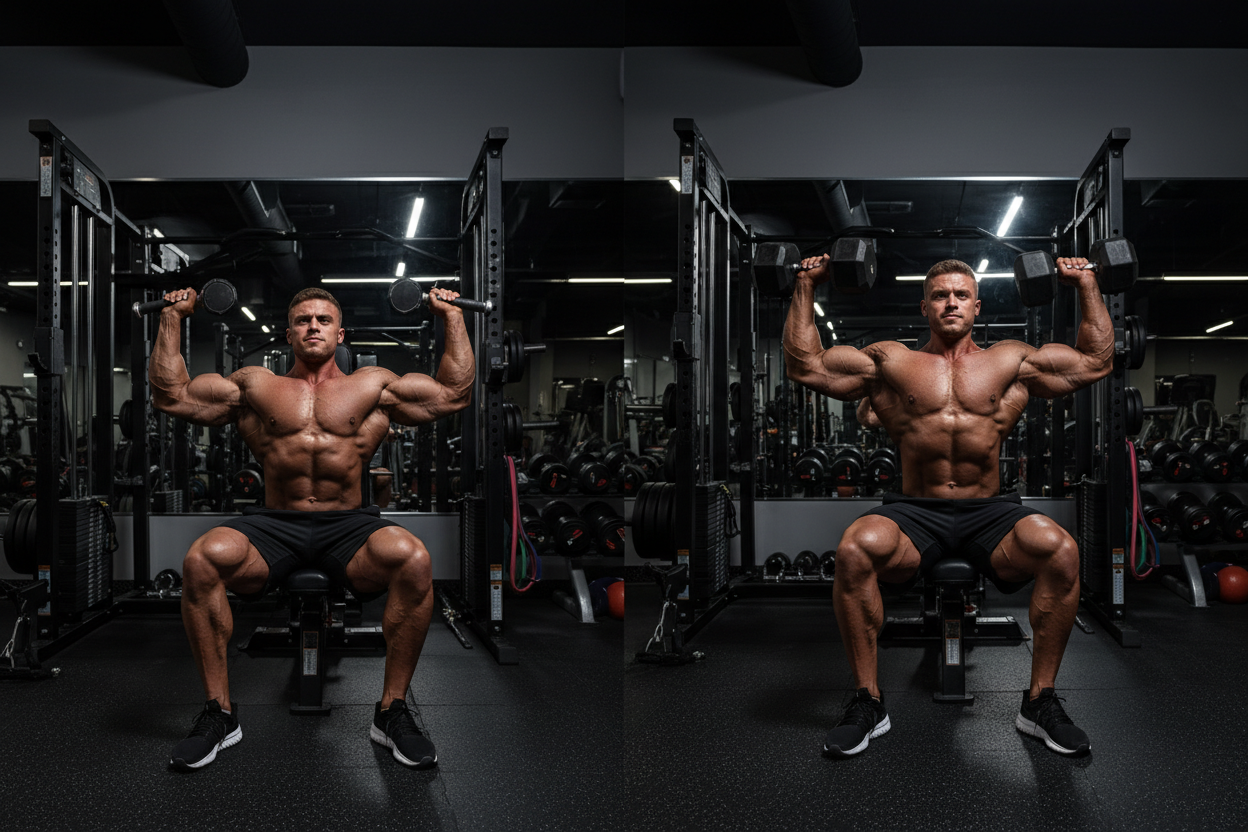
Shoulder Press Machine vs Dumbbell: Which Builds Bigger Delts?
You walk into the gym on push day, and you are faced with a classic dilemma. Do you head to the rack and grab the iron, or do you sit down at the fixed-path station? The debate of the shoulder press machine vs dumbbell is one of the oldest on the gym floor, yet most lifters choose their equipment based on habit rather than physiology.
If you want 3D delts, you cannot simply guess which tool is better. You need to understand how stability, range of motion, and mechanical tension differ between these two movements. Let’s break down the biomechanics so you can stop guessing and start growing.
Key Takeaways: The Short Answer
- Stabilization: Dumbbells recruit more stabilizer muscles and core strength, while machines isolate the deltoid by removing the need to balance the weight.
- Range of Motion (ROM): Dumbbells allow for a natural, converging arc that follows your shoulder joint's anatomy. Machines often force a fixed, linear path.
- Hypertrophy Potential: Machines allow you to push closer to true muscular failure safely, making them excellent for hypertrophy (muscle growth) without the risk of dropping weights.
- Imbalances: Dumbbells are superior for correcting strength asymmetries between the left and right sides.
The Case for Dumbbells: Function and Freedom
When asking whether to choose the shoulder press machine or dumbbell, the strongest argument for dumbbells is the freedom of movement. Your shoulder is a ball-and-socket joint; it doesn't naturally want to move in a perfectly straight line.
Dumbbells allow you to press in a slight arc, bringing the weights together at the top. This increases the peak contraction of the deltoids. Furthermore, because the weights aren't connected, your stronger arm cannot compensate for your weaker arm. This ensures balanced development.
The CNS Cost
However, this freedom comes at a cost. Machine vs dumbbell shoulder press movements differ significantly in Central Nervous System (CNS) fatigue. With dumbbells, a significant amount of neural energy is spent just keeping the weights from falling sideways. This is great for functional strength, but it can limit the raw output of the prime mover (the deltoid).
The Case for Machines: Isolation and Safety
Many purists scoff at machines, but if your goal is pure size, they are invaluable. When comparing the machine shoulder press vs barbell or dumbbells, the machine wins on stability. Stability is the foundation of force production.
Because the path is fixed, you don't waste energy balancing the load. All that energy goes directly into pushing the weight up. This allows for higher mechanical tension on the target muscle.
MTS and Iso-Lateral Machines
Not all machines are created equal. You might see terms like "MTS" (Motion Technology Selectorized) in your gym. The mts shoulder press vs shoulder press (standard stack) distinction is important. MTS machines are usually iso-lateral, meaning the arms move independently. This gives you the safety of a machine with the unilateral benefits of a dumbbell, bridging the gap between the two worlds.
Comparison: Machine vs. Overhead Press
It is also vital to contextualize this against the king of shoulder lifts: the standing barbell press. In a shoulder press machine vs overhead press comparison, the overhead press is a total body movement. It taxes the glutes, core, and lower back.
If your lower back is fried from deadlifts earlier in the week, the machine press is the smarter choice. It allows you to overload the shoulders without further stressing your spinal erectors.
My Training Log: Real Talk
I want to step away from the science for a second and talk about what this actually feels like in the trenches. I’ve spent years alternating between these movements, and here is the reality of the shoulder press machine vs dumbbell experience.
When I’m using heavy dumbbells—let’s say 80s or 90s—the hardest part isn't the press; it’s the setup. Hoisting those weights onto my knees and kicking them up into position takes a toll. I can feel the gritty knurling digging into my palms, and there is always that split-second of fear at the bottom of the movement where my wrist wobbles slightly. That wobble drains confidence.
Conversely, when I switch to the Hammer Strength machine late in a workout, the feeling is pure exhaustion without fear. I can grind out those last two reps where my face turns purple and the veins pop, knowing that if I fail, the handles just stop. I don't have to worry about dropping a dumbbell on my face. For me, dumbbells build the base, but the machine is where I safely take my muscles to the dark place required for growth.
Conclusion
So, is one better than the other? No. They serve different phases of your workout. Use dumbbells early in your session when your stabilizers are fresh to build coordination and raw strength. Move to the machine later in the workout to safely drive the muscle to failure without worrying about stability.
Frequently Asked Questions
1. Is the shoulder press machine safer than dumbbells?
Generally, yes. The machine provides a fixed path and safety stops, reducing the risk of dropping weights or hyperextending the shoulder joint. However, if the machine's seat isn't adjusted correctly, it can force your joints into an unnatural position.
2. Can I replace the barbell overhead press with a machine?
If your goal is purely hypertrophy (muscle size), yes. The shoulder press machine vs overhead press debate changes depending on goals. For athletes needing full-body coordination, keep the barbell. For bodybuilders wanting big delts, the machine is a perfectly adequate substitute.
3. Should beginners start with machines or dumbbells?
Beginners should ideally start with dumbbells to develop stabilizer muscles and learn proper movement patterns. Relying solely on machines early on can lead to a lack of core stability and coordination later in your lifting journey.


