Regain Full Mobility: Safe Guide to Rotator Cuff Surgery Exercises
Waking up in a sling with a shoulder that feels like it’s been encased in concrete is a humbling experience. You want to move, but you're terrified of undoing the surgeon's work. This is the delicate balance of recovery. The right exercise for rotator cuff after surgery is not just about getting strong; it is about teaching your brain to trust your arm again without compromising the structural repair.
Recovery follows a biological timeline that you cannot cheat. The tendon needs to knit back into the bone, a process that takes months, not days. Below, we break down the roadmap from passive protection to active strengthening.
Key Takeaways: The Recovery Roadmap
- Weeks 0-4 (Protection): Focus strictly on passive range of motion exercises after rotator cuff surgery. Let gravity or your other arm do the work.
- Weeks 4-6 (Mobility): Introduction of active-assist motion. You guide the arm, but the muscles start to wake up.
- Weeks 6-12 (Activation): Transition to active motion against gravity. This is where 6 weeks post op rotator cuff surgery exercises become critical.
- Weeks 12+ (Strengthening): Adding resistance bands and weights. This is true rotator cuff surgery rehabilitation exercises territory.
The Science of "Passive" vs. "Active" Recovery
Before jumping into movements, you must understand the "why." In the first few weeks, your post op exercises for rotator cuff surgery are strictly passive. This means your rotator cuff muscles must stay completely relaxed. If you contract the muscle that was just stitched to the bone, you risk pulling the anchor out.
We use physiotherapy exercises after rotator cuff surgery to keep the joint capsule from shrinking (freezing) while the tendon heals. It’s a trade-off between stiffness and integrity.
Phase 1: Early Protection (Weeks 0-4)
During this phase, at home physical therapy after rotator cuff surgery is boring but vital. You are maintaining range without engaging the muscle.
The Pendulum (The Right Way)
Most people do this wrong by using their shoulder muscles to circle the arm. Instead, lean over a table, supporting your good arm. Use your hips to sway your body. Let your surgical arm dangle like a dead weight. The momentum of your body should move the arm, not the shoulder muscles.
Passive Supine Forward Elevation
Lie on your back. Clasp your hands together. Use your good arm to lift the surgical arm straight up toward the ceiling. The surgical arm is just a passenger. This is one of the safest exercises for rotator cuff surgery recovery to prevent stiffness.
Phase 2: Active-Assist Motion (Weeks 4-6)
Once your surgeon clears you for 4 weeks post op rotator cuff surgery exercises, you can start sharing the load. We typically introduce a cane or a broomstick here.
Wand External Rotation
Lie on your back with elbows tucked by your sides (holding a cane). Use the good arm to push the surgical hand outward, away from your body. Stop when you feel a stretch. Do not force through pain. This is a cornerstone of exercises post rotator cuff repair because external rotation is often the hardest motion to regain.
Phase 3: Restoring Active Motion (Weeks 6-12)
At the six-week mark, the tendon has usually healed enough to withstand its own weight. Now we look at shoulder exercises after rotator cuff surgery that fight gravity.
The Finger Walk (Wall Crawl)
Stand facing a wall. Place your fingers on the wall and slowly "walk" them up as high as you can. The wall provides stability. As you lower your arm, control it slowly. This eccentric control is a vital part of physical therapy exercises for rotator cuff surgery.
Scapular Retraction
Your shoulder blade is the foundation of your shoulder. Squeeze your shoulder blades together as if trying to hold a pencil between them. Hold for 5 seconds. This isn't a direct rotator cuff exercise after surgery, but it stabilizes the platform the cuff operates on.
Phase 4: Strengthening (Weeks 12+)
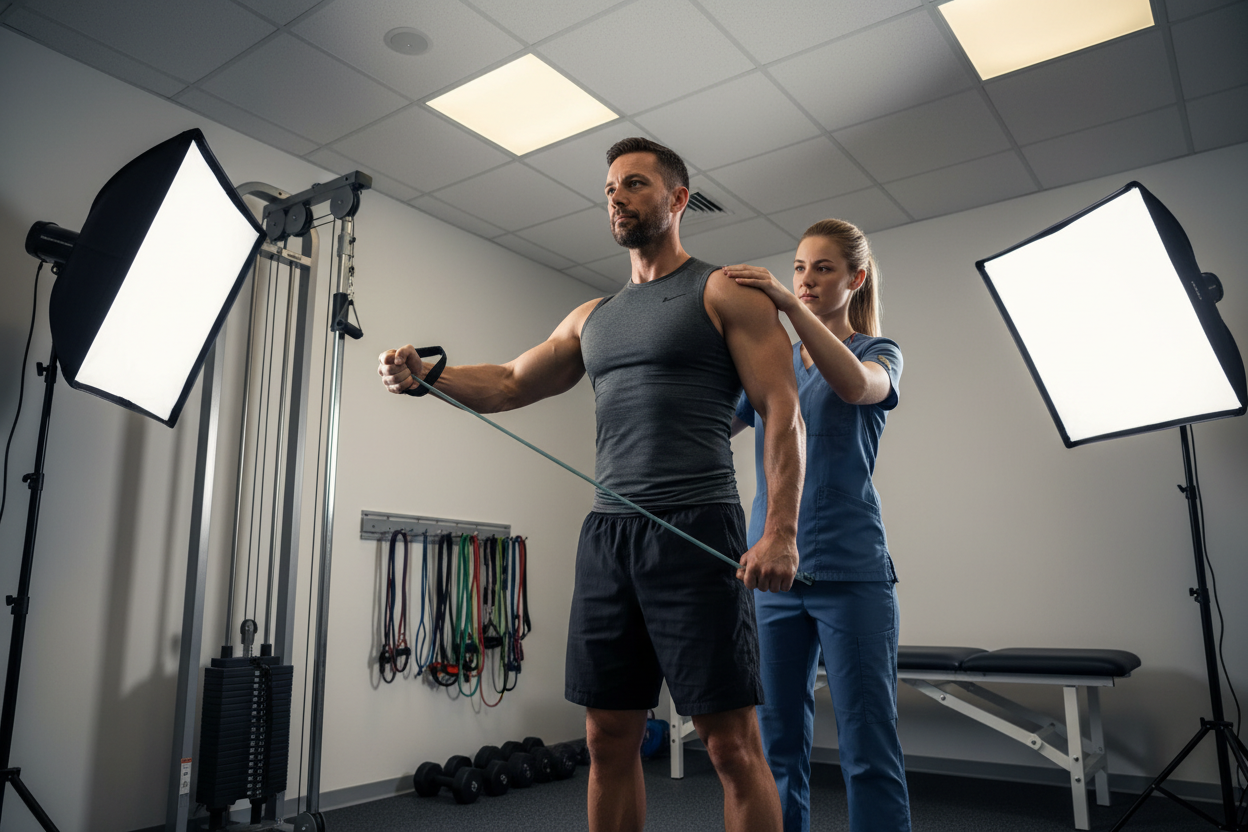
Real strengthening exercises for rotator cuff after surgery usually begin around month three. This is when resistance bands come into play.
Internal and External Rotation with Bands
Attach a resistance band to a doorknob. Keep your elbow tucked into your side (place a rolled-up towel between your elbow and ribs to ensure form). Rotate your arm outward against the resistance. This targets the Infraspinatus and Teres Minor. For internal rotation, turn around and pull the band inward toward your stomach.
My Personal Experience with Rotator Cuff Rehab
I want to share something that isn't usually in the medical brochures. When I was rehabbing a shoulder injury, the hardest part wasn't the pain—it was the "Trap Hike."
Around week 8, I felt like I was making great progress with my forward raises. I was lifting my arm to 90 degrees easily. But my physical therapist stopped me and filmed my back. I wasn't lifting with my shoulder joint; I was shrugging my entire shoulder blade up toward my ear using my upper trap muscles. I was cheating the movement entirely without realizing it.
That specific, deep burn in the neck and upper trap was my body compensating for a weak cuff. I had to regress, drop the weight entirely, and stand in front of a mirror to visually ensure my shoulder stayed depressed while the arm moved. If you feel the burn in your neck, you're likely compensating, too.
Conclusion
The path to full function is slow. It requires discipline to hold back when you feel good and grit to push through when you feel stiff. Adhering to these rotator cuff surgery exercises specifically designed for your timeline is the only way to ensure the repair holds for the long term. Trust the process, and listen to your PT.
Frequently Asked Questions
Why does my shoulder pop during exercises after surgery?
Popping or clicking is very common during post surgery exercises for rotator cuff. It is usually scar tissue breaking up or fluid moving within the joint capsule. Unless the noise is accompanied by sharp, shooting pain, it is generally not a cause for alarm. However, always mention it to your therapist.
When can I start lifting weights after rotator cuff repair?
Most protocols delay heavy lifting until at least 4 to 6 months post-op. Strengthening exercises after rotator cuff surgery start with light bands around week 12, but loading the joint with dumbbells or barbells requires the tendon to be fully matured to the bone.
How often should I do my home physical therapy exercises?
Consistency beats intensity. At home physical therapy after rotator cuff surgery is typically prescribed 2 to 3 times per day. Because the initial exercises are low-load and focused on range of motion, high frequency helps prevent the shoulder from stiffening up (frozen shoulder).