Powerbuilding Leg Day: The Blueprint for Size and Strength
For years, the fitness industry forced a false dichotomy on lifters: you could either train like a bodybuilder and look good, or train like a powerlifter and be strong. Rarely were you encouraged to do both. The result? Strong lifters with underwhelming physiques and aesthetic lifters who folded under heavy iron.
That era is over. A properly programmed powerbuilding leg day bridges the gap, allowing you to chase a 500-pound squat and tear-drop quads in the same session. It is not easy, and it requires a very specific approach to energy management, but the payoff is the complete package: performance and aesthetics.
Key Takeaways
- Compound First: Always start with a low-rep, heavy compound movement (Squat or Deadlift) to target the central nervous system.
- Volume Second: Follow the main lift with high-volume accessory work to induce metabolic stress and hypertrophy.
- Manage Fatigue: You cannot go to failure on every set. Reserve technical failure for accessories, not the main heavy lift.
- Progressive Overload: Track weight increases for the main lift and rep/volume increases for accessories.
The Philosophy Behind the Split
Powerbuilding isn't just throwing random exercises together. It is a structured hierarchy of needs. To understand why this works, you have to look at the physiology. Tension builds strength; metabolic stress builds size.
In a standard power building leg workout, we front-load the tension. You are freshest at the start of the session, which is why your heavy back squats or sumo deadlifts happen immediately after warming up. We are looking for neurological adaptations here—teaching your brain to recruit maximum muscle fibers.
Once the heavy work is done, the goal shifts. You are no longer trying to move weight A to B efficiently; you are trying to damage the muscle tissue to force growth. This is where the bodybuilding principles take over.
Structuring the Workout
1. The Tier 1 Lift (Strength)
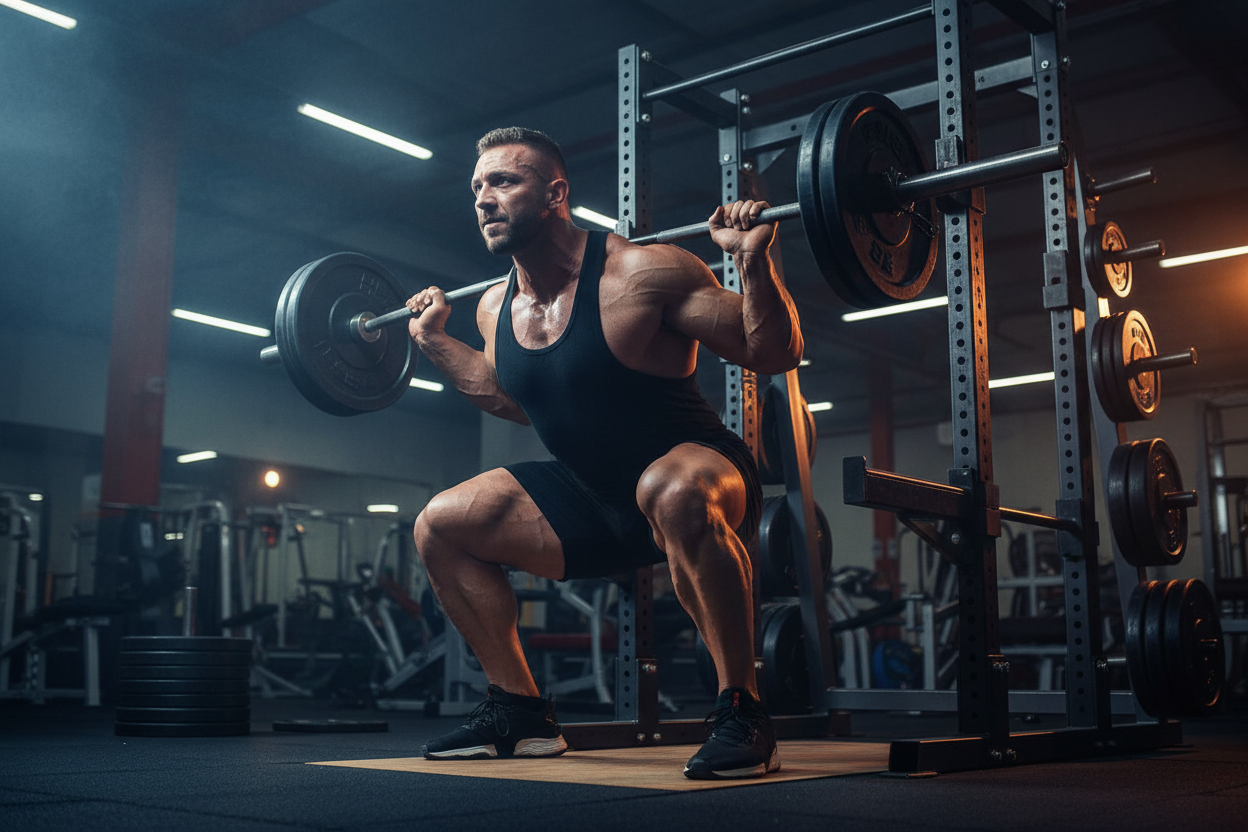
This is the cornerstone. Pick one movement: Low Bar Squat, High Bar Squat, or perhaps a Safety Bar Squat. Keep the reps in the 3–6 range. If you go higher than 6 reps here, cardiovascular fatigue often becomes the limiting factor before muscular failure, which defeats the purpose of strength training.
Rest periods should be long (3–5 minutes). You aren't trying to burn calories; you are trying to recover ATP so you can exert maximum force again.
2. The Tier 2 Lift (Hypertrophy Bridge)
This is where the magic happens. You move to a compound variation, but you increase the rep range to 8–12. Good options include the Hack Squat, Leg Press, or Romanian Deadlift.
This transitions your body from "performance mode" to "building mode." You are still moving heavy loads, but the focus is on time under tension. This is essential for developing power bodybuilding legs that look as strong as they are.
3. Isolation and Metabolic Stress
Finally, you finish with isolation movements like Leg Extensions, Hamstring Curls, or Calf Raises. Here, weight is irrelevant. The goal is blood flow and failure. Reps should be in the 15–20 range. This creates the "pump" and drives nutrients into the muscle belly to aid recovery and growth.
Common Mistakes to Avoid
The biggest error I see is intensity mismatch. Lifters often hold back on their heavy squats to save energy for the leg press, or they go too hard on the leg press and can't finish their isolation work.
You must treat the heavy lift with total respect. Empty the tank on strength. If you are tired for the accessories, that is fine—just drop the weight. Accessories are about muscle contraction, not ego lifting.
My Training Log: Real Talk
I want to be honest about what a true powerbuilding leg session feels like because the paper program doesn't do it justice. I remember a specific block where I was squatting heavy triples followed by high-rep hack squats.
The heavy squats are clean pain. It's heavy, your joints feel the compression, and you feel the knurling of the bar digging into your traps (even through a t-shirt). But the real test is the transition.
Moving from a heavy triple to a set of 15 on the hack squat creates a very specific type of nausea. It’s not just being out of breath. It’s that moment around rep 12 where your quads start to vibrate uncontrollably, and you get that metallic taste in the back of your throat. I recall sitting on the machine after a set, staring at a scuff mark on the rubber floor for a solid two minutes, unable to stand up because my legs felt like gelatin. That wobble you feel when you finally walk to the water fountain? That’s the indicator you did it right. If you walk out of the gym normally, you didn't train hard enough.
Conclusion
Powerbuilding is the most efficient way to train for the natural lifter. It respects the need for heavy loading to build dense muscle while acknowledging that volume is necessary for size. It requires grit, but the reward is a physique that is functional and impressive.
Frequently Asked Questions
How often should I do a powerbuilding leg day?
For most natural lifters, twice a week is ideal. You might do one session focused on Squats (Quad dominant) and a second session focused on Deadlifts (Hamstring/Glute dominant) to manage fatigue.
Can beginners use this program?
Technically yes, but it is better suited for intermediate lifters. Beginners can make gains on linear progression alone. Powerbuilding works best when you need more volume to spur growth that simple strength programs stop providing.
Do I need a lifting belt?
For the Tier 1 heavy lifts, a belt is highly recommended to increase intra-abdominal pressure and safety. However, take it off for your high-rep accessory work to allow for better breathing and core engagement.