Building a home gym usually starts with the fun stuff: picking out a power rack, hunting down the perfect barbell, and stacking up bumper plates. But the most critical decision you will make actually sits right beneath your feet. If you are lifting on bare concrete or cheap foam puzzle mats, you are on a fast track to cracked foundations and aching joints. That is where a high-quality plastic tile gym floor comes into the conversation.
Whether you are outfitting a humid basement or a sprawling two-car garage, your flooring dictates what kind of training you can safely perform. In this guide, we will break down exactly what makes interlocking plastic tiles a top contender, where they fall short, and how to decide if they are the right foundation for your setup.
Key Takeaways
- Moisture Resistance: Unlike rubber stall mats, rigid plastic tiles allow for airflow, preventing trapped moisture and mold in damp basements.
- High Load Capacity: Premium PVC and polypropylene tiles are engineered to withstand thousands of pounds, making them safe for heavy racks and parked vehicles.
- Tool-Free Assembly: Interlocking loop-to-peg systems mean you can floor a two-car garage in under two hours without adhesives.
- Acoustic Trade-off: While highly durable, plastic tiles are generally louder when dropping weights compared to thick vulcanized rubber.
Understanding the Material: PVC vs. Polypropylene
Not all plastic flooring is created equal. When shopping for a plastic tile gym floor, you will typically choose between two main materials: PVC (Polyvinyl Chloride) and Polypropylene. Knowing the difference is crucial for your training style.
Flexible PVC Tiles
PVC tiles feel closer to rubber. They offer a bit of give, making them excellent for joint support during plyometrics or heavy lifting. They are incredibly tough and provide excellent traction, even when you are sweating through a grueling metcon.
Rigid Polypropylene Tiles
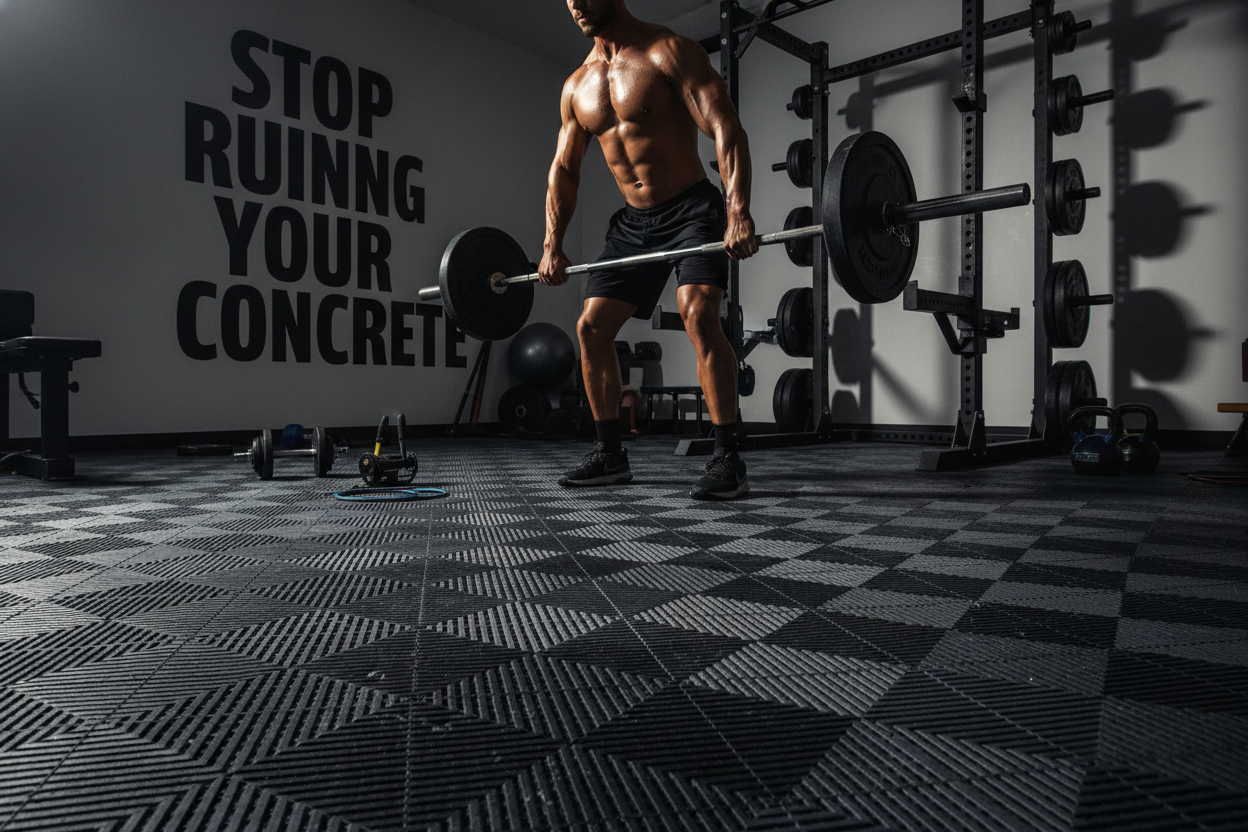
Polypropylene is a hard thermoplastic. These tiles are ultra-rigid and often feature a vented surface. While they are not ideal for dropping heavy barbells directly onto them without a crash pad, they are phenomenal for garage gyms because they can easily support the weight of a parked truck without denting.
Space Planning for Your Home Gym
One of the biggest advantages of a modular flooring system is adaptability. Standard North American garages and basements rarely have perfectly square dimensions, and dealing with 100-pound rubber stall mats can be a nightmare for solo installations.
Garage Gyms and Sloped Floors
Most garage floors slope toward the door for drainage. A rigid plastic tile gym floor handles slight gradients beautifully. If you live in a region with snowy winters, vented plastic tiles allow snowmelt from your car to drain underneath the floor, keeping your workout area dry and safe. Just ensure you leave a half-inch expansion gap around the perimeter, as plastic will expand in peak summer heat.
From Our Gym: Honest Take
We recently outfitted a 400-square-foot uninsulated garage gym with heavy-duty PVC interlocking tiles. The installation was a breeze—I snapped the entire floor together in about 90 minutes using just a rubber mallet and a utility knife for the edges.
Here is my honest takeaway: The stability is unmatched. When I step out for heavy squats, the floor feels completely planted with zero squish, which is a huge upgrade from the cheap EVA foam mats I used to use. However, the noise level is noticeably higher. When I drop my chalked-up bumper plates from hip height, the acoustic smack is louder than it was on 3/4-inch rubber stall mats. It is a trade-off I am willing to make for the ease of cleaning and the fact that my garage no longer smells like a tire factory, but it is something to consider if you have noise-sensitive neighbors.
Frequently Asked Questions
Can I park my car on a plastic tile gym floor?
Yes, provided you choose high-density polypropylene or commercial-grade PVC tiles. Many plastic garage tiles are rated for rolling loads of up to 40,000 pounds, making them perfectly safe for heavy SUVs and trucks.
Do plastic tiles expand in hot garages?
Yes, temperature fluctuations cause plastic to expand and contract. Always leave a 1/2-inch to 3/4-inch gap between the tiles and your walls to prevent buckling during hot summer months.
Are plastic gym tiles waterproof?
The tiles themselves are impervious to water. Vented tiles allow water to flow underneath and evaporate, which is ideal for damp environments, whereas solid PVC tiles will keep spills pooled on the surface for easy wipe-downs.