No Spotter? No Problem: Strength Training Women at Home
You’re staring at those 35-pound dumbbells, your heart is racing, and for the first time, it’s not because of the cardio. It’s the fear. You know that to see real changes in your physique, you have to push closer to failure, but there’s no one in your spare bedroom to catch the weight if your triceps give out. strength training women at home is a different beast than lifting in a crowded commercial gym where a spotter is just a head-nod away.
I’ve spent years testing everything from budget-tier adjustable dumbbells to commercial-grade racks in my own garage. I’ve also had to 'roll of shame' a barbell off my chest more than once because I let my ego outrun my safety setup. Lifting alone requires a shift in strategy, not a reduction in intensity. You can get strong as hell in your living room; you just need to know how to fail without breaking your floor or your ribs.
Quick Takeaways
- Learn to bail: Knowing how to drop a weight safely is a prerequisite for lifting heavy.
- Floor over bench: The floor is the ultimate safety catch for chest and shoulder work.
- Tension is king: Use tempo and pauses to make lighter weights feel like 100 pounds.
- Protect your space: Never lift heavy on bare hardwood or thin carpet.
The Invisible Wall You Hit Lifting Alone
There is a specific moment in every lifter’s life where the 'newbie gains' dry up. You’ve mastered the form, you’re consistent, but suddenly the weights feel heavy enough to be dangerous. This is where many women stall. When you transition out of the beginner phase, the psychological barrier of getting pinned becomes real. If you’re used to 10-pounders, dropping them is no big deal. If you’re moving 40s or 50s, the stakes change.
Effective at home weight training for women requires acknowledging this wall. You stop pushing that final RPE 9 or 10 rep because you’re worried about who will help you if you get stuck. To break the plateau, you have to replace that fear with a system. You aren’t 'lifting alone' if you have the right mechanics and the right environment to support a failed rep.
Why You Actually Need to Learn How to Bail
If you never fail a rep, you aren't training hard enough. Muscle hypertrophy happens when you challenge the fibers to do something they aren't sure they can do. In a home gym, 'bailing' is a skill. For dumbbells, this means practicing the 'drop'—flaring your elbows slightly and letting the weights fall to your sides, rather than trying to guide them down gently and straining a rotator cuff.
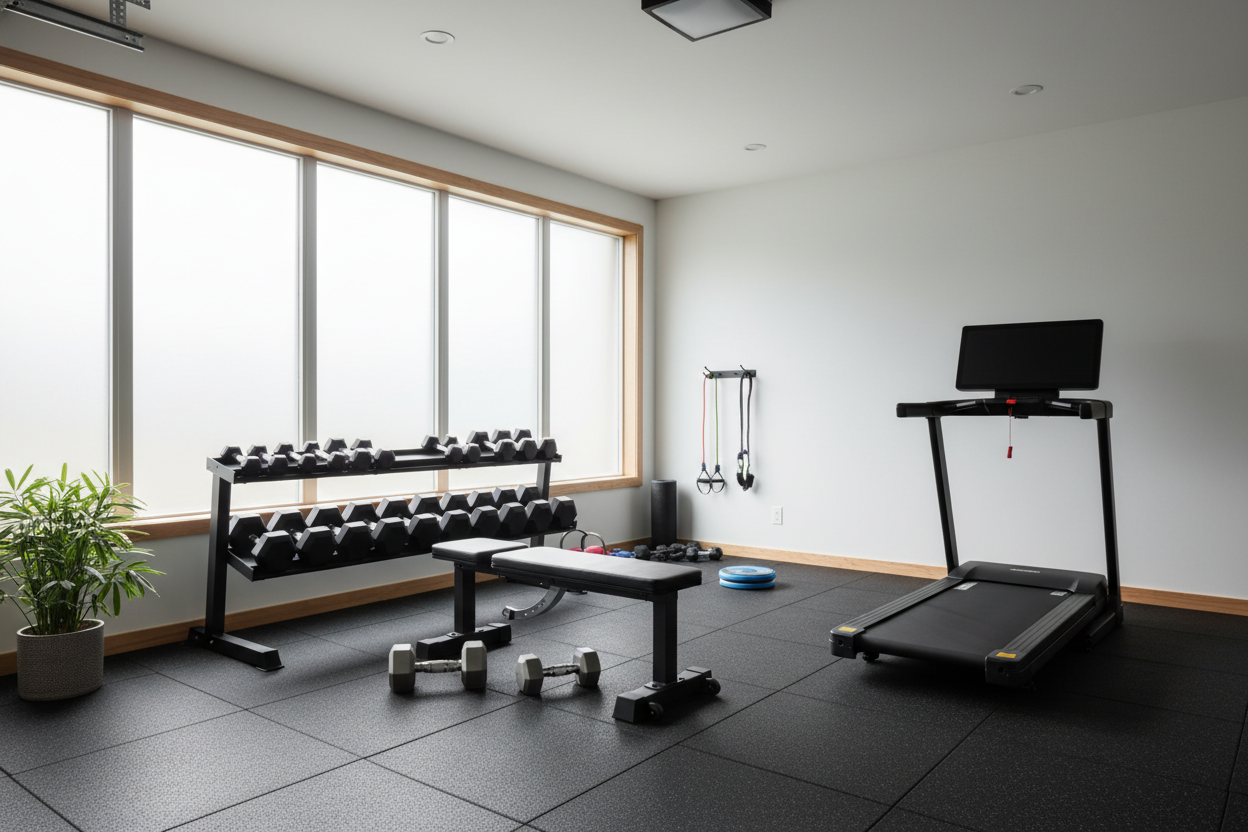
You cannot do this on a bare floor. I’ve seen people crack tiles and dent subfloors trying to be 'careful' with a heavy set. You need a large exercise mat for home gym use that can actually take a hit. A good 7mm or 8mm high-density mat acts as your insurance policy. When you know the floor can take the impact, you stop holding back on that last grindy rep of overhead presses.
Ditch the Bench for the Floor Press
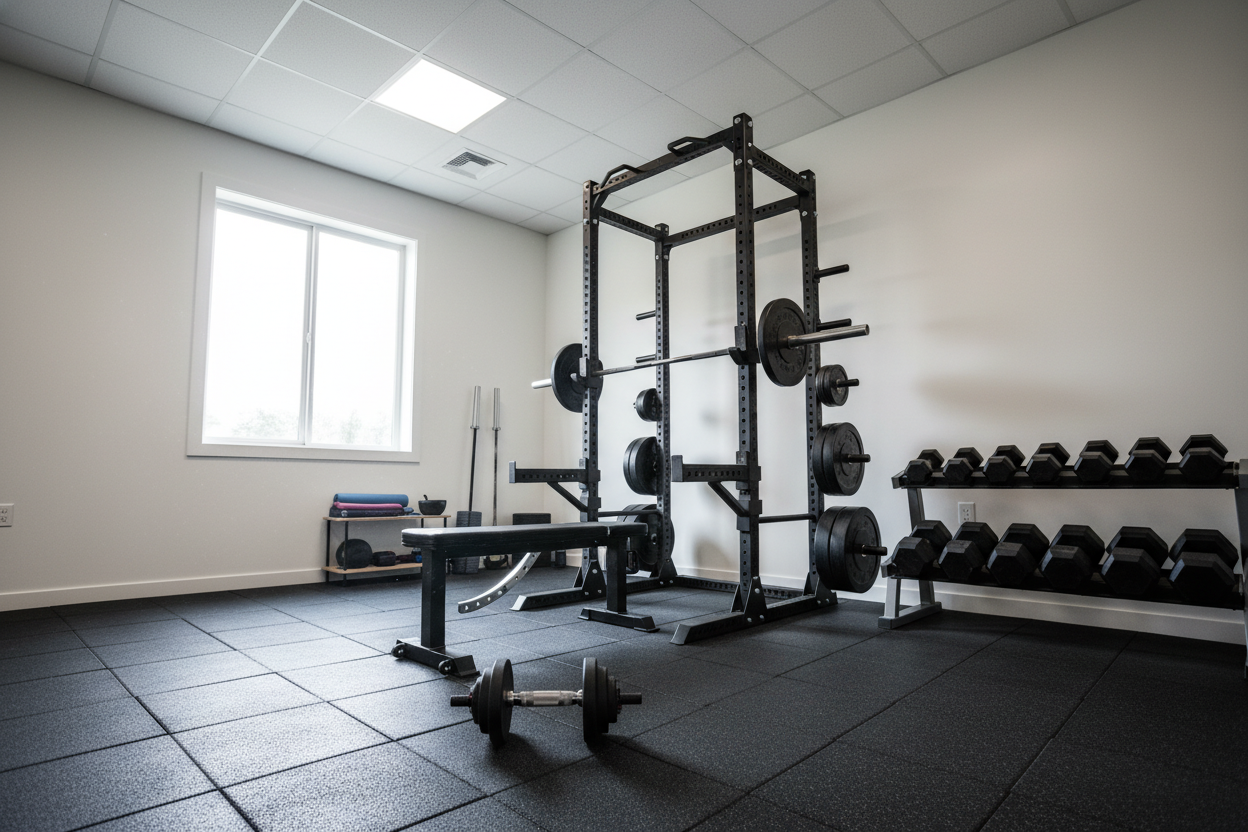
I love a good utility bench, but if you’re training solo and don’t have a full power rack with safety spotter arms, the bench press is a liability. Enter the floor press. By lying directly on the ground, the floor acts as a built-in safety catch. Your elbows hit the ground before the weight can crush your chest. It’s a shorter range of motion, sure, but it allows you to overload your triceps and chest with zero fear.
To do this right, you need a stable base. I recommend laying down thick, shock-absorbing gym flooring so your elbows aren't grinding into the concrete or sliding on carpet. This setup lets you push to absolute muscle failure. If you can’t get the weight back up, you just rest your elbows on the mat and roll the weights off. It’s the most underrated move for the solo home lifter.
Making Lighter Weights Feel Brutally Heavy
Sometimes you don't need a heavier dumbbell; you need a harder rep. If you’ve maxed out your current gear and aren't ready to drop $500 on a new set of adjustables, you have to manipulate tension. Most people stop copying commercial gym routines and realize that at home, tempo is your best friend. Try a 4-second eccentric (the lowering phase) followed by a 2-second pause at the bottom.
Isometric holds are another way to redline your intensity without adding iron. Hold the bottom of a split squat for 3 seconds on every rep. I promise those 20-pound dumbbells will feel like 50s by the time you hit rep eight. This isn't 'toning'—this is high-intensity mechanical tension that builds real muscle while keeping the absolute load low enough to manage safely alone.
Personal Experience: My 'Roll of Shame' Lesson
A few years ago, I was testing a new 1RM on bench press in my garage. No spotter, no safeties. I got halfway through the ascent and my strength just evaporated. I had to slowly lower the bar to my chest and roll it down my stomach to my hips so I could sit up. It was painful, embarrassing, and totally avoidable. Now, if I’m lifting heavy, I either use the floor press or I ensure my safety arms are set exactly one inch below my chest height. Don't let your ego dictate your safety; the iron doesn't care about your pride.
FAQ
Is it okay to drop dumbbells on a mat?
If it's a high-density rubber mat, yes. Avoid dropping them on cheap foam 'puzzle pieces' as they will just compress and let the weight damage the floor underneath. Control the drop, but don't try to catch it.
How do I know if I'm hitting 'failure'?
Failure is when your form breaks down or you cannot physically complete the concentric (upward) part of the rep. For safety at home, aim for 'technical failure'—the point where one more rep would look ugly.
What's the best exercise for solo leg training?
Bulgarian Split Squats. They are brutal on the quads and glutes, but because the weights are at your sides, you can just let go of them if you lose your balance or hit failure. No risk of getting pinned like a back squat.