No Gym Required: How to Sculpt Strong Legs in Your Living Room
You do not need a squat rack, a leg press machine, or a monthly gym membership to build powerful, athletic legs. While heavy iron is useful for absolute strength, your muscles only understand tension. If you can generate enough tension using your body weight and gravity, your legs will grow. The secret lies in manipulating leverage, increasing time under tension, and utilizing high-volume repetition ranges to force adaptation.
Many people assume that leg exercises at home are just for beginners or warm-ups. That is a massive misconception. If you have ever tried to do 100 consecutive air squats or a slow-tempo pistol squat, you know that bodyweight training can be humbling. The key is to stop focusing on what you don't have and start maximizing the physics of your own body.
My Wake-Up Call with Bodyweight Training
I learned this lesson the hard way a few years ago. I was traveling for three weeks and found myself in a remote rental with absolutely no access to weights. I had been lifting heavy for years—squatting double my body weight—and I arrogantly thought a few weeks of calisthenics would be a "deload" or a break. I decided to do a circuit of lunges and jump squats in the living room.
By the third round, my legs were shaking uncontrollably. The next morning, I could barely walk down the stairs. It wasn't the weight that crushed me; it was the sheer volume and the instability of unilateral movements. That experience shifted my perspective entirely. It proved that you can maintain and even build muscle mass with nothing but a floor and some determination.
The Fundamentals of Home Leg Training
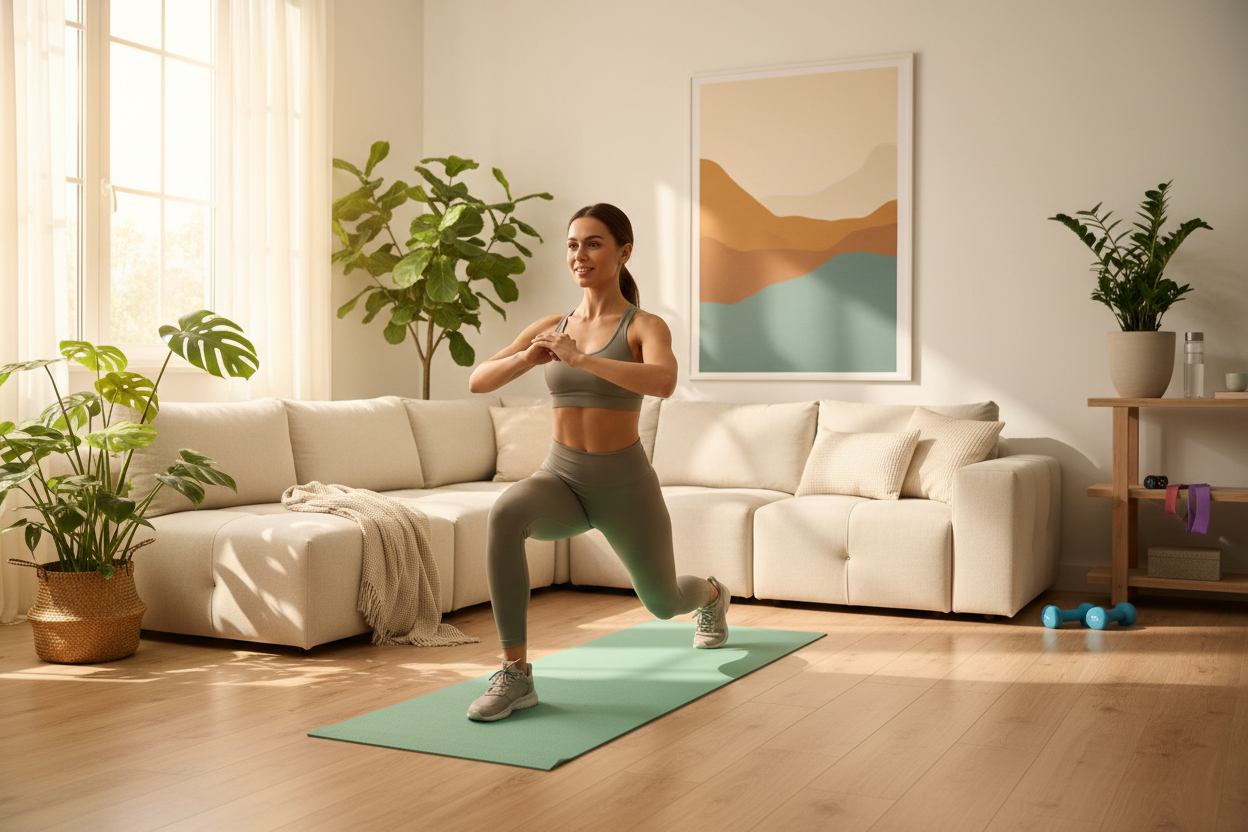
To get results without external load, you have to change your approach. In the gym, you might do 5 reps of a heavy squat. At home, that won't provide enough stimulus. You need to focus on three levers: Unilateral movements (using one leg at a time), Tempo (slowing down the rep), and Range of Motion.
When you shift to single-leg movements, you effectively double the load on the working muscle compared to a two-legged stance, while simultaneously engaging your stabilizers. This is why the best leg exercises to do at home almost always involve splitting your stance.
The Bulgarian Split Squat
This is arguably the king of lower body development, regardless of whether you have weights or not. It targets the quads, glutes, and hamstrings while challenging your balance.
Find a couch, a sturdy chair, or even a coffee table. Stand facing away from it and place the top of one foot on the surface behind you. Hop your front foot forward until you are in a lunge stance. Lower your hips until your back knee almost touches the floor. Your front thigh should be parallel to the ground.
Drive back up through your front heel. Keep your torso upright to hit the quads, or lean forward slightly to engage the glutes more. If you think bodyweight isn't enough, try doing 15 reps with a 3-second descent on each rep. The burn is immediate and intense.
The Sliding Leg Curl
The posterior chain—specifically the hamstrings—is often neglected in home workouts because we don't have leg curl machines. However, if you have a hardwood or tiled floor and a pair of socks (or a towel), you have a hamstring machine.
Lie on your back with your knees bent and feet flat on the floor. Lift your hips into a bridge position. Squeeze your glutes. Now, slowly slide your feet away from you until your legs are almost straight, keeping your hips off the ground the entire time. Dig your heels in and pull your feet back toward your glutes. This movement creates immense tension in the hamstrings and teaches the muscles to work in coordination with the glutes.
Squat Variations for Mass
Standard air squats are great, but your body adapts to them quickly. To continue progressing, you need to increase the mechanical disadvantage.
The Pistol Squat
This is an advanced move that requires significant mobility and strength. Stand on one leg, extend the other leg straight out in front of you, and squat down on the supporting leg. The goal is to get your hamstring to touch your calf.
Most people cannot do this immediately. You can modify it by holding onto a doorframe for support or by placing a chair behind you and sitting down onto it, then standing back up using only one leg. This is one of the most effective leg exercises at home for building genuine single-leg power.
The 1.5 Rep Squat
If pistol squats are out of reach or irritate your knees, modify the standard squat to increase time under tension. Perform a standard squat, go all the way down, come up halfway, go back down, and then stand up fully. That is one repetition. This technique keeps the muscles under tension for longer periods and removes the momentum often used to bounce out of the bottom of a squat.
Don't Forget the Calves
Calves are stubborn. They are used to carrying your body weight all day, so they require high volume or extreme stretching to grow. Find a step, a block of wood, or simply the edge of a staircase. Stand on the edge with your heels hanging off.
Perform a calf raise, but focus entirely on the tempo. Lower your heels as far as possible to get a deep stretch—hold this painful position for two seconds. Then, explode up onto your toes and squeeze hard at the top for another second. Do not bounce. Bouncing uses the Achilles tendon's elasticity rather than the muscle fibers. Aim for sets of 20 to 30 reps.
Structuring Your Routine
Randomly doing a few lunges during commercial breaks won't get you the results you want. You need a structured approach that ensures progressive overload. Since you cannot easily add weight, you must add reps, sets, or reduce rest times.
A solid routine of leg exercises to do at home might look like this:
- Bodyweight Squats: 2 sets of 20 (warm-up)
- Bulgarian Split Squats: 4 sets of 12-15 reps per leg
- Sliding Leg Curls: 4 sets of 12 reps
- 1.5 Rep Squats: 3 sets of 15 reps
- Single-Leg Calf Raises: 4 sets of 20 reps per leg
Rest for 60 seconds between sets. If this feels too easy, cut the rest to 30 seconds. The metabolic stress accumulated by short rest periods triggers a hormonal response conducive to muscle growth and fat loss.
Consistency Wins
The beauty of training at home is the removal of barriers. You don't have to drive anywhere or wait for equipment. However, the trap is becoming complacent because you are in your comfort zone. Treat your living room workout with the same respect and intensity you would give a heavy gym session. Put on your workout clothes, play your music, and focus on the movement. Your legs will reflect the effort you put in, not the location where you trained.
Frequently Asked Questions
Can I actually build muscle size without weights?
Yes, but you must train close to failure. Hypertrophy (muscle growth) occurs when muscle fibers are fatigued, which can be achieved through high repetitions and shorter rest periods just as effectively as heavy weights, up to a certain point.
How often should I do these leg workouts?
For most people, training legs 2 to 3 times per week is ideal. Since bodyweight exercises generally cause less systemic fatigue and joint stress than heavy barbell lifting, you can often train them with higher frequency to maximize volume.
What if I have bad knees?
Focus on posterior chain exercises like glute bridges and hamstring curls which place less stress on the knee joint. For squats and lunges, limit your range of motion to a pain-free depth and focus on controlling the descent rather than bouncing out of the bottom.