No Gym, Big Gains: How to Build Serious Leg Muscle at Home
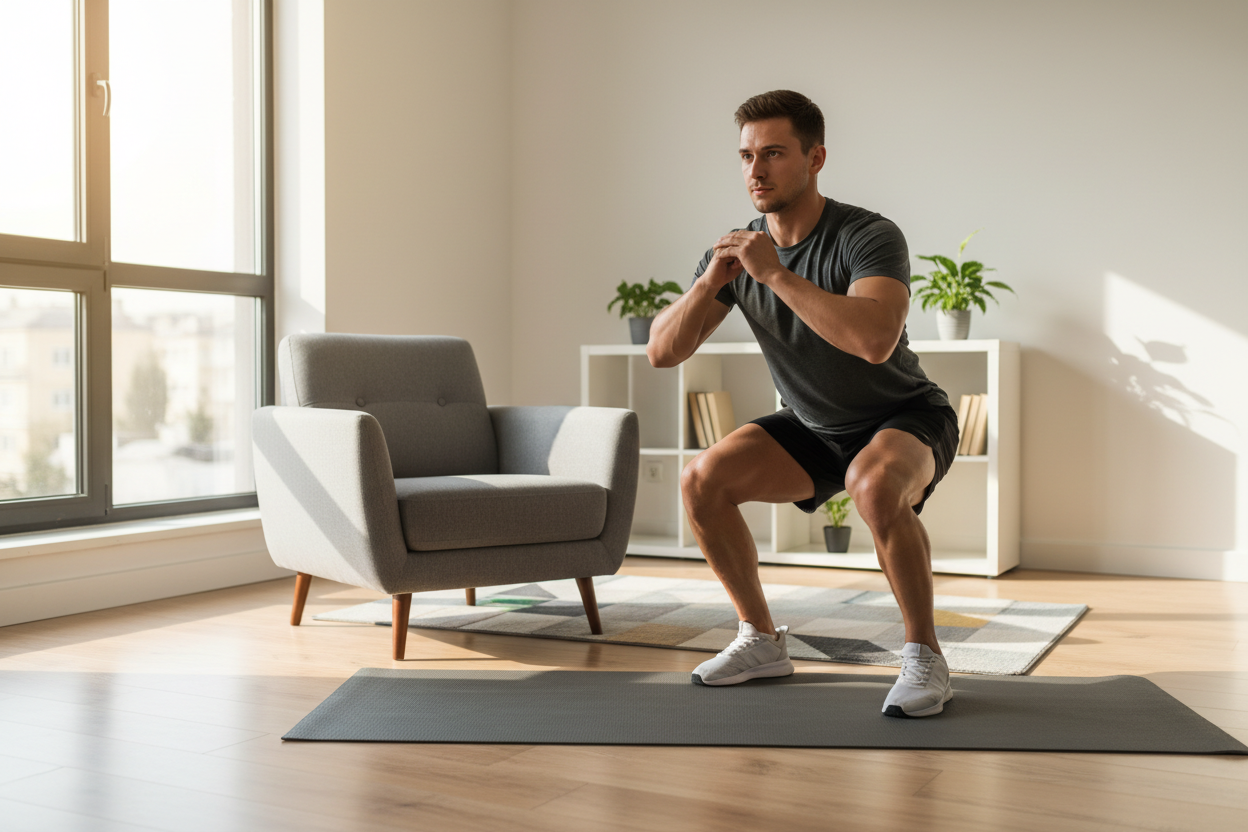
You do not need a squat rack, a leg press machine, or heavy iron plates to grow your legs. The answer to building size is mechanical tension and metabolic stress, both of which can be achieved in your living room. If you are looking for effective leg exercises to build muscle at home, the secret lies in unilateral training—working one leg at a time—and manipulating the tempo of your movement. By shifting the load to a single limb, you instantly double the relative resistance, turning bodyweight movements into serious mass builders.
Why Bodyweight Leg Training Actually Works
There is a pervasive myth in the fitness industry that muscle growth stops the moment you step away from a barbell. This simply isn't true. Your muscles cannot tell the difference between a metal plate and your own body weight; they only understand tension. If you can create enough tension to fatigue the muscle fibers, growth will occur. The challenge with home workouts isn't the lack of weight; it is the lack of creativity in applying that weight.
I learned this lesson the hard way a few years ago. I was recovering from a lower back injury that strictly prohibited spinal loading. No back squats, no deadlifts. I was terrified my legs would atrophy. Forced to adapt, I switched entirely to high-volume calisthenics and isolation movements. After three months, not only had I maintained my size, but the separation in my quadriceps was actually deeper than before. I realized that performing the right exercise to build leg muscles at home often requires more focus and stability than mindlessly pushing a sled at the gym.
The King of Home Leg Exercises: The Split Squat
If you only do one movement, make it the Bulgarian Split Squat. This is arguably the most potent of all leg muscle building exercises at home. It places the quadriceps under an immense stretch while demanding significant glute activation to maintain balance.
To perform this correctly, place your rear foot on a couch, chair, or low table. Step your front foot out far enough so that when you lower your hips, your front knee forms a 90-degree angle. Lower yourself slowly—take three full seconds to go down—and drive back up explosively. Because you are balancing on one leg, your stabilizers work overtime, and the load on the front quad is comparable to a weighted squat.
Making It Harder Without Weight
When basic reps become too easy, don't just add more reps; change the mechanics. Try the "1.5 rep" method. Go all the way down, come halfway up, go back down, and then return to the top. That counts as one repetition. This increases the time under tension, which is crucial for hypertrophy when you lack heavy external loads.
Posterior Chain: Hamstrings and Glutes
Most people neglect their hamstrings outside of the gym because they rely on leg curl machines. However, you can replicate this stimulus effectively. Sliding Leg Curls are phenomenal at home leg exercises to build muscle in the posterior chain. You need a slick floor (wood or tile) and a towel, or paper plates if you are on a carpet.
Lie on your back with your heels on the towel/plates. Bridge your hips up towards the ceiling, squeezing your glutes. While keeping your hips high, slide your heels out until your legs are nearly straight, then dig your heels into the floor to drag them back towards your glutes. This eccentric (lengthening) and concentric (shortening) motion torches the hamstrings.
The Unsung Hero: The Single-Leg Hip Thrust
Squats are great, but for pure glute development, the hip thrust reigns supreme. Doing this on one leg fixes imbalances and ensures your dominant side isn't taking over. Place your upper back against a couch. Plant one foot firmly on the ground and extend the other leg straight out. Drive through the heel of the planted foot to lift your hips until your torso is parallel to the floor. Pause at the top for a hard two-second squeeze.
Structuring leg workouts to build muscle at home requires you to pair these exercises strategically. A superset of Single-Leg Hip Thrusts immediately followed by Sliding Leg Curls will leave your hamstrings trembling without touching a dumbbell.
Explosive Power: Plyometrics
Once you have exhausted your muscles with slow, controlled movements, finish them off with plyometrics. Jump Squats or Alternating Lunge Jumps recruit fast-twitch muscle fibers, which have the highest potential for growth. Perform these with max effort. The goal isn't cardio; it's height and power. Do 3 to 5 sets of 8 reps, focusing on landing softly and exploding upward immediately.
Sample Home Leg Hypertrophy Routine
Here is how to put these pieces together into a cohesive session. Perform this routine twice a week with at least two days of rest in between.
- Bulgarian Split Squats: 4 sets of 12-15 reps per leg (Use the 1.5 rep style if you can do more than 15 easily).
- Single-Leg Hip Thrusts: 4 sets of 15-20 reps per leg (Hold the top squeeze for 2 seconds).
- Sliding Leg Curls: 3 sets of 12-15 reps (Slow tempo on the way out).
- Walking Lunges: 3 sets of 20 steps (Keep constant tension, do not lock out knees at the top).
- Calf Raises on a Step: 5 sets of 20 reps (Single leg if possible).
Nutrition and Recovery
You cannot train your way out of a bad diet, especially when trying to build mass. Since bodyweight training causes slightly less systemic fatigue than heavy spinal loading, you might feel like you can train every day. Resist that urge. Muscles grow during rest, not during the workout.
Ensure you are consuming enough protein to support repair. Whether you are lifting 300 pounds or doing high-rep lunges, the biological requirement for amino acids remains. Pair your training with a slight caloric surplus if your main goal is size.
Consistency is the Variable
The biggest pitfall with home training is a lack of intensity. It is easy to sandbag a set when you are in your living room. To see results, you must take every set close to failure. If you finish a set of squats and feel like you could have done five more, you didn't work hard enough. The best leg exercises to build muscle at home are only as effective as the effort you apply to them. Treat your living room workout with the same respect you would give a session at a commercial gym, and your legs will grow.
Frequently Asked Questions
Can I really get big legs without heavy weights?
Yes, but you must increase the volume and intensity. By using unilateral exercises (one leg at a time), increasing time under tension, and training to failure, you can stimulate significant hypertrophy without heavy external loads.
How often should I train legs at home?
Since bodyweight exercises typically cause less central nervous system fatigue than heavy barbell lifts, you can often train legs 2 to 3 times per week. Ensure you have at least 48 hours of rest between sessions to allow for muscle repair.
What if I have bad knees?
Home exercises can actually be better for bad knees because there is less compressive force on the joint. Focus on posterior chain movements like glute bridges and hamstring curls, and limit the depth of your squats to a pain-free range of motion until your strength improves.