No Barbell? No Problem. Here’s How to Build Massive Legs With Just Dumbbells
There is a persistent myth in the weight room that you cannot build a truly impressive lower body without a squat rack and hundreds of pounds of plates. This couldn't be further from the truth. While the barbell back squat is a classic movement, it is not the only path to hypertrophy. You can absolutely build significant muscle mass using only hand weights if you understand the mechanics of tension and volume. If you want to know how to get bigger legs with dumbbells, the secret lies in increasing the intensity of the movement through range of motion and unilateral training rather than just stacking on absolute load.
The barbell allows for maximum loading, but dumbbells allow for a greater range of motion and the ability to correct muscle imbalances. By shifting your focus from "how much weight is on the bar" to "how much tension is on the muscle," you can stimulate growth just as effectively. This approach is particularly useful for those training in home gyms or crowded commercial facilities where the squat rack is perpetually occupied.
The Reality of Dumbbell Leg Training
I remember a specific period a few years ago when I didn't have access to a commercial gym for about four months. All I had in my garage was a bench and a pair of adjustable dumbbells that maxed out at 50 pounds. As someone used to squatting over 300 pounds, I was convinced my legs would shrink. I was wrong. I was forced to rely on Bulgarian split squats and high-rep goblet squats with slow eccentrics. Within six weeks, my quads had more separation and size than they did during my heavy barbell cycles. The humbling burn of unilateral work taught me that heavy weight isn't the only driver of growth; mechanical disadvantage and time under tension are just as powerful.
The Mechanics of Growth Without Heavy Loads
To understand how to get big legs with dumbbells, you have to stop thinking about moving weight from point A to point B and start thinking about muscle fatigue. Since you cannot load a dumbbell squat as heavily as a barbell squat, you must manipulate other variables to force the muscle to adapt.
The primary mechanism here is metabolic stress. When you perform higher repetitions (12 to 20 range) with shorter rest periods, you create a buildup of metabolites (like lactate) in the muscle. This "pump" is a potent signal for hypertrophy. Additionally, dumbbells are superior for unilateral training—working one leg at a time. When you perform a single-leg squat with 50 pounds, the load on that specific quad is comparable to a bilateral squat with significantly more weight, but with added stability challenges that recruit more stabilizer muscles.
The King of Dumbbell Leg Exercises
If you want to maximize your results, your routine needs to be built around compound movements that allow for the heaviest loading possible with the equipment you have.
1. The Bulgarian Split Squat
This is arguably the most effective leg builder in existence, barbell or otherwise. By elevating your rear foot on a bench and holding dumbbells at your sides, you place nearly the entire load on the front leg. This movement targets the quads and glutes with brutal efficiency. Because balance is a factor, your body cannot cheat the movement. If you are limited on weight, you can increase the difficulty by placing the front foot on a small platform to increase the depth (range of motion).
2. The Dumbbell RDL (Romanian Deadlift)
You cannot neglect the posterior chain. The RDL targets the hamstrings and glutes. To get the most out of this with dumbbells, focus on a slow, controlled descent. Push your hips back as far as possible until you feel a deep stretch in the hamstrings. Since you aren't restricted by a bar hitting your shins, you can keep the weights directly over your center of gravity, which often feels more natural for the lower back.
3. The Goblet Squat
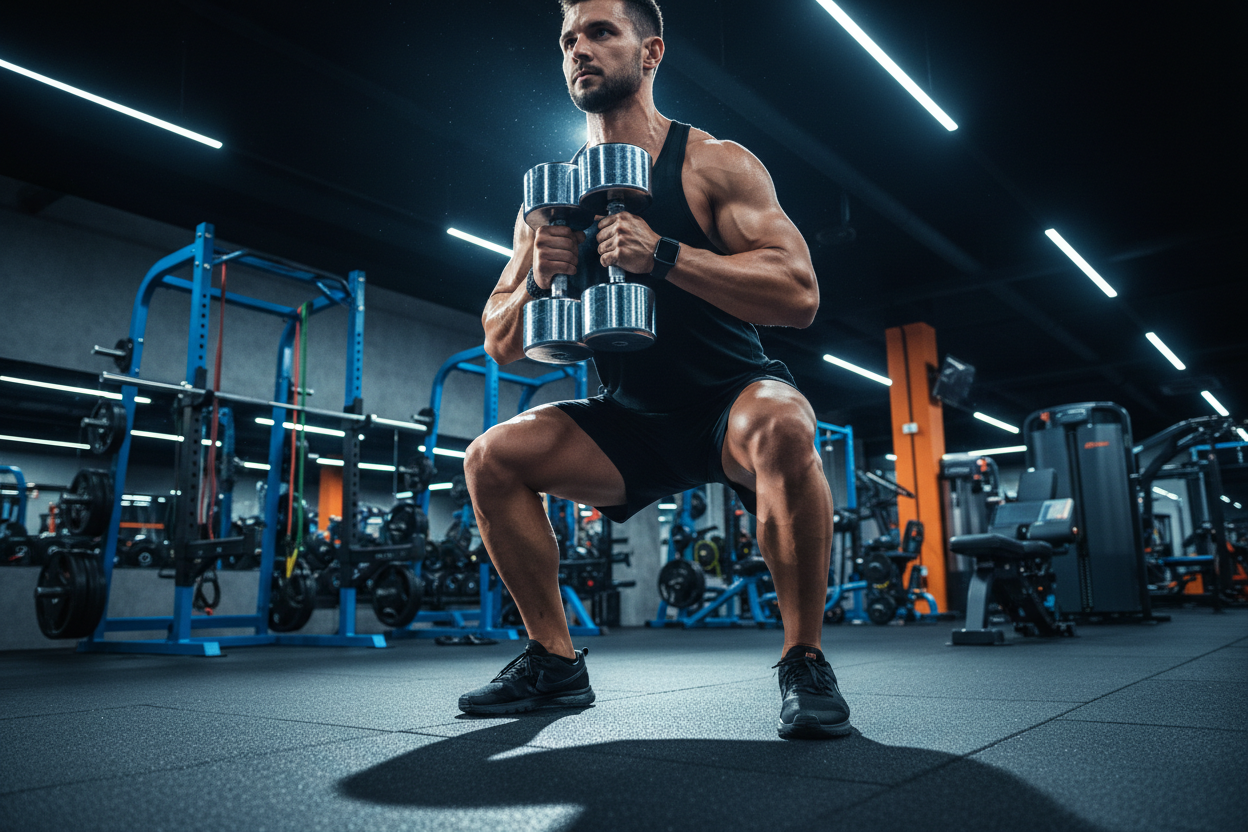
Holding a single heavy dumbbell against your chest changes the center of gravity, forcing your core to work overtime to keep you upright. This upright torso position allows for a deeper squat, which recruits more quad muscle fibers. For those wondering how to get bigger legs with dumbbells when the weights feel too light, try "1.5 reps." Go all the way down, come halfway up, go back down, and then stand up fully. That counts as one rep.
4. Walking Lunges
Lunges provide a dynamic stimulus. They require coordination and drive. Doing these at the end of a workout as a "finisher" ensures that every last muscle fiber is exhausted. High-rep walking lunges are particularly effective for conditioning and hypertrophy simultaneously.
Programming for Hypertrophy
Randomly lifting weights won't get the job done. You need a structured approach. Since the absolute load is lower, volume must go up. A standard 3 sets of 8 reps might not provide enough stimulus if the weights aren't near your one-rep max. Instead, aim for 3 to 5 sets per exercise in the 10 to 20 rep range.
Progressive overload is still required. If you cannot add weight because you have maxed out your dumbbells, you must progress in other ways:
- Increase Reps: If you did 12 reps last week, aim for 13 or 14 this week.
- Decrease Rest: Cut your rest times from 90 seconds to 60 seconds to increase metabolic demand.
- Slow Down: Take 3 to 4 seconds to lower the weight on every rep.
Overcoming Grip Strength Limitations
One specific hurdle people face when learning how to get big legs with dumbbells is that their hands give out before their legs do. Your quads are much stronger than your forearms. If you are doing heavy lunges or RDLs, your grip will likely fail first, which means your legs aren't getting a full workout.
Do not let your ego prevent you from using lifting straps. Straps are an essential tool for dumbbell leg training. They allow you to hold onto heavy dumbbells long enough to truly fatigue the lower body muscles. If you don't have straps, you are likely training your grip more than your legs.
Consistency and Nutrition
Training is only the stimulus; food is the building material. You can do all the split squats in the world, but without a caloric surplus and adequate protein, the muscle will not grow. Ensure you are eating enough to support recovery. Leg training, even with dumbbells, is systemic and taxing. Prioritize sleep and hydration to allow the tissue to repair and grow larger.
Building an impressive lower body without a barbell is not only possible, it is a fantastic way to improve athleticism, balance, and joint health. By mastering unilateral movements and embracing the burn of high-volume training, you will find that heavy iron is a luxury, not a necessity.
Frequently Asked Questions
Can I really get "huge" legs without heavy squats?
Yes, but it requires higher volume and intensity. While powerlifters need heavy squats for maximal strength, bodybuilders have long used moderate weights with high reps and strict form to build muscle size. The key is reaching muscular failure, which can be achieved with dumbbells through unilateral exercises like split squats.
How often should I train legs with dumbbells?
Since dumbbell training generally places less compressive stress on the spine and central nervous system than heavy barbell squatting, you can often train legs more frequently. A frequency of twice a week (e.g., a dedicated leg day and a full-body day, or an Upper/Lower split) is usually optimal for hypertrophy.
What should I do if my dumbbells aren't heavy enough for squats?
Switch immediately to single-leg variations. If you can easily squat your heaviest dumbbells for 20 reps, move to Bulgarian split squats or single-leg box squats. Unilateral training effectively doubles the load on the working muscle, making light weights feel twice as heavy.