My Go-To Beginners Workout for Women at Gym (No BS Allowed)
I remember my first time walking into a big-box commercial gym. I spent twenty minutes on a dusty treadmill I didn't even want to use, simply because I was too intimidated to walk into the free-weight section. It felt like a stage where I hadn't memorized my lines. This beginners workout for women at gym is the survival guide I wish I had—no wandering, no guessing, and no feeling like a guest in your own gym.
Quick Takeaways
- Claim a 4x4 foot space and stay there to reduce 'gymtimidation.'
- Focus on four compound movements to hit every muscle group.
- Dumbbells are more accessible and often safer for beginners than barbells.
- Consistency beats intensity every single time in the first six weeks.
The Weight Room Intimidation Factor (And How to Beat It)
Walking into the free weight area can feel like walking into a high-stakes meeting where everyone else knows the secret handshake. You see people slamming plates and wonder if you belong. Here is the reality: most of those people are staring at their own reflection or their phone. They aren't watching you.
Having a rigid, written plan is your best armor. When you walk in with a specific gym workout for women beginner routine, you move with purpose. You aren't that person wandering around looking at machines like they are alien technology. You are there for a job. Purpose kills anxiety every time.
Mapping Out Your Gym Workout for Women Beginner Plan
Most commercial gyms follow a predictable, albeit annoying, layout. Cardio is usually at the front, machines are clustered in the middle, and the heavy iron is in the back. Do yourself a favor: bypass the endless rows of ellipticals. Walk straight to the dumbbell rack.
Your goal is to grab one or two pairs of dumbbells and find a small corner or an open flat bench. This is your home base. You do not need to traverse the entire gym floor between sets. By staying in one spot, you eliminate the stress of 'losing' your equipment or having to navigate through crowds. This is the most efficient way to execute gym exercises for women beginners without the headache.
The 'No Panic' Beginners Workout for Women at Gym
We are sticking to four movements. These are the 'Big Rocks' of strength training. We are hitting your legs, chest, back, and glutes. If you do these four things with focus, you are doing more for your body than 90% of the people on the stair climber.
Movement 1: The Goblet Squat
Grab one dumbbell and hold it against your chest like a precious goblet. Keep your elbows tucked in. Sit your hips back and down like you are sitting into an invisible chair. This is vastly superior to a barbell back squat for day one because the weight in front of you acts as a counterbalance. It keeps your spine upright and teaches you how to use your glutes. Once you master the mechanics here, you can eventually transition to a more high-volume lower body workout for women at the gym.
Movement 2: Dumbbell Floor Press
If the benches are all occupied by guys chasing a pump on a Monday, don't wait. Just lie on the floor. The floor press is a hidden gem for shoulder health because the floor acts as a physical stop, preventing you from over-extending your shoulders. Press the dumbbells from your chest toward the ceiling. It builds chest and tricep strength with zero setup time and maximum stability.
Movement 3: Dumbbell Romanian Deadlifts (RDLs)
Hold your dumbbells in front of your thighs. Hinge at the hips—think about pushing your car door shut with your butt because your hands are full of groceries. Go down until you feel a deep stretch in your hamstrings, then snap back up. Do not just bend over at the waist; that is how you wake up with a sore lower back. Keep the weights close to your shins the entire time.
Movement 4: Supported Dumbbell Rows
Find a bench or even the end of a weight rack to lean on. Support your weight with one hand and pull the dumbbell toward your hip with the other. This isn't just an arm exercise; you are targeting the lats and the muscles between your shoulder blades. Building a strong upper back is the secret to better posture and making those heavy grocery bags feel like feathers.
The Core Gym Exercises for Women Beginners to Master Next
Once this four-move routine feels like second nature—usually after about 4 to 6 weeks—it is time to branch out. You've built the foundational 'hinge' and 'squat' patterns. Now you can confidently approach the cable machines for lat pulldowns or the seated row. The goal is progression. If you used 15lb dumbbells last week, try the 17.5lb or 20lb ones today. Strength is a skill, and like any skill, it requires practice and slightly heavier 'problems' to solve over time.
Why I Eventually Built a Garage Gym Instead
I’ll be honest: after years of commercial gym memberships, the 'gymtimidation' didn't drive me away, but the crowds did. Waiting 15 minutes for a squat rack or dealing with a 30-minute commute eventually felt like a chore. I wanted to train on my own terms, in my own space.
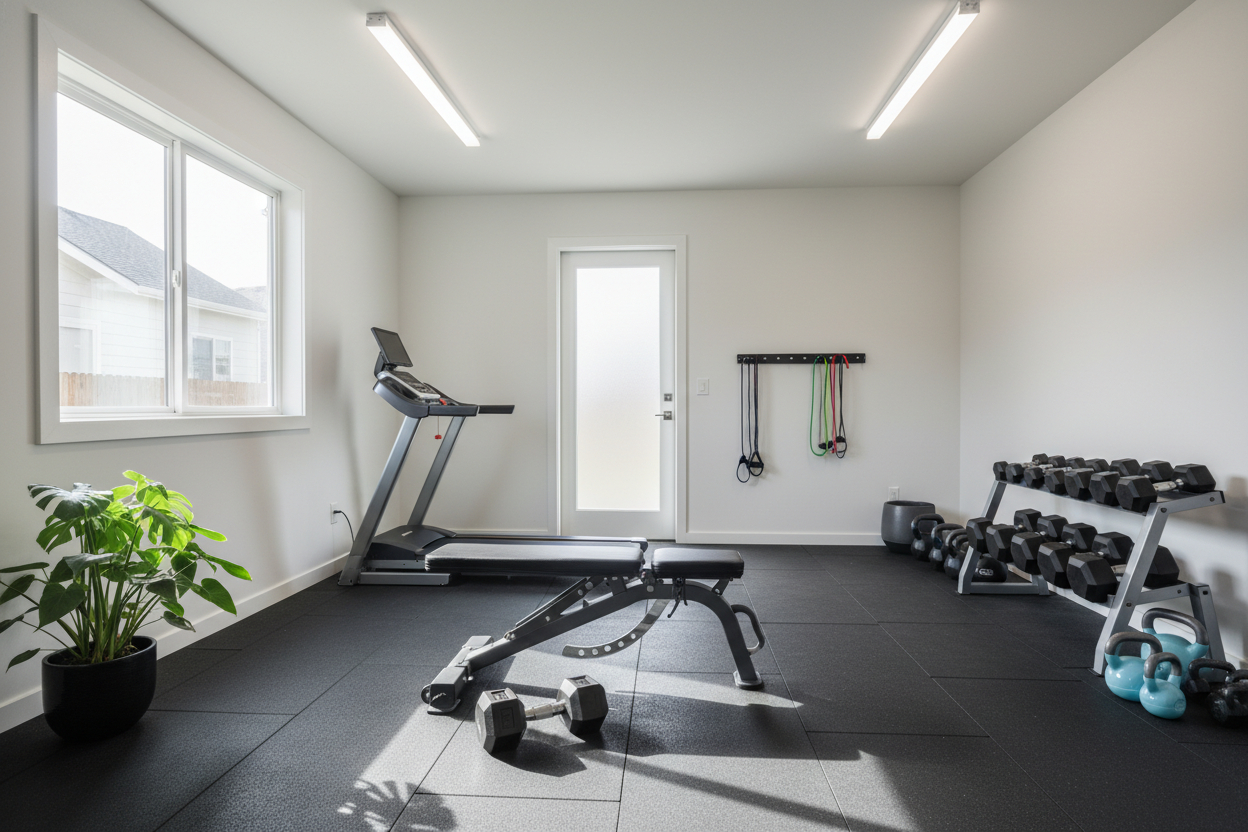
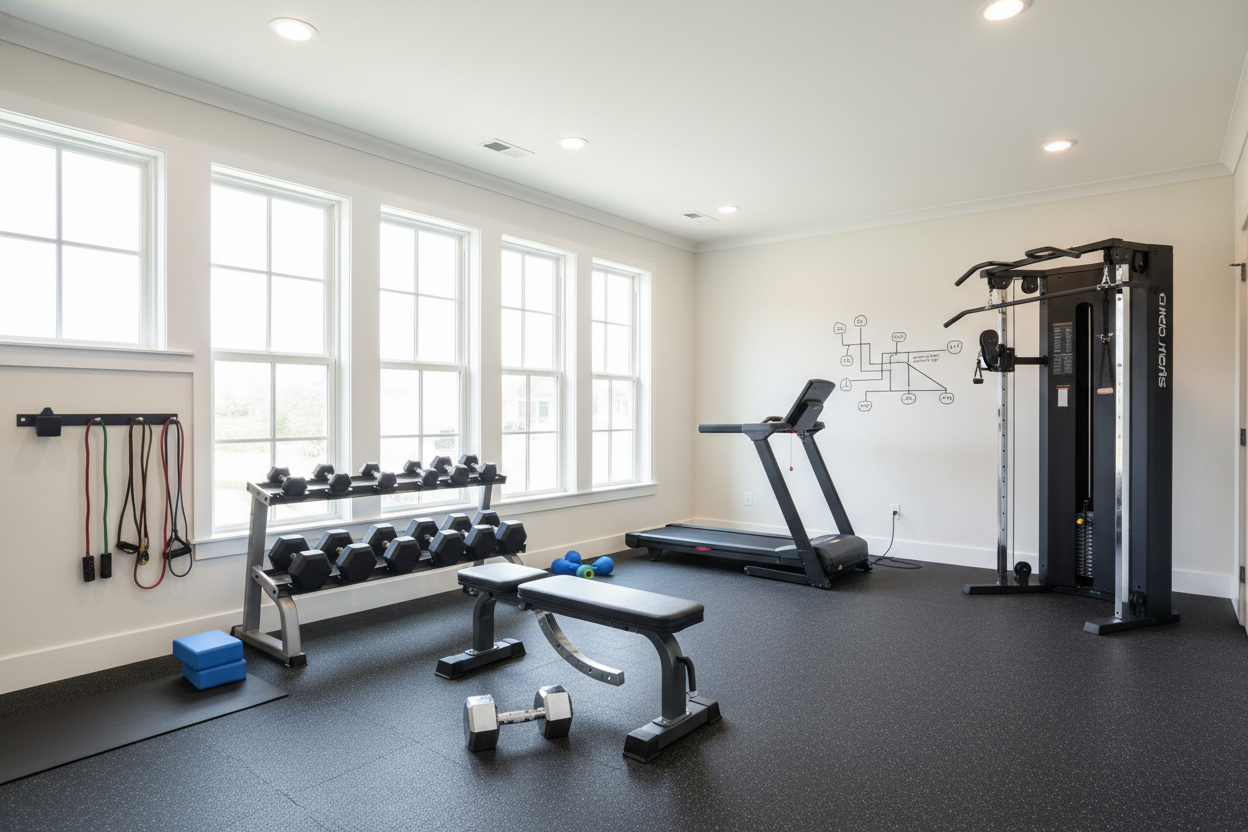
I eventually pivoted to a strength workout for women at home. If you decide the commercial gym scene isn't for you long-term, my advice is to start small but high-quality. Don't buy those cheap, plastic-coated weights that crack. My first real investment was a heavy-duty exercise mat gym flooring for home workout. It defined my space and protected my floors from my (many) dropped dumbbells. Whether you stay at the gym or move to the garage, the most important thing is that you stop wandering and start lifting.
FAQ
How heavy should I start?
Pick a weight where the 10th rep is hard, but your form still looks exactly like the 1st rep. If you are shaking or arching your back, put it down and go 5 lbs lighter.
How many sets and reps?
Aim for 3 sets of 10 to 12 reps for each movement. This is the 'sweet spot' for building muscle and learning the movement patterns without burning out.
What if someone is using the dumbbells I need?
Don't just stand there. Ask, 'How many sets do you have left?' or 'Can I work in?' Most people will say yes. If they have five sets left, find a slightly lighter or heavier pair and adjust your reps accordingly.