Muscles for Shoulder Movement: The Definitive Anatomy Guide
The human shoulder is an engineering marvel, capable of a range of motion that no other joint in the body can match. However, that freedom comes at a cost: stability. If you don't understand the specific muscles for shoulder movement, you are lifting blind. Whether you are a bodybuilder trying to cap off your delts, a pitcher refining your mechanics, or someone rehabbing a nagging injury, knowing the "what" and "how" of shoulder anatomy is non-negotiable.
Many people treat the shoulder like a single hinge. It isn't. It is a complex interplay between the humerus (arm bone), scapula (shoulder blade), and clavicle (collarbone). Let's break down the mechanics so you can train smarter, not harder.
Quick Summary: Primary Shoulder Movers
If you are looking for a rapid breakdown of shoulder movement and muscles involved, here is the cheat sheet for the primary actions:
- Flexion (Raising arm forward): Anterior Deltoid, Coracobrachialis, Pectoralis Major (clavicular head).
- Extension (Pulling arm back): Latissimus Dorsi, Teres Major, Posterior Deltoid.
- Abduction (Raising arm sideways): Supraspinatus (initiates the first 15 degrees), Middle Deltoid.
- Adduction (Lowering arm): Pectoralis Major, Latissimus Dorsi.
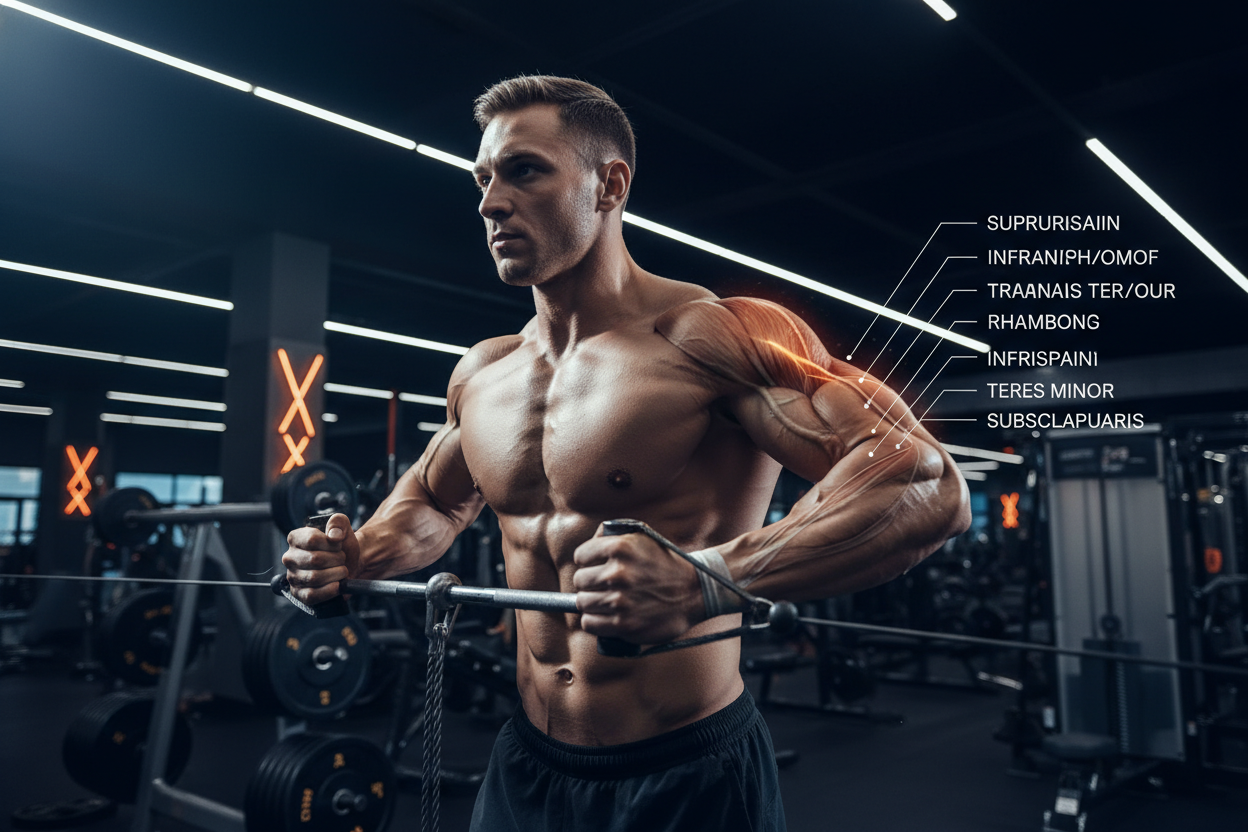
- External Rotation: Infraspinatus, Teres Minor.
- Internal Rotation: Subscapularis, Pectoralis Major, Latissimus Dorsi.
The Biomechanics of Shoulder Muscle Actions
To fully grasp shoulder muscle movement, you have to look beyond just the "deltoids." While the delts give you that broad look, the smaller stabilizers and large back muscles dictate how the joint actually functions.
Flexion and Extension
Shoulder flexion occurs when you raise your arm in front of your body, like reaching for a top shelf or performing a front raise. The primary driver here is the Anterior Deltoid. However, it doesn't work alone. The generic "chest muscle," specifically the upper fibers of the Pectoralis Major, assists heavily here. This is why your front delts often feel fried after a heavy bench press session.
Conversely, extension is the act of bringing the arm backward. Think of the motion used in a rowing exercise or when sprinting. The powerhouse here is the Latissimus Dorsi (your lats). The Posterior Deltoid and Teres Major act as the rear-guard, pulling the humerus behind the torso. Neglecting these shoulder motions and muscles leads to the dreaded "slumped forward" posture common in office workers.
Abduction and The "Starter Motor"
Abduction—lifting your arm out to the side—is a fascinating study in biomechanics. Most people assume the Middle Deltoid does all the work. It does the heavy lifting, but it can't start the movement effectively on its own.
The Supraspinatus (one of the Rotator Cuff muscles) is the spark plug. It initiates the first 0 to 15 degrees of movement. If you have ever felt a sharp pain immediately upon trying to lift your arm, that is often a supraspinatus issue. Once the arm clears that initial range, the large Middle Deltoid takes over to lift the arm overhead.
The Rotational Engines
When discussing shoulder muscle movements, rotation is often where injuries happen. The shoulder is a ball-and-socket joint, meaning it needs to rotate to function safely.
External Rotation
This is the motion of keeping your elbow at your side and swinging your hand outward. The Infraspinatus and Teres Minor handle this. Weakness here is rampant in the general population. If you can bench press 200lbs but can't externally rotate against a light resistance band, your shoulder health is a ticking time bomb.
Internal Rotation
This is the opposite motion—swinging the hand inward toward the stomach. The Subscapularis is the main rotator cuff muscle for this, but it gets massive help from the larger "mirror muscles" like the Pecs and Lats. Because we train chest and back so often, most people have strong internal rotation but weak external rotation, leading to imbalance.
Scapulohumeral Rhythm: The Hidden Factor
You cannot talk about shoulder muscles and movements without mentioning the shoulder blade. The scapula must move to accommodate the arm. For every 2 degrees your arm moves up, your scapula should rotate upward roughly 1 degree.
Muscles like the Serratus Anterior and the Trapezius (upper, middle, and lower) control the scapula. If these muscles are asleep at the wheel, the humerus jams into the acromion process, causing impingement. This is why "setting your shoulders" is a cue that matters in everything from deadlifts to overhead presses.
My Training Log: Real Talk
I want to share a specific realization I had regarding movement of shoulder muscles that changed how I lift. For years, I ignored the Supraspinatus and the concept of the "subacromial space." I was obsessed with heavy upright rows because I wanted big traps and side delts.
I remember the exact session where it went wrong. I was using a close grip on a cambered bar, pulling high toward my chin. There wasn't a "pop," but rather a grinding sensation—like two pieces of dry leather rubbing together deep inside the joint. It wasn't muscle soreness; it was mechanical friction.
I couldn't lift my arm past shoulder height for three weeks without a sharp pinch. That "grinding" was the supraspinatus tendon being crushed because I was forcing internal rotation while abducting (raising) the arm. I learned the hard way that you can't bully biomechanics. Now, when I do lateral raises, I tilt my thumbs slightly up rather than down (pouring the pitcher), and the difference in joint space feeling is night and day. It feels smooth, like a well-oiled hinge, rather than that gritty, bone-on-bone sensation.
Conclusion
Understanding the muscles for shoulder movement transforms you from someone who exercises into someone who trains. It allows you to visualize the fibers contracting, ensures you are balancing your push and pull ratios, and keeps your rotator cuff happy. Don't just move weight; understand the machinery moving it.
Frequently Asked Questions
Which muscle initiates the first 15 degrees of shoulder abduction?
The Supraspinatus, one of the four rotator cuff muscles, is responsible for the initial 15 degrees of abduction. After this point, the deltoid becomes the primary mover.
What are the main muscles for shoulder movement during a push-up?
During a push-up, the primary movers are the Pectoralis Major (horizontal adduction) and Anterior Deltoid (flexion), with the triceps extending the elbow. The Serratus Anterior is also critical for stabilizing the scapula at the top of the movement.
Why is knowing shoulder muscle actions important for injury prevention?
Understanding shoulder muscle actions helps you identify imbalances. For example, if you overtrain internal rotators (pecs/lats) and neglect external rotators (infraspinatus), you risk shoulder impingement and poor posture.