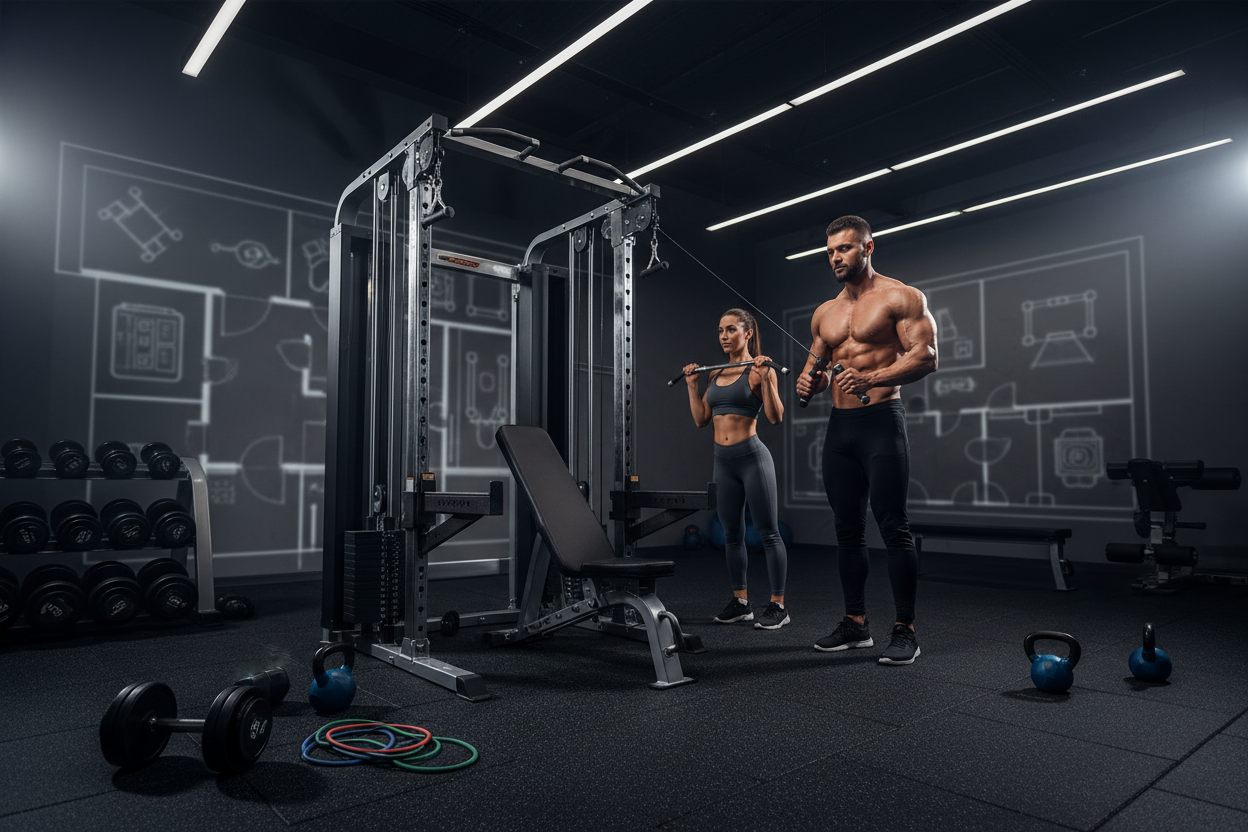
Multifuncional Gym Explained: Build Your Perfect Setup
Building a workout space often involves a frustrating game of equipment Tetris. You want a power rack, a cable crossover, and a lat pulldown, but you only have half a garage or a spare bedroom. This is exactly where a high-quality multifuncional gym steps in to save both your floor plan and your budget.
Often referred to as an all-in-one trainer or a gym multifuncional, these versatile units combine multiple lifting stations into a single footprint. But with prices ranging widely, how do you know which one actually delivers? In this guide, we will break down exactly what to look for when investing in a home gym multifuncional, helping you avoid costly mistakes and build the ultimate training setup.
Key Takeaways
- Space Efficiency: Replaces 4-5 standalone machines, saving roughly 50-70% in floor space.
- Versatility: Allows for over 100 different exercises, covering every major muscle group.
- Cost-to-Value: Higher upfront cost, but significantly cheaper than buying individual commercial-grade stations.
- Resistance Types: Available in plate-loaded (budget-friendly) or selectorized weight stacks (premium convenience).
Sizing Up Your Space: Will It Fit?
The biggest mistake buyers make is measuring their floor space but forgetting about their working space. A machine might have a compact footprint, but you need room to actually move and lift around it.
Ceiling Height and Working Clearance
Most standard units require at least an 84-inch ceiling, but if you plan on doing pull-ups or muscle-ups, you need a minimum of 96 inches (8 feet) to avoid bumping your head. Additionally, leave at least 3 feet of clearance on the sides for loading Olympic plates and 4 feet in front for bench work and cable walk-outs.
Key Specs: What Separates Good from Great
Not all all-in-one trainers are created equal. When comparing models, look beyond the shiny exterior and focus on the mechanics.
Weight Stacks vs. Plate-Loaded
Entry-level models often use a plate-loaded system where you add your own bumper or iron plates for resistance. While cost-effective, it slows down supersets. Premium models feature dual selectorized weight stacks (usually 150-200 lbs per side) allowing for instant weight changes with a magnetic pin.
Pulley Ratios Explained
Pay attention to the cable ratio. A 2:1 ratio means a 100 lb stack provides 50 lbs of actual resistance. This is ideal for functional training and fast, explosive movements. A 1:1 ratio provides true weight, which is better for heavy lat pulldowns and low rows. Choose based on your primary training style.
From Our Gym: Honest Take
Having tested dozens of all-in-one units over the last five years, I recently spent three months running a popular dual-stack model through the wringer in my own garage. The knurling on the integrated Smith machine bar is noticeably more aggressive than older models—my chalked grip held solid through heavy 400 lb shrugs without slipping. The aluminum pulley wheels also provided a buttery-smooth glide that rivals what you feel on a $5,000 commercial cable crossover.
However, I have to be completely honest about the setup: the assembly process is an absolute beast. It took me and a buddy nearly eight hours, three cups of coffee, and a lot of patience to put together. If you aren't mechanically inclined, I highly recommend paying the extra fee for professional white-glove assembly.
Frequently Asked Questions
Is a multifuncional gym worth the investment?
Yes, if you have limited space and want to perform a wide variety of exercises. While the initial investment is high, it is far more economical than purchasing a half rack, functional trainer, lat pulldown, and Smith machine separately.
How much space do I actually need for a home gym multifuncional?
At a minimum, plan for a 10x10 foot area. This accounts for the machine's physical footprint, the bench extending outward, and the necessary clearance on the sides to load and unload weight plates.
Can you build serious muscle with just one machine?
Absolutely. Because these systems combine free weights (via a half rack or Smith machine) with constant cable tension, you can perform heavy compound lifts like squats and bench presses, alongside isolating hypertrophy work like cable flyes and tricep pushdowns.