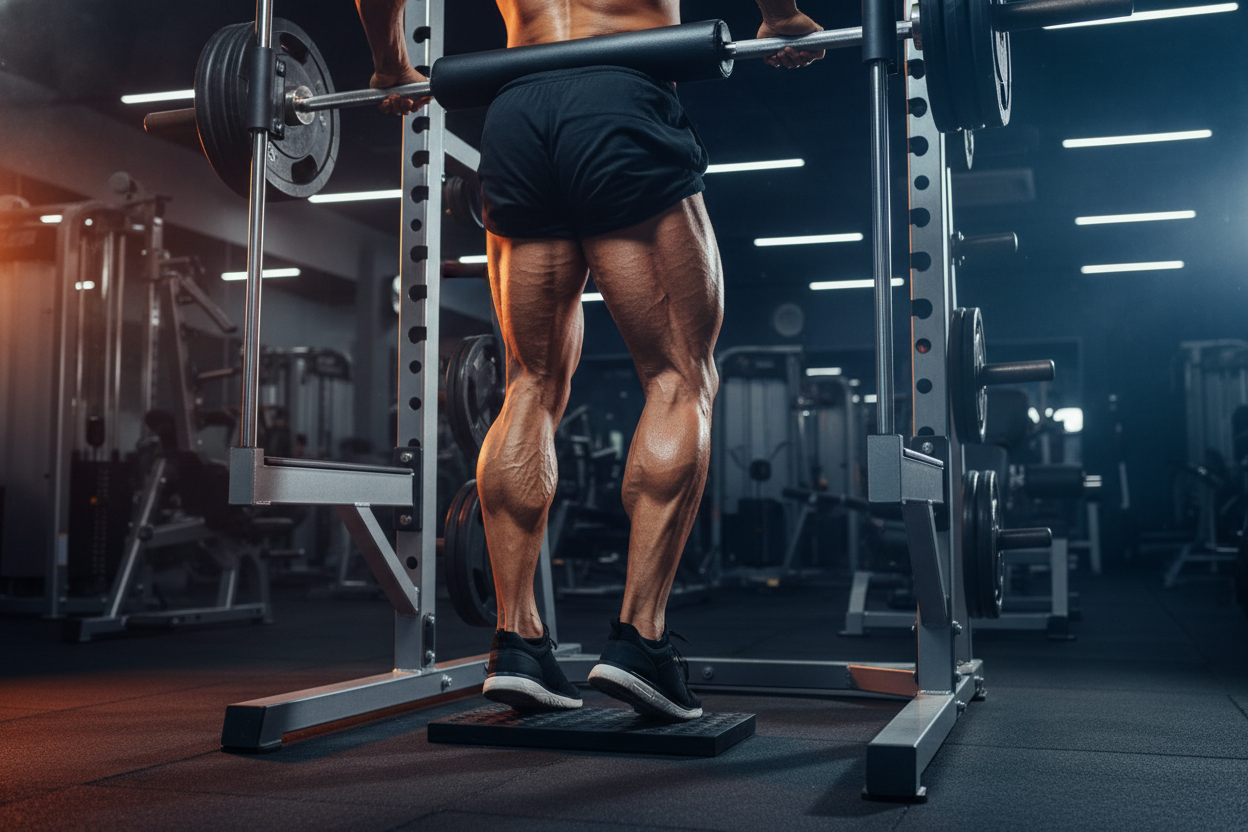
Master the Calf Raise on Smith Machine for Massive Growth
If you have been hammering away at your lower legs with free weights and seeing zero results, you are not alone. Calves are notoriously stubborn, often requiring a level of intensity and stability that dumbbells simply cannot provide. This is where the calf raise on smith machine changes the game.
Unlike free-standing variations where half your energy is wasted trying not to fall over, the Smith machine locks you into a fixed vertical path. This allows you to isolate the gastrocnemius muscle completely and load it with weight that would be dangerous to attempt with a barbell on your back. Let’s break down how to turn this machine into your primary mass builder.
Key Takeaways: Quick Summary
- Stability is King: The fixed rail system removes the need to balance, allowing for heavier loads and stricter isolation.
- Full Range of Motion (ROM): You must use a block or step to allow the heels to drop below the level of the toes for a deep stretch.
- Tempo Matters: A 2-second pause at the bottom eliminates the Achilles tendon's stretch reflex, forcing the muscle to do the work.
- Versatility: The machine supports standing, seated, and donkey variations to target both the gastrocnemius and soleus.
Why the Smith Machine Beats Free Weights for Calves
The primary function of the calf muscles is to lift the heel, but they also play a massive role in stabilization. When you do a standing calf raise with a free barbell, your calves are firing just to keep you upright. While that is functional, it isn't optimal for hypertrophy (growth).
Smith machine calves exercises remove the balance factor. When you don't have to worry about tipping forward or backward, your nervous system allows you to recruit more motor units in the target muscle. You can grind out those last few painful reps safely, knowing the safety hooks are just a wrist rotation away.
How to Do Calf Raises on Smith Machine
Executing the perfect smith machine standing calf raise requires a bit of setup. Don't just stand on the floor; the floor limits your range of motion, and range of motion is the primary driver of calf growth.
1. The Setup
Place a stable aerobic step, a dedicated calf block, or a 45lb plate under the bar. Set the bar height so that when you stand on the block, the bar rests comfortably on your upper traps (not your neck). If the knurling is aggressive, use a bar pad or a towel.
2. Foot Placement
Step onto the block so that only the balls of your feet are on the edge. Your heels should be hanging off into empty space. Keep your feet hip-width apart. Pointing toes straight ahead is the standard for overall mass, though you can experiment with slight angles later.
3. The Execution
Unrack the bar. Keep your knees slightly unlocked—never hyperextended—to protect the joint. Lower your heels slowly toward the floor until you feel a painful stretch in your calves. Hold this position for one second. Then, drive up explosively onto your big toes, squeezing hard at the top.
Variations for Complete Development
While the standing version is the bread and butter, a complete calf workout smith machine routine should hit the muscle from different angles.
Smith Machine Seated Calf Raise
The standing raise targets the gastrocnemius (the diamond shape). To build width, you need to target the soleus, which sits underneath. This requires bent knees. Place a flat bench in front of the Smith machine. Sit on the edge, place your toes on a block, and lower the bar onto your quads (use a thick pad here, or it will bruise). Perform the raise just like the standing version. This mimics a dedicated seated calf machine perfectly.
Smith Machine Donkey Calf Raise
This is an old-school favorite. Hinge at the hips so your torso is parallel to the floor. You can place the bar on your lower back (glutes/hips area). This smith machine donkey calf raise removes spinal compression while placing an intense stretch on the calves. It’s awkward to set up solo, so it works best if you have a training partner to help unrack.
Common Mistakes to Avoid
Even with a guided machine, things can go wrong. Here is why most people fail to see growth with calf exercises on smith machine:
- The Bounce: If you bounce out of the bottom position, you are using your Achilles tendon like a rubber band. You are doing zero muscle work. Pause at the bottom.
- Partial Reps: If you aren't dropping your heels below the platform, you are wasting your time. The stretch is where the growth signal is generated.
- Ego Lifting: Calf press smith movements allow for heavy weight, but if the weight shortens your range of motion, strip it off. Full range beats heavy weight every time.
My Training Log: Real Talk
I have a love-hate relationship with calves on smith machine. The first time I truly committed to them, I realized how much I had been cheating with dumbbells.
Here is the specific thing nobody tells you: the bar path on a Smith machine is fixed, but your body isn't perfectly linear. When I go heavy (3+ plates), the bar tends to dig aggressively into my traps, and because the machine doesn't sway, there is zero relief. I actually had to start wearing a hoodie or using a thick pad specifically for this exercise, or I'd end up with bruising on my neck.
Also, the "catch" mechanism can be annoying. On my gym's machine, if I get too tired and my wrists roll forward, the hooks hit the safety stoppers mid-rep with a loud CLANG that kills my rhythm. I learned the hard way to keep my wrists aggressively extended back to keep the hooks clear. But the pump? It feels like the skin is going to split. That is a sensation I never got from free-standing raises.
Conclusion
Building impressive lower legs doesn't require complex machinery. The smith machine calf raise offers the perfect blend of safety, stability, and loadability. By removing the need to balance, you can focus 100% of your mental energy on the contraction and the stretch. Remember: full range of motion, pause at the bottom, and embrace the burn.
Frequently Asked Questions
Is the Smith machine better than dumbbells for calves?
For pure hypertrophy (muscle growth), generally yes. The smith machine calves setup allows for greater stability, meaning you can use heavier loads and focus entirely on the muscle contraction without worrying about balance.
Where should I place my feet for Smith machine calf raises?
Place the balls of your feet on the edge of a step or block. For general mass, keep your feet hip-width apart with toes pointing forward. Rotating toes in or out shifts emphasis slightly, but neutral is best for the majority of lifters.
How many reps should I do for calves on the Smith machine?
Calves are endurance muscles, but they also need load to grow. A mix is best. Try heavy sets of 8–12 reps for the smith machine standing calf raise to hit fast-twitch fibers, and higher rep sets (15–25) to exhaust the slow-twitch fibers.