Master Leg Exercise on Smith Machine for Safe Hypertrophy
Many strength purists scoff at the idea of performing a leg exercise on smith machine equipment. They claim it isn't "functional" because the bar moves on a fixed rail. But if your goal is pure muscle growth (hypertrophy) rather than learning how to balance a barbell, those critics are missing the point. The Smith machine removes the need for stabilization, allowing you to drive every ounce of energy directly into the muscle fibers.
Let’s strip away the dogma and look at how this machine can actually become the cornerstone of your lower body training.
Quick Summary: Why Use the Smith Machine?
- Stability Increases Output: Because you don't have to balance the weight, you can push closer to true mechanical failure safely.
- Foot Placement Versatility: You can place your feet further forward to target quads without falling backward—something impossible with a free weight barbell.
- Safety Without a Spotter: The locking mechanism allows you to train heavy alone with peace of mind.
- Constant Tension: The fixed path forces a strict tempo, keeping tension on the target muscle groups like quads and glutes.
Why the Smith Machine Belongs in Your Leg Day
The biggest misconception about a smith machine leg workout is that it's "cheating." It isn't cheating; it is isolating. When you squat with a free bar, a significant amount of neural energy goes into keeping you upright. The Smith machine handles that stability for you.
This means your smith machine lower body workout can focus entirely on the contraction. It is particularly effective for bodybuilders or anyone looking to bring up lagging body parts without the systemic fatigue of heavy free-weight squats.
Top Movements for a Smith Machine Leg Workout
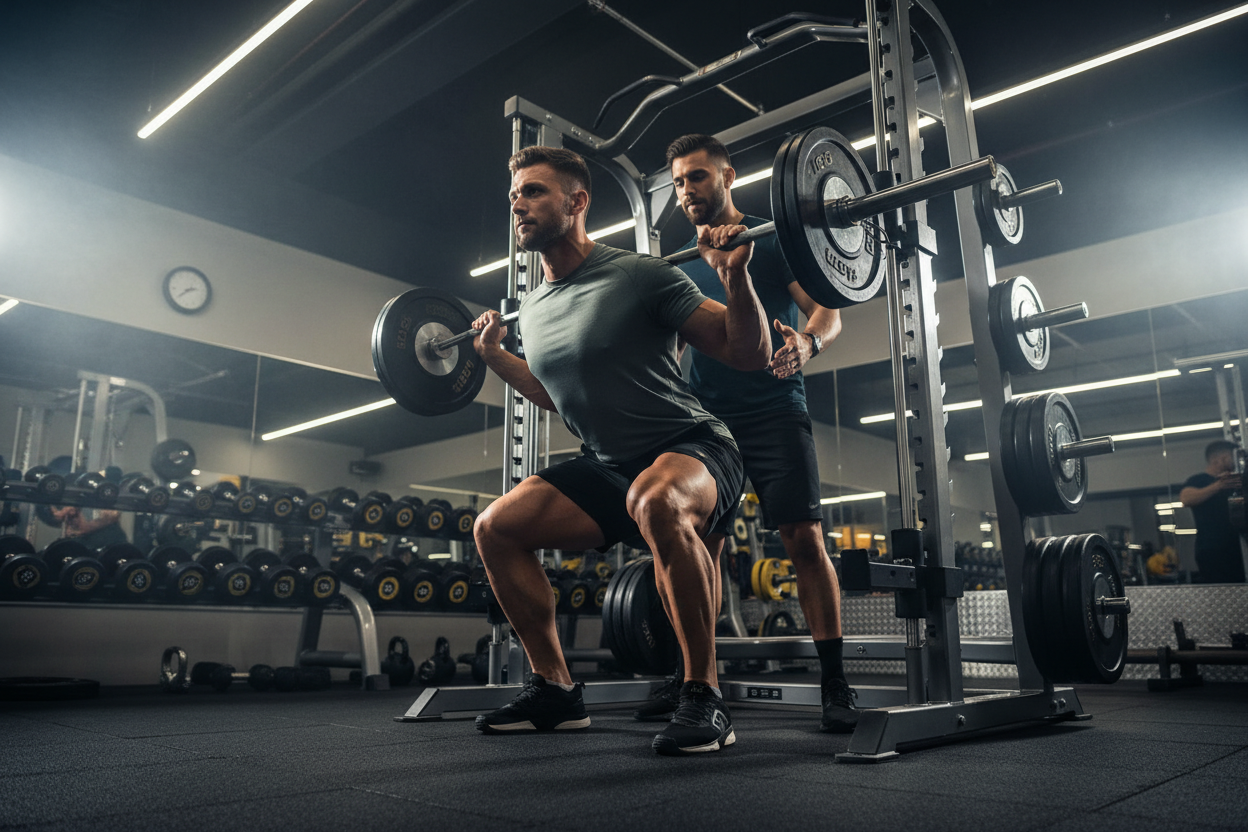
1. The "Feet-Forward" Squat
This is the unique advantage of smith machine leg exercises. By placing your feet about 6 to 12 inches further forward than a traditional squat, you can keep your torso perfectly upright. This mimics a hack squat and places almost 100% of the load on the quadriceps.
Ensure your knees track over your toes. Because the bar path is fixed, you must adjust your body to the bar, not the other way around. If you try to squat with a traditional powerlifting stance, the fixed rail will force you into an unnatural movement pattern that can hurt your lower back.
2. Stability-Focused Bulgarian Split Squats
Bulgarian split squats are notoriously difficult to balance. Performing this leg exercise on smith machine equipment solves the wobble. You can focus on the depth and the drive through the front heel rather than hopping around trying not to tip over.
This variation allows for significantly heavier loading on the glutes and quads compared to the dumbbell variation.
3. Smith Machine RDLs (Romanian Deadlifts)
For the posterior chain, smith machine exercises legs effectively by keeping the bar close to the shins. The fixed path prevents the bar from drifting forward, which protects the lower back. Focus on pushing your hips back until you feel a deep stretch in the hamstrings, then drive the hips forward to lock out.
Common Mistakes to Avoid
The most frequent error I see during a smith machine leg day is poor alignment. Since the bar cannot move horizontally, your joints must be positioned perfectly under the load. If your feet are too far back during a squat, your knees will experience excessive shear force.
Additionally, do not rely on the "springs" at the bottom of some machines. Bouncing the weight off the safety stops creates dangerous momentum. Control the eccentric (lowering) phase and pause briefly before exploding up.
My Personal Experience with leg exercise on smith machine
I used to be one of those "free weights or nothing" guys until a lower back tweak forced me to rethink my programming. I shifted to a smith machine workout legs routine for six weeks, and here is the gritty reality of it.
The first thing I noticed wasn't the pump—it was the friction. On older gym machines, you can actually feel the grit of the bearings sliding up the rail. It creates this weird, inconsistent drag that you don't get with a barbell. I learned quickly that I had to grease the rails myself or find the "smooth" machine in the corner.
Also, the wrist mechanic is something nobody warns you about. To un-rack the weight, you have to roll your wrists back. When you are under a heavy load (I was doing 3 plates a side), that wrist extension feels sketchy. I found that using a thumbless grip (suicide grip) actually felt safer here because it aligned my radius better for the "hook and roll" motion needed to re-rack the bar safely when my legs were shaking from fatigue.
Conclusion
Integrating legs on smith machine sessions isn't about replacing the barbell; it's about utilizing a tool for a specific purpose. If you want maximum stability to induce maximum hypertrophy, this machine is unmatched. Stop worrying about what looks "hardcore" and start focusing on the stimulus your muscles are receiving.
Frequently Asked Questions
Is the Smith machine bad for your knees?
No, but improper foot placement is. If your feet are directly under the bar (like a free weight squat), the fixed path creates shear force on the knee joint. Walking your feet forward relieves this pressure and targets the quads safely.
Can I build mass with just a Smith machine leg workout?
Absolutely. Muscle hypertrophy requires tension and progressive overload. The Smith machine allows for high loads and high volume with greater safety, making it highly effective for building muscle mass.
How do I target glutes on the Smith machine?
To target glutes, use a wider stance and place your feet further forward. Focus on deep hip flexion (sitting back) and drive through your heels. Reverse lunges and deep squats on the Smith machine are excellent for glute development.