Master Bedroom Exercise in Tight Spaces
I remember staring at the three-foot gap between my queen bed and the closet door in my first apartment. I had zero budget for a gym membership and barely enough floor space to stretch my arms. That narrow strip of carpet forced me to get creative.
It turns out, that tiny runway is all the square footage you need for an intense bedroom exercise routine. You do not need a massive garage or a dedicated spare room to get strong. You just need to understand leverage, tension, and how to use the environment you already have.
Quick Takeaways for Small Space Training
- Treat the 3-to-4 foot gap next to your bed as a dedicated high-tension corridor.
- Use your mattress edge to change pushup angles and hit different chest fibers.
- Focus on closed-chain leg movements like Bulgarian split squats that require zero horizontal travel.
- Protect your joints and flooring by covering plush carpet or slick hardwood with a dense, stable base.
Rethinking the Micro-Space Corridor
Most people look at the narrow gap between their bed and the wall and see dead space. As a trainer, I see a micro-space corridor. This three-to-four foot wide strip is actually the perfect dimension for high-tension, stationary training.
When you are confined to a small rectangle, you cannot rely on momentum or jumping around. You are forced to slow down, control your eccentric movements, and focus on muscle contraction. This restriction is actually a massive advantage for hypertrophy and strength.
By shifting your mindset from "I do not have enough room" to "this is my dedicated tension zone," you instantly unlock the potential of your bedroom. A standard 3x6 foot strip of floor is plenty of room to execute full body mechanics if you program your exercises intelligently.
Leveraging Furniture for Any Exercise You Can Do In Your Room
Your bed frame and mattress are heavy, stable structures that can easily support your body weight. This makes them ideal for manipulating leverage. Instead of just doing flat pushups on the floor, elevate your feet on the edge of the mattress for decline pushups, which target the upper chest and front deltoids.
Flip it around and place your hands on the solid edge of the bed frame for incline pushups. This is highly effective if you are building up your pressing strength. If you want to build a routine around fast chest workouts you can do anywhere, your bed is the ultimate tool.
You can also use the bed edge for triceps dips. Slide your hips straight down parallel to the mattress to keep the tension strictly on your arms. Aim for 3 sets of 12-15 reps with a slow two-second descent to maximize the burn without needing heavy dumbbells.
Structuring Workouts You Can Do In Your Room
Training legs in a tight space means eliminating exercises that require horizontal travel. Walking lunges and broad jumps are out. Instead, we focus on closed-chain movements where your feet stay planted.
The Bulgarian split squat is the king of the micro-space leg day. Rest your rear foot on the mattress, hop your front foot out about two feet, and drop your back knee straight down. You get a massive quad and glute stretch without needing more than a few square feet. Laying down a large exercise mat instantly defines your workout zone and anchors your grip during these closed-chain movements.
Pair those split squats with wall sits against your closet door and deep, slow-tempo bodyweight squats. For your core, planks and hollow body holds fit perfectly into the narrow corridor, forcing your abs to brace hard without requiring any swinging or sprawling.
Optimizing the Floor for Exercise In Your Room
One of the biggest mistakes I see clients make is trying to train directly on plush bedroom carpet or slippery hardwood. Carpet absorbs force, making your wrists wobble during pushups and your ankles cave during squats. Hardwood is a slip hazard the second you start sweating.
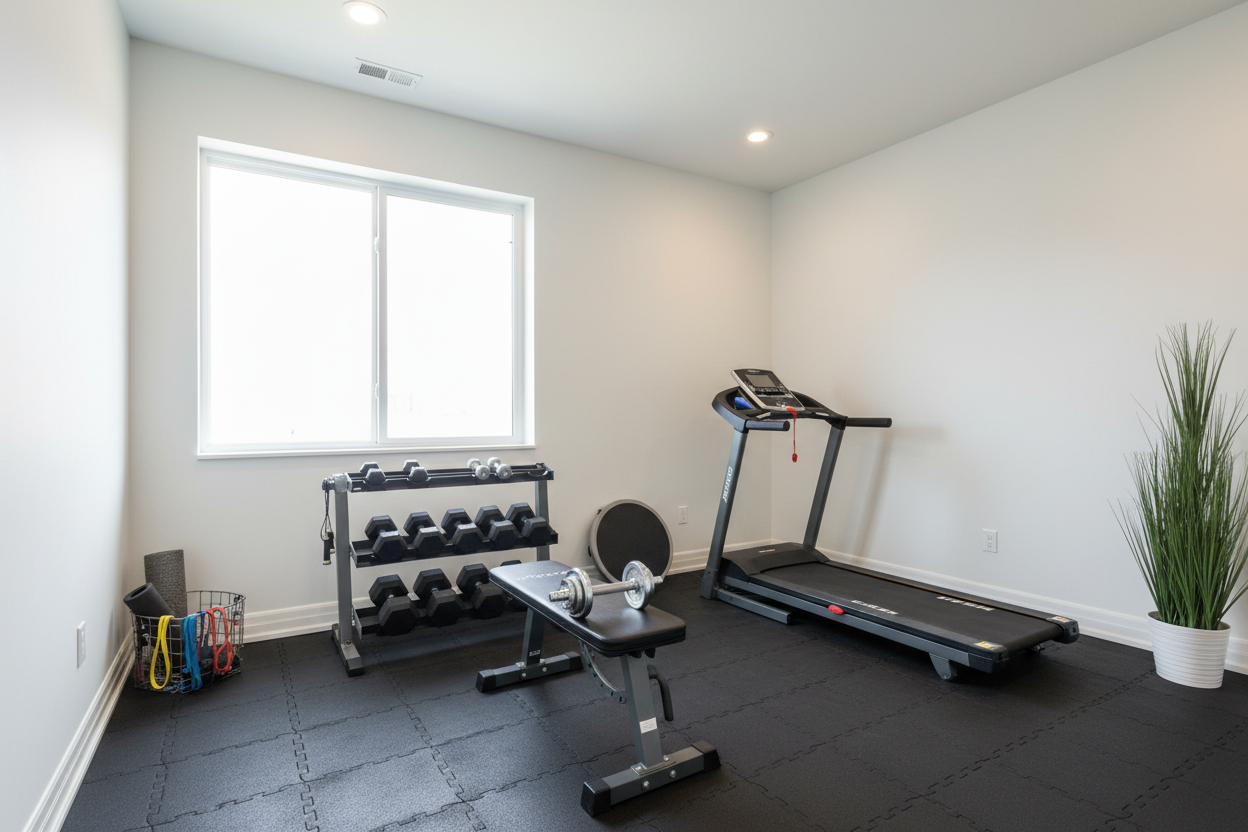
To create a gym-quality base, you need a dense surface that grips the floor and provides joint support. I usually recommend laying down a large exercise mat 6x4 because it perfectly fits that standard gap between a bed and a wall while protecting the floor.
A proper mat gives you enough traction to drive hard out of a split squat without sliding. It also dampens any noise if you live on a second floor, and it rolls up easily under the bed when you finish your session.
Building a Habit With Workouts I Can Do In My Room
The greatest advantage of bedroom training is the total elimination of friction. There is no commute, no waiting for a bench, and no packing a gym bag. When you wake up, your training zone is literally inches away.
This zero-commute setup builds unstoppable consistency. Even if you only have fifteen minutes before your morning shower, you can drop into your micro-space corridor and knock out a few high-intensity sets. Removing the barrier of leaving the house is often the single most effective way to guarantee you actually do the work.
My Experience Training in the Micro-Space
Over the last five years, I have programmed these exact corridor routines for dozens of busy clients. I even ran a strict six-week bedroom-only protocol myself using just bodyweight and a single 35-pound adjustable dumbbell. The strength gains were identical to my gym phases because I focused strictly on time-under-tension. The only honest downside? You will probably stub your toe on the bed frame a few times until you map out your exact foot placements. It is a small price to pay for the convenience.
Frequently Asked Questions
Can I build muscle with just bedroom workouts?
Yes. Muscle growth requires mechanical tension and progressive overload, not a specific location. By using slow tempos, high reps, and leverage from your furniture, you can easily stimulate hypertrophy.
Will jumping exercises annoy my downstairs neighbors?
Absolutely. That is why micro-space training avoids plyometrics. Stick to slow, grounded movements like split squats and pushups, which are completely silent and highly effective.
How do I train my back without a pull-up bar?
If you cannot fit a doorway pull-up bar, use a sturdy bedsheet tied in a knot. Close the knot securely in your bedroom door frame, lean back, and perform bodyweight rows. Always test the door's stability first.