Leg Extension/Leg Curl Bench: The Definitive Home Gym Guide
Squats and deadlifts are undeniably the kings of leg development. However, if you are strictly relying on compound movements in your home gym, you are missing a critical component of hypertrophy: isolation. Achieving that deep quad sweep and developing the hamstrings fully requires targeted tension. This is exactly where a dedicated leg extension/leg curl bench becomes the most valuable piece of real estate in your garage.
Many lifters try to hack their way around this with bands or awkward dumbbell setups, but the resistance curve is never quite right. A specialized bench solves the mechanical disadvantage of training legs at home, allowing you to safely take your quadriceps and hamstrings to absolute failure without taxing your lower back.
Key Takeaways
- Targeted Isolation: It is the only safe way to isolate the rectus femoris (quad) and hamstring short head effectively at home.
- Space Efficiency: A combo leg curl and extension bench combines two massive commercial machines into one compact footprint.
- Safety: It allows you to train to failure safely without the risk of getting crushed under a barbell.
- Adjustability: Look for a bench with an adjustable pivot point to align with your knee joint, preventing ligament strain.
Why You Need More Than Just Squats
Compound movements are fantastic for overall mass, but they engage the entire posterior chain and core. Sometimes, your lower back or glutes will fatigue before your quads do.
A leg curl extension bench allows you to bypass systemic fatigue. You can hammer the muscle directly. For the hamstrings specifically, the leg curl is one of the few movements that fully engages the short head of the biceps femoris, which does not cross the hip joint and is largely inactive during deadlifts.
The Mechanics of the Combo Bench
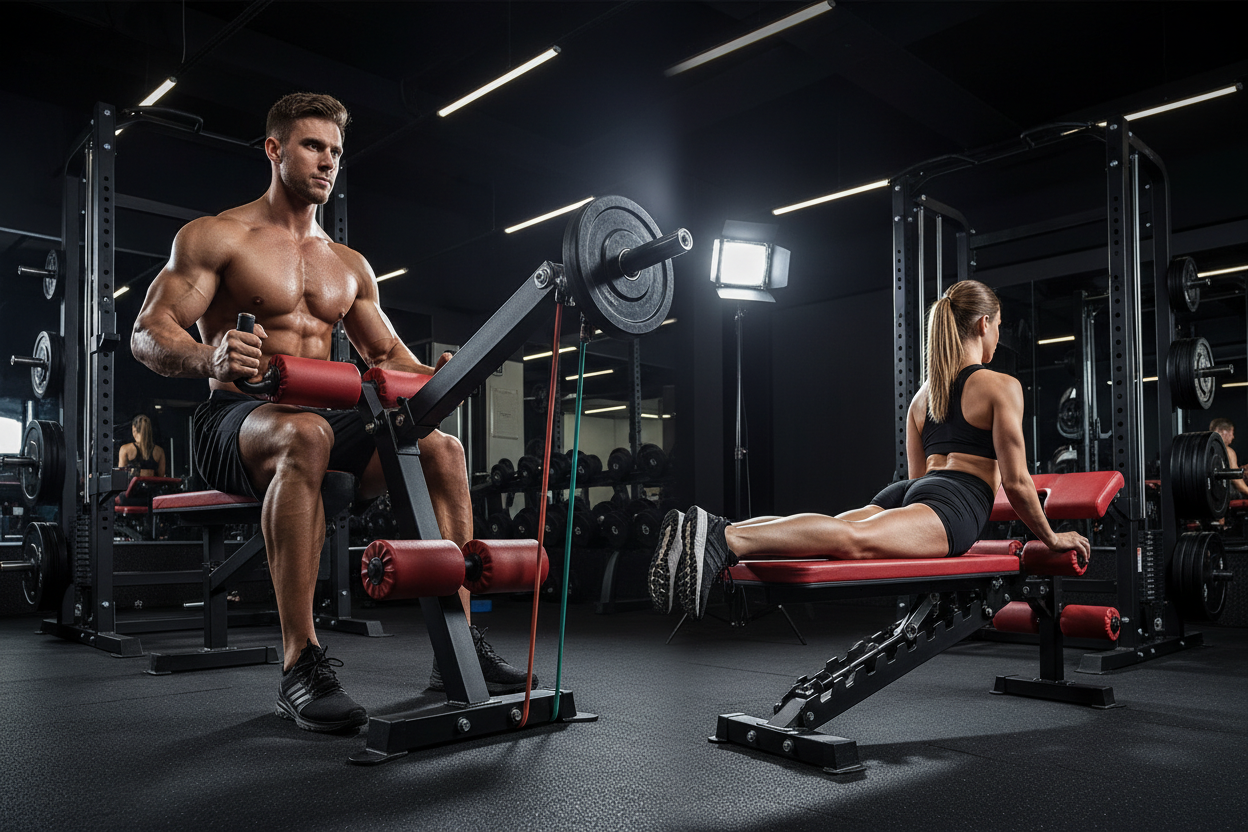
Unlike commercial gym units which are usually two separate massive machines, a home gym version is a hybrid. It uses a single weight horn (usually plate-loaded) and a movable arm.
The engineering challenge here is the pivot point. On a high-quality leg curl and extension bench, the pivot point aligns perfectly with your knee's axis of rotation. If this alignment is off, you will feel a grinding sensation in your knee cap rather than a burn in your muscle belly.
Selecting the Right Equipment
Not all benches are created equal. When browsing for a leg curl extension bench, ignore the fancy colors and look at the steel gauge and pad density.
Stability and Weight Capacity
When you are grinding out a heavy set of hamstring curls, the last thing you want is the bench tipping over. You need a wide base. If the unit wobbles when you test it empty, it will be dangerous when loaded with 45lb plates.
The Pad Gap and Comfort
Thick, vinyl-wrapped foam rollers are non-negotiable. Cheap rollers will dig into your shins during extensions and crush your Achilles tendon during curls. Additionally, check the gap between the seat and the backrest. A large gap can make lying leg curls uncomfortable, putting unnecessary pressure on your lower back.
My Training Log: Real Talk
I want to share a specific experience from when I first transitioned to a home gym. I tried to save money by buying a cheap "all-in-one" utility bench with a leg attachment rather than a standalone unit.
It was a mistake. I remember loading up about 80 pounds for leg extensions. As I reached the top of the rep, the entire bench shifted sideways because the attachment pin was loose. But the worst part was the shin roller. It wasn't adjustable enough for my height.
Instead of rolling smoothly up my shin, it stayed fixed, grinding into the middle of my shin bone. I ended up with a horizontal bruise line across both legs that looked like I'd been hit with a pipe. It hurt so bad I couldn't focus on the quad contraction. I sold it a week later and bought a dedicated unit with a proper cam system. The difference in the "smoothness" of the rep was night and day—no friction, just tension.
Conclusion
Building an impressive lower body requires a blend of heavy compounds and strict isolation. A leg extension/leg curl bench bridges the gap between a basic home setup and a professional physique lab. It allows you to pre-exhaust your legs before squats or finish them off safely after heavy lifting. Don't neglect the details; getting the right equipment now saves your joints later.
Frequently Asked Questions
Can I build mass with a plate-loaded leg extension bench?
Absolutely. Your muscles do not know the difference between a weight stack and iron plates. As long as you can apply progressive overload by adding more weight or reps, you will achieve hypertrophy.
Is a leg curl and extension bench bad for your knees?
Not if used correctly. The danger comes from using a machine where the pivot point doesn't align with your knee, or using excessive momentum (swinging the weight). Controlled, strict movement is actually used in rehabilitation settings to strengthen the tissues around the knee.
Should I buy a standalone unit or an attachment for my current bench?
If you have the space and budget, a standalone leg curl extension bench is superior. Attachments often suffer from poor biomechanics and lower weight capacities. A standalone unit offers better stability and adjustability for different body types.