Leg Curl Machine for Home: The Definitive Guide for Serious Lifters
Most home gym owners fall into a common trap: they build a setup perfect for pushing but terrible for pulling. You have your power rack for squats and bench press, but what about your posterior chain? If you are relying solely on Romanian Deadlifts to build your hamstrings, you are missing half the equation. To truly isolate the knee flexion aspect of the hamstring, adding a leg curl machine for home is not just a luxury—it is a biomechanical necessity.
Quick Summary: Before You Buy
- Biomechanics Matter: Deadlifts train the hip hinge; leg curls train knee flexion. You need both for complete development.
- Space vs. Stability: Plate-loaded machines save money but require more floor space for loading; selectorized (weight stack) machines are compact but heavier to move.
- The "Combo" Compromise: Many home units combine leg extensions and curls. Ensure the pivot point aligns correctly with your knee to avoid joint strain.
- Adjustability is Key: Look for adjustable shin pads and backrests to ensure the machine fits your femur length, not just the average user.
Why Your Home Gym Needs Knee Flexion
There is a misconception that heavy squats and deadlifts are enough for total leg development. While those compound movements are king for mass, they primarily recruit the hamstrings as hip extensors.
To fully shorten the hamstring muscle fibers, you must perform knee flexion against resistance. Without a dedicated station, you are leaving performance and aesthetics on the table. A proper leg curl machine home setup allows you to target the short head of the biceps femoris, which squatting simply cannot touch.
Lying vs. Seated: Which is Better?
When selecting a home leg curl machine, you are generally choosing between two variations. Both have distinct advantages depending on your space and training goals.
1. The Seated Leg Curl
Science suggests the seated variation may be superior for hypertrophy. Sitting flexes the hip, which puts the hamstrings in a stretched position before you even start the curl. This tension at long muscle lengths often results in better growth stimulus.
However, seated units tend to have a larger vertical footprint and can be more expensive due to the seat mechanics and thigh pads required to lock you in.
2. The Lying (Prone) Leg Curl
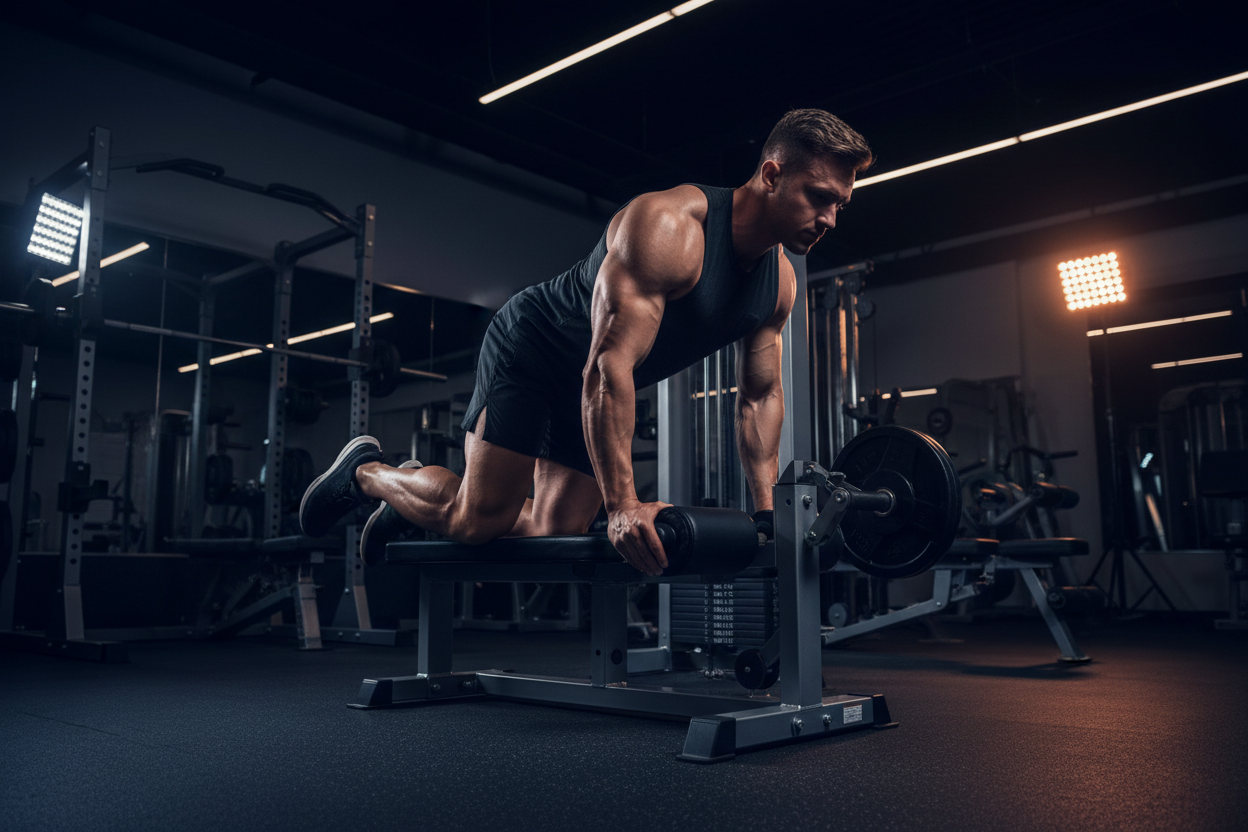
This is the classic bodybuilder favorite. It provides a distinct "peak contraction" feel at the top of the movement. For a garage gym, a lying leg curl machine at home often doubles as a flat bench or has a lower profile, making it easier to store.
The downside? It is easier to cheat by lifting your hips off the pad as the weight gets heavy, shifting tension to your lower back.
Plate-Loaded vs. Selectorized Stacks
This is usually the deciding factor for home gym owners regarding budget.
Plate-Loaded: These use standard Olympic plates for resistance. They are significantly cheaper and virtually unbreakable because there are fewer moving parts. However, the resistance curve can feel uneven—easy at the start and incredibly heavy at the top of the rep due to gravity and leverage.
Selectorized (Weight Stack): These provide constant tension and allow for rapid drop sets (just move the pin). The trade-off is the price and the nightmare of assembling a heavy weight stack alone.
My Training Log: Real Talk
I want to share a specific detail about owning these machines that product descriptions hide. I started with a budget-friendly, plate-loaded leg curl attachment for my bench. The biggest issue wasn't the weight capacity—it was the friction.
On cheaper home units, the pivot point often uses plastic bushings rather than ball bearings. When I loaded it up with anything over 40lbs, I could feel a gritty, grinding sensation halfway through the rep. It kills the mind-muscle connection. Furthermore, with plate-loaded ham curls, there is a "dead zone" at the very bottom of the rep where there is almost no tension.
I eventually upgraded to a standalone unit with a cam system. The difference in the resistance curve was night and day. If you are buying cheap, expect to use a lot of silicone lubricant and perhaps add a resistance band to smooth out the tension.
Conclusion
Building a complete physique requires attention to the muscles you can't see in the mirror. A leg curl machine for home is the best way to ensure your hamstrings keep up with your quads, preventing knee injuries and improving your major lifts. Whether you choose a compact plate-loaded unit or a full commercial stack, the key is consistency.
Frequently Asked Questions
How much space do I need for a home leg curl machine?
For a standalone unit, plan for a footprint of roughly 3 feet by 5 feet. However, if you choose a plate-loaded machine, you must add an extra foot of clearance on the loading side to slide plates on and off comfortably.
Can I just use resistance bands instead of a machine?
Bands are a decent temporary fix, but they lack the consistent resistance curve needed for significant hypertrophy. Bands get harder as they stretch, which is the opposite of the hamstring's strength curve (which is strongest in the mid-range). A machine provides the necessary stability for heavy loading.
Are leg extension/curl combo machines effective?
Yes, they are the most popular choice for home gyms due to space efficiency. The key is to ensure the machine allows you to adjust the backrest and shin pad so your knee aligns perfectly with the machine's pivot point during both movements.