
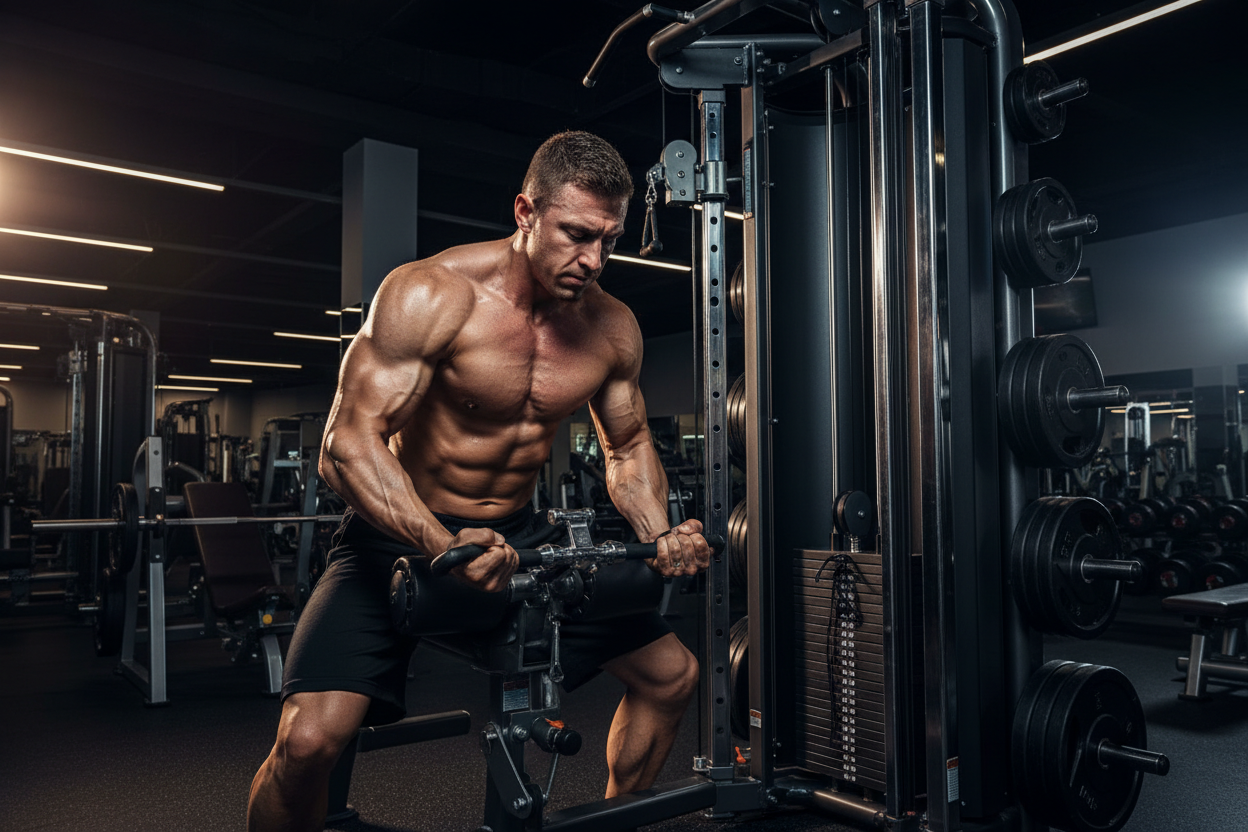
Is the Muscle Building Machine Actually Effective? The Honest Truth
For decades, a stigma has lingered in weight rooms across the world. If you aren't under a bending barbell, you aren't training hard. But modern exercise science paints a very different picture. The humble muscle building machine is not just a tool for beginners or rehabilitation; it is a potent instrument for hypertrophy that, when used correctly, can outperform free weights in specific contexts.
The debate isn't about whether machines work. It's about how to leverage their unique mechanics to create tension that free weights simply cannot replicate. Let's strip away the bro-science and look at the reality of machine-based training.
Key Takeaways: Machine Training Summary
- Stability equals output: Machines remove the need to stabilize the load, allowing 100% of your effort to go toward the target muscle.
- Failure is safer: You can push to absolute mechanical failure without the risk of being crushed, leading to higher intensity sets.
- Constant tension: Unlike dumbbells, many cable and cam-based machines keep tension on the muscle throughout the entire range of motion.
- Volume tolerance: Machines generally inflict less systemic fatigue on the central nervous system than heavy compound free weights, allowing for higher training volume.
The Science of Stability and Output
To induce growth, you need to expose muscle fibers to mechanical tension. When you squat with a barbell, a significant amount of your energy goes into balancing the bar and coordinating your nervous system to keep you upright. This is great for functional strength, but it can be a limiting factor for pure size.
A high-quality muscle building machine solves this via external stability. Because the machine creates a fixed path of motion, your body doesn't waste energy on balance. This allows you to drive every ounce of force directly into the tissue you are trying to grow. If your goal is to build muscle machine workouts allow you to isolate the variable of intensity without form breakdown.
Selecting the Right Tool: Plate-Loaded vs. Selectorized
Not all equipment is created equal. Understanding the difference between machine types is crucial for your programming.
Selectorized Machines (Pin-Loaded)
These are the machines with weight stacks and pins. They are excellent for "drop sets"—a technique where you lower the weight immediately after failure to continue the set. Because you can change the load in two seconds, you can keep the metabolic stress on the muscle high. They are ideal for isolation movements like leg extensions or lateral raises.
Plate-Loaded Machines
These move closer to the feel of free weights. Machines like the Hammer Strength chest press have independent arms, meaning your stronger side can't compensate for your weaker side. These are superior for heavy, compound movements where you want to move significant loads safely.
The "Safety Net" Advantage
Hypertrophy requires pushing close to muscular failure. With a bench press, fear is a limiting factor. If you fail, the bar lands on your neck. This subconscious fear often makes lifters stop two or three reps short of true failure.
With a chest press machine, that danger is removed. You can grind through a rep that takes five full seconds to complete. If you fail, the handles simply return to the starting position. This psychological safety net allows you to access the high-threshold motor units responsible for growth that are often left untouched during free weight training.
My Training Log: Real Talk
I want to talk about the specific reality of using a pendulum squat machine, which I've prioritized over free-weight squats for the last six months. On paper, it sounds easier. In reality, it’s brutal in a way a barbell isn't.
There is a very specific, distinct friction sound—a low-pitched whirring of the bearings—that happens when you hit the bottom of the movement. When I'm under a barbell, I'm worried about my lower back rounding or my knees caving. But locked into that machine, with the shoulder pads digging into my traps (which, by the way, always smell faintly of old vinyl and sweat regardless of how much I wipe them down), I experienced a different kind of pain.
I remember hitting failure on rep 12 last Tuesday. My quads were on fire, but my lungs were fine and my back was secure. I didn't have to rack it. I could just sit in the bottom position, let the safety stops catch with that metallic clank, and roll out. That ability to go until my legs literally stopped functioning—without fear of injury—is why my leg development has finally caught up after years of stalling on barbells.
Conclusion
You do not need to choose sides. The smartest bodybuilders use a hybrid approach. Use free weights to build coordination and systemic strength, but rely on the muscle building machine to safely take your muscles to the dark place required for growth. If you are training for aesthetics, the stability and safety of machines are not crutches; they are catalysts.
Frequently Asked Questions
Can you build muscle with just machines?
Yes, absolutely. Your muscles do not know if you are holding a dumbbell or a machine handle; they only detect tension. As long as you apply progressive overload (increasing weight or reps over time) and eat enough protein, you can build a significant physique using only machines.
Are machines safer than free weights?
Generally, yes. Machines restrict your range of motion to a fixed path, which reduces the risk of moving into a compromised position. They also remove the risk of dropping weights on yourself, making them ideal for training to failure without a spotter.
What is the best machine for building legs?
While the leg press is popular, the Hack Squat or Pendulum Squat are often superior for hypertrophy. They mimic the mechanics of a squat but stabilize the back, allowing for extreme knee flexion which places maximum tension on the quadriceps.


