
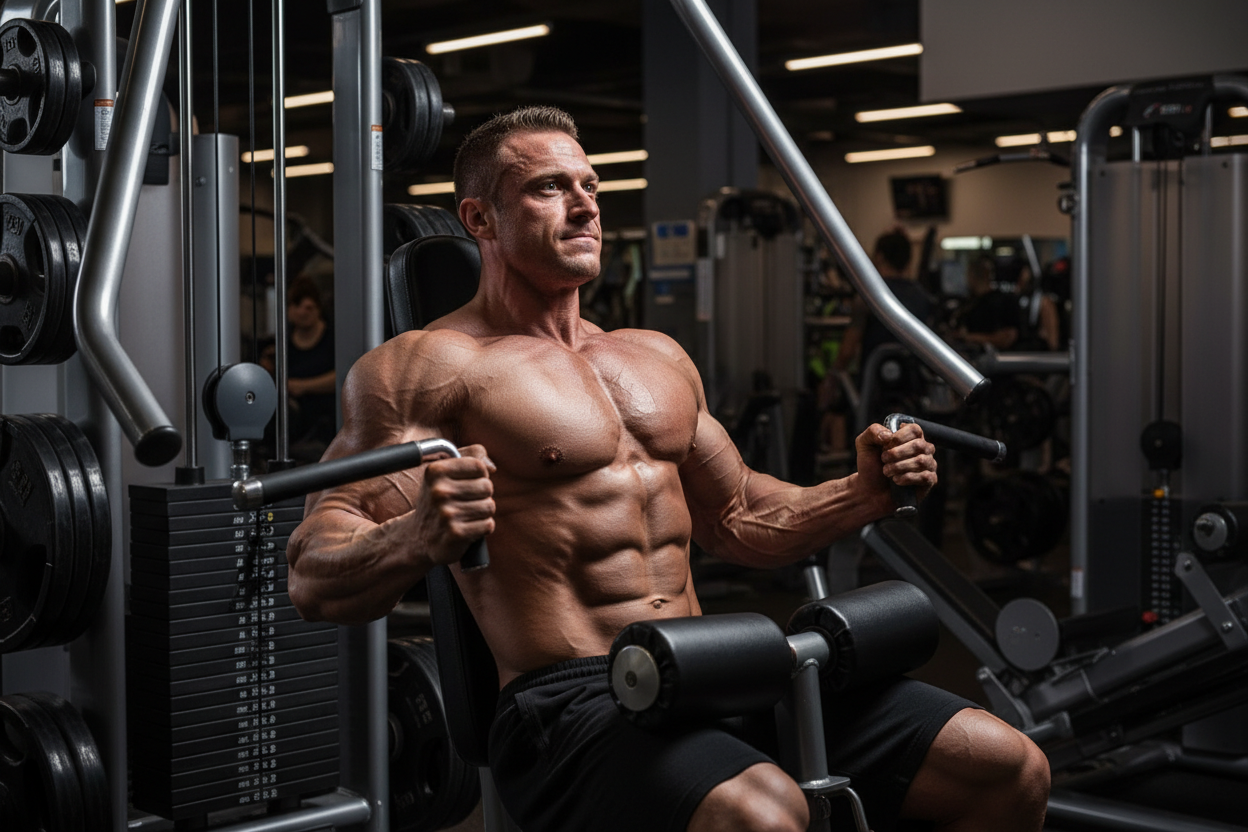
Is Machine Exercise Actually Effective? The Honest Truth
For decades, a stigma has haunted the gym floor. You’ve likely heard it: “Real lifters use free weights; machines are for beginners.” This outdated mentality keeps many trainees from maximizing their hypertrophy potential. While barbells and dumbbells have their place, relying solely on them ignores the unique mechanical advantages of machine exercise.
The truth is, your muscles do not know if you are holding a rough iron bar or pushing a padded handle. They only understand tension. When applied correctly, machines offer stability that free weights simply cannot match, allowing you to take muscles to absolute failure safely.
Key Takeaways
- Superior Stability: Machines remove the need for stabilizer muscles to balance the load, allowing 100% of your effort to go toward the target muscle group.
- Fixed Strength Curves: Many modern machines are engineered to match human biomechanics, keeping tension constant throughout the entire range of motion.
- Safety at Failure: You can push a machines workout to true muscular failure without the fear of getting crushed by a barbell.
- Reduced Systemic Fatigue: Because you aren't stabilizing a heavy load with your entire body, you generate less central nervous system fatigue, potentially allowing for higher volume.
The Science of Stability and Output
The primary argument for a workout with machine movements is stability. When you squat with a barbell, a significant amount of your neural drive is spent just keeping you upright. Your lower back, core, and stabilizers work overtime.
However, when you use a Hack Squat or Leg Press, that stability is provided externally by the frame of the machine. This means your nervous system can dedicate maximum motor unit recruitment to the quadriceps. If your goal is specifically muscle growth (hypertrophy) rather than learning a skill (like the snatch), this external stability is a massive advantage.
Designing a High-Yield Machines Workout
To get the most out of these tools, you cannot treat them as a vacation from hard work. A common error is using machines to “coast” through a session.
1. Alignment is Non-Negotiable
Every machine has an axis of rotation—usually a bolt or pivot point where the moving arm connects to the frame. If your joint (knee or elbow) is not perfectly aligned with this mechanical axis, the movement will feel unnatural and can cause sheer force on the joint. Take the time to adjust the seat height until the machine moves exactly how your body moves.
2. Control the Eccentric
The friction on a weight stack can sometimes help you “cheat” on the way down. Don't let the weight stack crash. Control the lowering phase for 2-3 seconds. This is where the most muscle damage and growth signaling occur.
Common Mistakes When Training With Machines
Even with a fixed path of motion, things can go wrong. The biggest issue is “fitting” the machine. Most equipment is built for a person of average height (roughly 5'9" to 5'10"). If you are significantly shorter or taller, you may need to use pads or modify your starting position to ensure you aren't starting the movement in a mechanically compromised position.
Another mistake is ignoring the “strength curve.” Some older machines are incredibly heavy at the start and light at the end. If a machine feels jerky or causes pain at a specific point in the rep, it might simply be a poorly designed piece of equipment. Not all machines are created equal.
My Personal Experience with Machine Exercise
I used to be a free-weight purist. If it wasn't a barbell, I didn't touch it. That changed when I started dealing with lower back fatigue that was ruining my leg days. I switched to a pendulum squat machine for my primary heavy movement.
I specifically remember the first time I truly took it to failure. On a barbell squat, “failure” usually means your form breaks down or your back rounds before your legs are truly toast. On the pendulum machine, the experience was visceral. I remember the specific friction of the shoulder pads digging into my traps and the distinct “clack-clack” of the weight stack hitting the bottom. There was no fear of falling over, just the burning sensation of my quads completely quitting. I couldn't walk right for two days, but my back felt fresh. That was the moment I realized the “easy” option was actually the harder, more effective option for isolation.
Conclusion
Stop viewing machine work as a downgrade. It is a precision tool. By incorporating a structured machines workout into your routine, you can target muscles with laser focus, reduce injury risk, and push past plateaus that stability limitations were holding you back from. Mix the iron with the machines for the best results.
Frequently Asked Questions
Can you build mass with only machines?
Absolutely. Your muscles respond to mechanical tension and metabolic stress. As long as you are applying progressive overload—increasing weight or reps over time—you can build significant mass using only machines.
How often should I use machines vs. free weights?
A balanced approach often works best. Use free weights for compound, multi-joint movements to build coordination and systemic strength, and use machine exercise to finish off specific muscle groups safely and effectively.
Are machines safer for injury recovery?
Generally, yes. Because machines control the path of motion, they prevent you from moving into compromised positions. This makes them excellent for working around injuries or rehabilitating specific muscles without stressing vulnerable joints.


