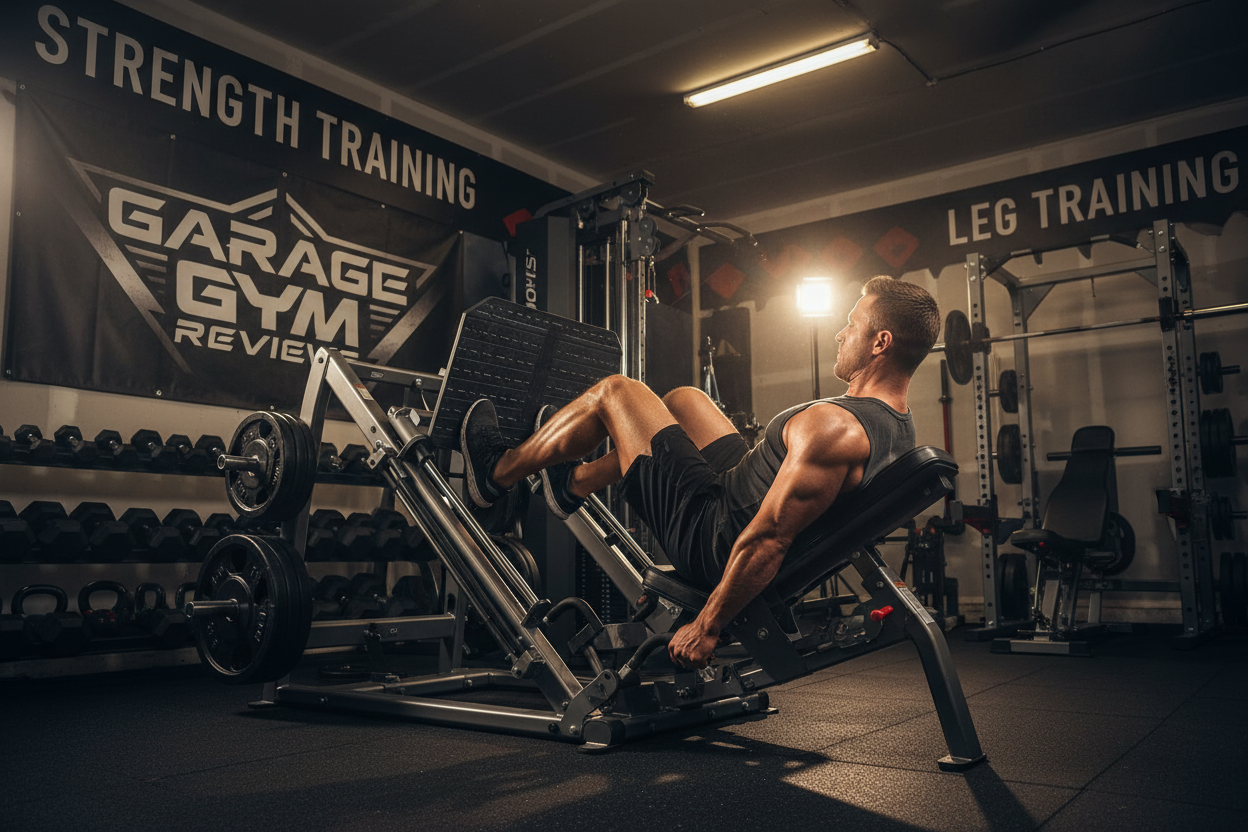
Is an All in One Home Gym With Leg Press Worth the Investment?
Most home gym setups have a glaring weakness: leg day. Sure, you have a squat rack and a barbell, but replicating the sheer volume and stability of machine-based lower body training is notoriously difficult in a garage. This is where the all in one home gym with leg press enters the conversation.
It promises to be the holy grail of efficiency, combining upper body cables with heavy-hitting lower body mechanics. But does a compact, multi-station unit actually replicate the feel of a commercial sled, or is it just an expensive coat rack in the making? Let’s break down the biomechanics, the space requirements, and the reality of training legs at home.
Key Takeaways
- Footplate Ergonomics: Look for a wide, textured footplate to allow for different stance widths; narrow plates limit muscle targeting.
- Ratio Matters: Many home gyms use a 2:1 cable ratio, effectively halving the weight. Ensure the stack is heavy enough for leg pressing.
- Versatility: The best units include a multi gym leg extension attachment to target the quads in the shortened position.
- Stability: A universal home gym with leg press requires a perfectly level floor to prevent frame warping under heavy loads.
Why Squats Aren't Always Enough
There is a misconception that if you have a barbell, you don't need machines. As a coach, I disagree. While the squat is the king of compound movements, it requires immense systemic fatigue and spinal loading.
The best home gym for legs allows you to isolate the quadriceps and hamstrings without the lower back being the limiting factor. A leg press station removes the balance component, allowing you to drive to absolute failure safely—something that is risky to do alone under a heavy barbell.
Analyzing the Leg Press Attachment
Not all leg press stations are created equal. In the home gym market, you generally encounter two types: the vertical press and the horizontal cable-driven press.
The Horizontal Cable Press
This is the standard found on a universal home gym with leg press. You sit upright, and the footplate moves away from you (or the seat moves away from the plate).
The science here relies heavily on the pulley ratio. If the machine has a 200lb stack but a 2:1 pulley ratio, you are only pressing 100lbs of resistance. For most trained lifters, this is insufficient for strength gains. If you go this route, verify that the cabling allows for a 1:1 ratio or has the capacity for additional plate loading.
The Articulating Arm Press
Some all-in-one units use a leverage arm rather than a cable. These generally offer a smoother strength curve and can handle significantly more weight. They mimic the biomechanics of a commercial machine much better than cable variants, providing a solid endpoint for the concentric portion of the lift.
Don't Ignore the Leg Extension
A leg press is a compound movement (involving knee and hip extension). To fully develop the anterior thigh, you need isolation. This is why a high-quality multi gym leg extension is critical.
The rectus femoris (one of the quad muscles) crosses the hip joint. It doesn't get fully engaged during a squat or leg press. It needs leg extensions to be fully shortened. When selecting your gym, check the pivot point of the extension arm. It should align perfectly with your knee joint to prevent shearing forces on the patella.
My Personal Experience with all in one home gym with leg press
I’ve spent years training in commercial facilities, so my standards for machine smoothness are high. When I first bought a mid-range all-in-one unit for my basement, the first thing I noticed wasn't the weight—it was the friction.
There is a specific, gritty "stutter" you feel on the eccentric (lowering) phase of a cheap leg press attachment when the guide rods aren't perfectly lubricated. It kills the mind-muscle connection immediately.
Another detail the spec sheets don't tell you is the footplate limitation. On my unit, the plate was too narrow. I like a wide stance to engage my adductors and glutes, but the compact design forced me into a narrow, quad-dominant stance. My knees ended up tracking way over my toes, which is fine for some, but it wasn't the position I wanted to train in heavy. If you have a size 12 shoe or larger, measuring that footplate surface area is non-negotiable before you buy.
Conclusion
Investing in an all in one home gym with leg press is a commitment to both space and budget. If you choose a unit with a heavy stack (or 1:1 ratio), proper pivot points, and a wide footplate, it can effectively replace a commercial leg day. Focus on the biomechanics first and the extra bells and whistles second.
Frequently Asked Questions
How much space do I need for a home gym with a leg press?
You typically need a footprint of at least 8x8 feet. The leg press station usually extends outward from the main frame, and you need an additional 2 feet of clearance to load weights or adjust the seat comfortably.
Is a cable leg press effective for building muscle?
Yes, provided the resistance is high enough. Hypertrophy requires mechanical tension. If the weight stack is too light due to pulley ratios, you will need to perform very high reps (20+) to approach failure, which isn't optimal for everyone.
Can I assemble a universal home gym by myself?
It is possible but difficult. These units often come in 5+ boxes with complex cabling diagrams. Having a second person to hold the frame while you bolt it together is highly recommended to ensure the structure remains square.