
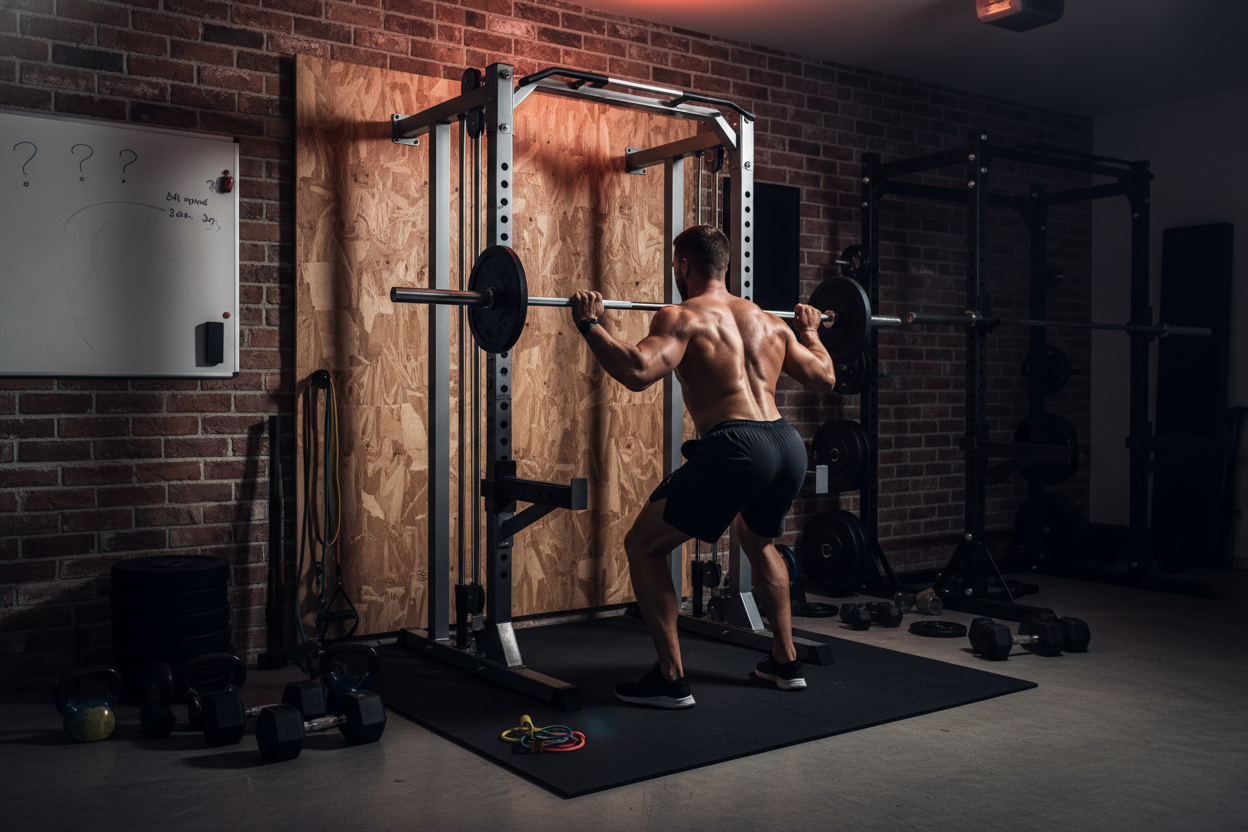
Is A Wall Mounted Smith Machine Actually Worth It? The Honest Truth
Space is the ultimate luxury in a home gym. Most of us don't have a dedicated warehouse; we have a slice of a garage or a spare bedroom. You want the safety to squat heavy without a spotter, but you can't justify sacrificing 20 square feet for a massive four-post cage. This is exactly where the wall mounted smith machine enters the conversation.
It promises the stability of a commercial rig with a fraction of the footprint. But does it actually deliver, or is it just a wobbly compromise? Let's break down the mechanics, the installation realities, and the training feel.
Key Takeaways
- Zero Footprint Impact: Unlike freestanding cages, a wall smith machine utilizes existing structural support, often extending less than 20 inches from the wall.
- Structural Integrity: Stability relies entirely on proper installation into wall studs; using a stringer board is non-negotiable for safety.
- Hypertrophy Focus: The fixed path isolates muscles more effectively than free weights, making it ideal for bodybuilding-style training.
- Cost-Efficiency: generally cheaper than full power racks because there is less steel involved in the manufacturing.
The Space-Saving Engineering Behind It
The primary appeal of a smith machine wall mounted setup is simple physics. Traditional racks rely on a wide base and heavy steel uprights to prevent tipping. By anchoring the unit to the wall, you eliminate the need for rear support legs and stabilizer bars.
This allows you to park a car in the garage or use the room for yoga when you aren't lifting. However, this design shifts the burden of stability from the floor to your house's framing.
Verticality and Tension
Because the guide rods are fixed vertically (or at a slight pitch depending on the brand), the machine forces a strict movement path. For hypertrophy, this is excellent. It removes the need for stabilizer muscles to balance the load, allowing you to focus purely on driving the weight up. This mechanical tension is the driver of muscle growth.
Installation: The Part No One Tells You About
Here is the reality check. You cannot simply screw a wall smith machine into drywall and hope for the best. The dynamic force of a 200lb squat moving rapidly can rip anchors right out of sheetrock.
You need to locate your studs precisely. If your studs are spaced 16 inches on center (standard in the US), but the machine is built for a different width, you will need a stringer. This is a thick board (usually 2x6 or 2x10) bolted across multiple studs, which the machine then mounts to. If you aren't handy with a drill and a level, you might need to budget for a contractor.
Training Feel: Smooth vs. Sticky
A high-quality wall mounted unit should feel almost weightless when the bar is unloaded. Linear bearings are the gold standard here. If the unit uses cheap plastic bushings, you will feel friction—a "gritty" sensation—during the eccentric (lowering) phase of the lift.
Since the unit is fixed to the wall, there is zero "give." If your floor is uneven or the wall isn't perfectly plumb, the guide rods might bind. This creates resistance spots that ruin the flow of a bench press or squat.
My Training Log: Real Talk
I want to share a specific detail from my own experience installing and using a wall mounted smith machine in a converted garage gym. The specs always talk about weight capacity, but they rarely mention vibration transfer.
The first time I racked a heavy set of shrugs, the "clank" didn't just stay in the gym. Because the unit was bolted directly to the studs, the impact vibration traveled through the frame of the house. My wife, sitting in the living room two walls away, felt the picture frames rattle. It’s a visceral, jarring sensation you don't get with a freestanding rack.
Also, there is a very specific installation headache I encountered: The Plumb Line Struggle. My garage floor has a slight slope for drainage. When I bolted the machine to the wall, the bottom of the guide rods didn't sit flush with the floor. I had to shim the base by about 3 millimeters. Before I did that, the bar would catch and "stutter" about halfway down because the guide rods were being slightly bent by the misalignment. If you don't own a pack of composite shims, buy one before this equipment arrives.
Conclusion
A wall mounted smith machine is the single best solution for lifters who need heavy loading capabilities in tight quarters. It offers safety and isolation that free weights can't match. However, it requires a commitment to proper installation. If you are willing to do the handy-work, it transforms a spare room into a legitimate hypertrophy dungeon.
Frequently Asked Questions
Can I install a wall smith machine on a brick or concrete wall?
Yes, and often this is more stable than wood studs. However, you must use masonry sleeve anchors (Red Heads) or Tapcons rather than standard lag bolts to ensure the machine doesn't pull out under load.
Is it safe to bench press alone on a wall mounted unit?
Absolutely. This is one of the main benefits. The safety catches allow you to twist the bar to lock it instantly at any height, eliminating the risk of getting pinned under the bar without a spotter.
Does the wall mounted design limit the weight capacity?
Generally, no. Most high-quality units are rated for 500 to 1000 lbs. The limiting factor is usually not the steel of the machine, but the strength of the lag bolts and the structural integrity of the wall you attach it to.


