Is a Smith Machine at Home Actually Worth It? The Honest Truth
Building a garage gym usually starts with a rack and a barbell. But once the basics are covered, the debate begins: should you invest in a smith machine at home? For years, functional training purists have dismissed this piece of equipment as a "coat rack" or a cheat code for people who can't stabilize a free weight. They are missing the point.
If you train alone, the calculus changes. It isn't just about stability; it is about the capability to push to failure safely without a spotter. Understanding the mechanical advantages—and the limitations—of this machine will determine if it becomes the centerpiece of your training or an expensive towel holder.
Key Takeaways
- Solo Safety Protocol: The primary benefit is the self-spotting mechanism, allowing you to train to absolute failure safely without a training partner.
- Hypertrophy Focus: The fixed path removes the need for stabilization, allowing you to direct 100% of your neural drive into the target muscle tissue.
- Vertical vs. Angled: Home versions often come angled (7-12 degrees) to mimic natural pressing arcs, while commercial units are often vertical. Knowing the difference changes how you set up.
- Space Economy: Modern home gym setups often combine a half-rack with a Smith mechanism, saving footprint compared to standalone units.
The Science of Stability: Why Fixed Paths Work
The biggest criticism of the Smith machine is also its greatest strength: the fixed plane of motion. Critics argue this isn't "functional" because real life requires you to stabilize loads. While true, stability is a double-edged sword when it comes to muscle growth.
When you squat with free weights, your primary movers (quads/glutes) are limited by your stabilizers (core/lower back). Once your core fatigues, the set ends, often before your legs are truly toasted.
With a smith machine home setup, the guide rods handle the stabilization. This allows you to overload the target muscle with more volume and intensity than you could with a free barbell. You aren't training movement proficiency here; you are training tissue tolerance.
Solving the "Solo Lifter" Dilemma
Training at home means you rarely have a spotter. This psychological barrier often prevents lifters from attempting that final, grinding rep on a bench press or squat.
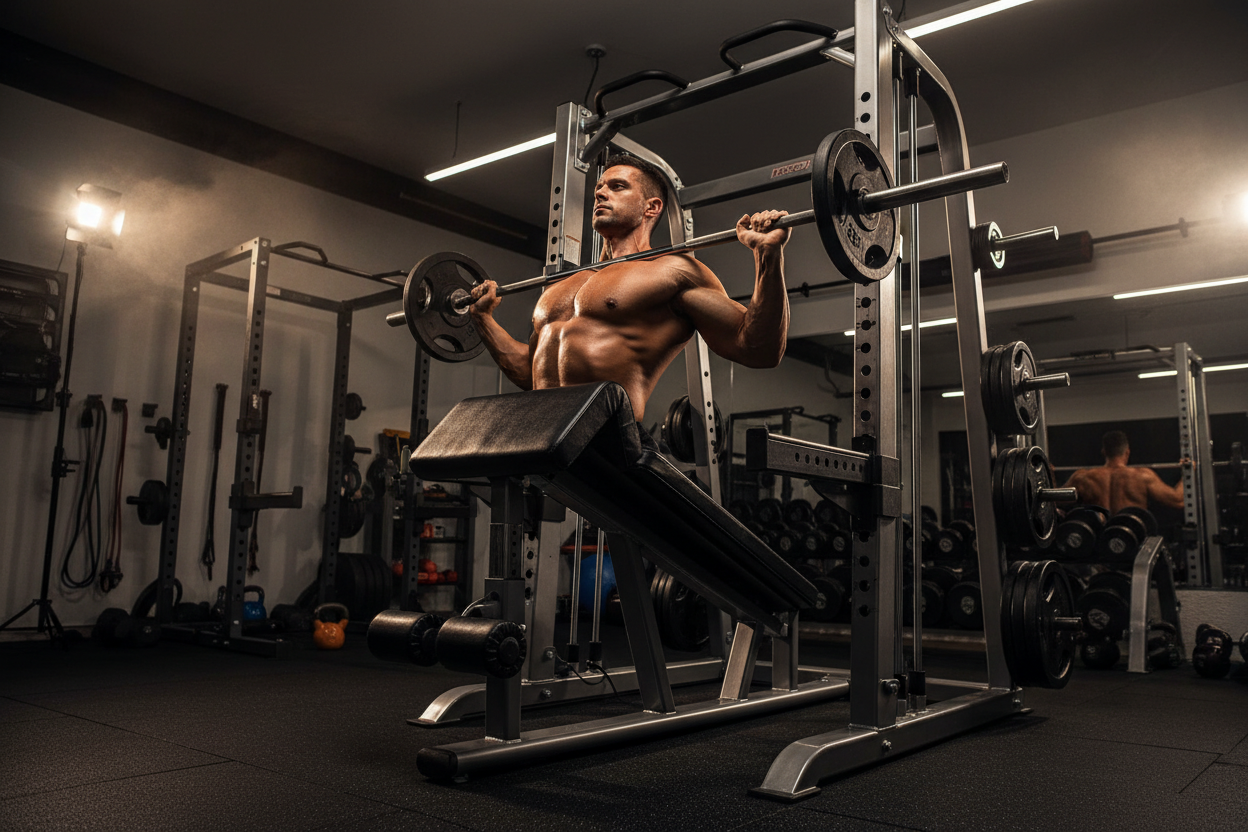
The Smith machine eliminates this fear. The ability to rotate the wrist and lock the bar instantly at any point in the range of motion is a safety feature a power rack safety pin cannot replicate with the same immediacy. This confidence allows for higher intensity training, which is the primary driver of adaptation.
Selecting the Right Machine: Vertical vs. Angled
Before you buy, check the path. Commercial gyms usually feature vertical guide rods. However, many residential units feature a 7 to 12-degree angle.
Neither is strictly "better," but they require different positioning. An angled path is generally smoother for pressing movements (bench and overhead) as it mimics the natural J-curve of a bar path. However, for squats and deadlifts, you must face the correct direction (usually facing out/away from the angle) to ensure the bar travels with your natural center of gravity, not against it.
Common Mistakes That Kill Progress
The most frequent error is trying to duplicate free weight form exactly. Because the bar doesn't move horizontally, you must adjust your body around the bar.
For example, during a Smith machine squat, you can place your feet further forward than you would with a barbell. This creates a leverage advantage that targets the quadriceps more aggressively while taking shear force off the lower back. If you try to squat with a vertical torso and heels under your hips (like a high-bar squat), you will likely feel uncomfortable joint compression.
My Personal Experience with smith machine at home
I learned the hard way that not all home units are built like the tanks at the local commercial gym. When I installed my first residential Smith attachment, I ignored the maintenance instructions. Two months in, I was stuck under a heavy calf raise because the linear bearings had gummed up with dust and humidity.
There is a specific, gritty friction you feel on a home unit if you don't use silicone spray on the guide rods weekly. It’s not that smooth "gliding on ice" feeling you get at a Life Fitness machine. Also, the knurling on my home unit was surprisingly passive compared to my Olympic bar. I actually had to start using straps for shrugs earlier than usual, not because of grip strength, but because the bar rotation mechanism would roll slightly in my sweaty palms, causing the hook to graze the catch pins mid-rep. That "clack-clack" sound is annoying, but once I learned to keep my wrists locked in a neutral position to prevent accidental rotation, the machine became my go-to for burning out my triceps safely at 11 PM.
Conclusion
A Smith machine at home isn't a replacement for a barbell; it is a force multiplier for hypertrophy and safety. If you have the budget and the floor space, it bridges the gap between "working out" and training with genuine intensity alone. Don't let the purists talk you out of gains.
Frequently Asked Questions
Can you build as much muscle with a Smith machine as free weights?
Yes, and potentially more for specific muscle groups. Research suggests that while free weights activate more stabilizer muscles, Smith machines allow for greater isolation and force output on the prime movers (like the pecs or quads) because stability is managed by the machine.
Is a Smith machine bad for your joints?
It is only bad for joints if you force your body into an unnatural position. Because the bar path is fixed, you must adjust your foot placement and body angle to align your joints with the machine's path. Once aligned correctly, it can actually be safer for joints than free weights.
Does a Smith machine take up more space than a power rack?
Generally, yes, but not by much. Most home gym Smith machines are integrated into a power rack or half-rack system. The footprint is similar, but you need to account for the width of the bar (usually 7 feet) and room to load plates on the sides.