Is a Lateral Pull-Up Machine Worth Your Home Gym Space?
Building a massive, V-taper back in a home gym usually presents a dilemma: you either need soaring ceilings for a power rack pull-up bar, or a massive footprint for a commercial selectorized unit. If you are stuck in a low-clearance basement or a cramped garage, a dedicated lateral pull-up machine might be the space-saving compromise you have been looking for.
Often overlooked in favor of standard cable towers, these specialized leverage or plate-loaded machines offer a unique biomechanical advantage. In this guide, we will break down exactly how these machines fit into a North American home gym, what specs matter, and whether it is truly worth the floor space.
Key Takeaways
- Space Efficiency: Most lateral pull-up units require less vertical clearance than standard power racks, making them ideal for 7-foot basement ceilings.
- Targeted Isolation: Fixed-plane movement allows for stricter lat isolation compared to free-hanging pull-ups.
- Versatility: Many modern units double as a lat pull-up machine and feature attachments for low rows.
- Budget-Friendly: Plate-loaded models cost significantly less than their selectorized commercial counterparts while offering similar resistance curves.
Space Planning: Will It Fit Your Setup?
The biggest mistake home gym owners make is underestimating the working footprint of their equipment. It is not just about the machine's dimensions; it is about the space you need to load plates and actually perform the movement.
Garage Gyms vs. Basements
If you are in a standard two-car garage, depth is usually your main constraint. A plate-loaded lateral pull-up machine typically requires a footprint of about 48 by 55 inches. However, if you are building out a basement gym, height is the true enemy. Because the user is seated and pulling down toward the shoulders, the highest point of the machine rarely exceeds 82 inches, easily clearing standard 84-inch basement joists.
Training Application: Beyond the Basics
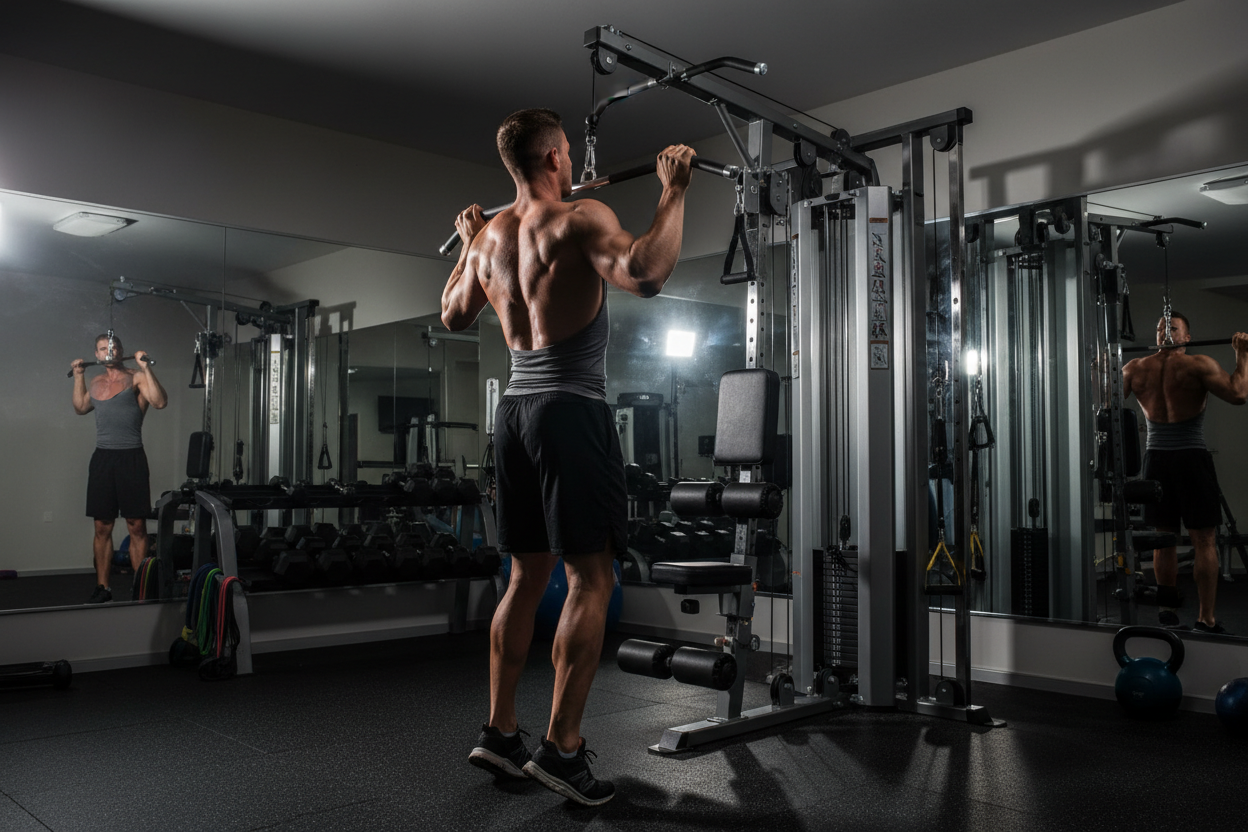
Why choose a dedicated leverage machine over a simple cable pulley? It comes down to the strength curve and stability. When your lower body is locked under the thigh pads, you can move significantly more weight without losing your form to momentum.
Complementing Your Routine
If you struggle with strict pull-ups, this equipment bridges the gap. You can overload the eccentric (lowering) portion of the movement safely. Additionally, some versatile home gym setups combine these with a lat push-up machine or dip station, giving you a complete upper-body push/pull superset station in one corner of your room.
Buying Guide: Specs That Actually Matter
Not all machines are created equal. When comparing models online, look past the glossy photos and check the actual engineering specs.
Weight Capacity and Pivot Points
For a plate-loaded unit, look for a minimum weight capacity of 300 lbs per arm. Anything less usually indicates thin-gauge steel that will warp over time. Pay close attention to the pivot points; sealed ball bearings provide a buttery-smooth pull, whereas cheap plastic bushings will stutter and catch, ruining your mind-muscle connection.
From Our Gym: Honest Take
We have had a mid-tier, plate-loaded lateral pull-up machine in our testing garage for over a year now. Honestly? It completely changed my back day. At 6'1", I always struggled to get a full stretch on standard home-gym cable attachments because the weight stack would bottom out. The independent leverage arms on this machine fixed that entirely, allowing for a deep, unilateral stretch.
That said, it isn't perfect. The starting weight of the lever arms is quite heavy (around 15 lbs per arm), which might be aggressive for absolute beginners. Also, loading 45-pound plates on the rear pegs can be a tight squeeze if you push the machine too close to the drywall. Leave yourself at least 18 inches of rear clearance.
Frequently Asked Questions
Is a lateral pull-up machine worth it for a home gym?
Yes, if back development is a priority and you have the floor space. It offers superior isolation compared to free weights and is safer for lifting to failure without a spotter.
Can beginners use a lat pull-up machine?
Absolutely. Unlike traditional bodyweight pull-ups which require significant baseline strength, a plate-loaded or selectorized machine allows you to scale the weight down to your current fitness level.
How much maintenance does this equipment require?
Very little. For plate-loaded models, simply wipe down the upholstery after use and apply a few drops of 3-in-1 oil to the pivot bearings every six months to keep the movement smooth.