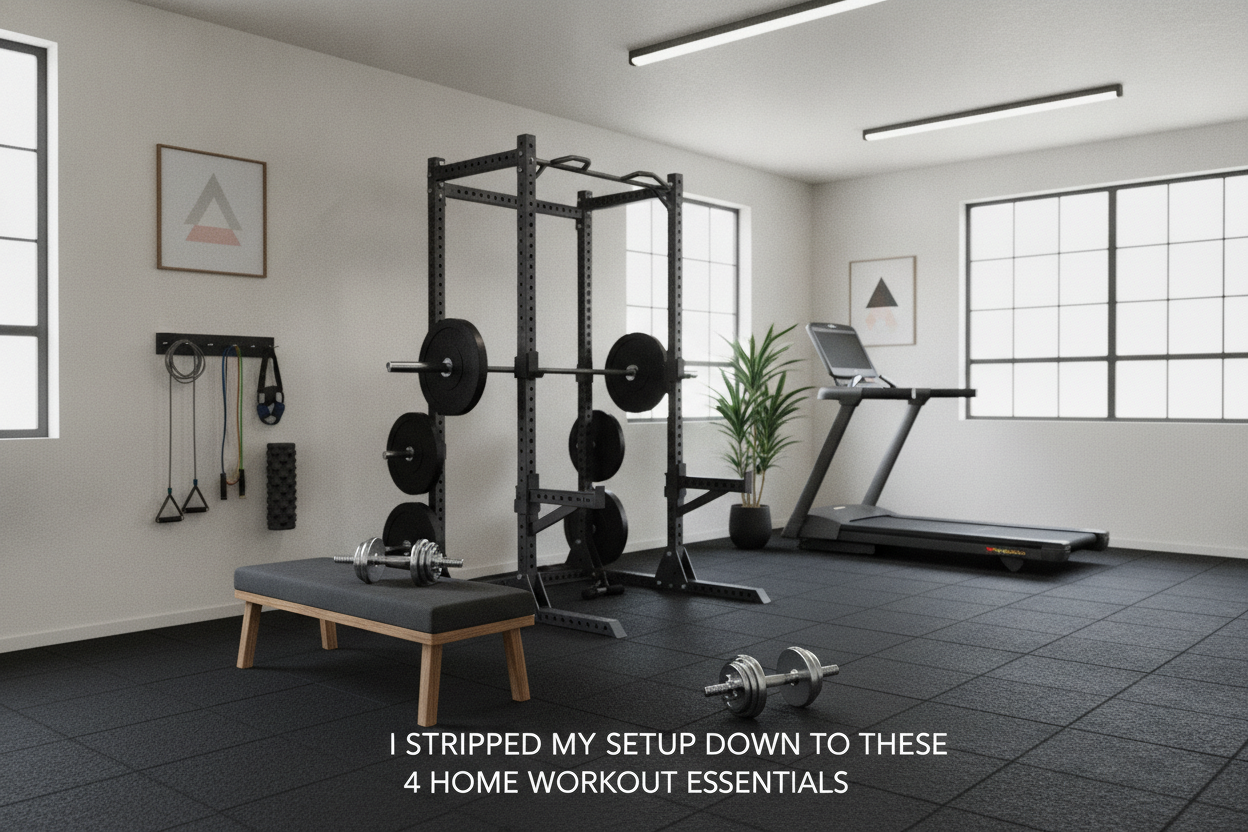
I Stripped My Setup Down to These 4 Home Workout Essentials
I once spent $400 on a 'multi-function' tower that ended up as a glorified coat rack. It shook if I breathed too hard, and the pulleys felt like they were filled with sand. That was the moment I realized most home workout essentials lists are written by people who have never actually finished a heavy set of squats in their garage.
Building a training space shouldn't feel like buying a second mortgage. You don't need a 1,000-square-foot basement or a $3,000 'smart' mirror to get results. You need high-quality tools that provide enough resistance to force your muscles to change.
Quick Takeaways
- Adjustable dumbbells are the single most important investment for space-saving.
- A bench is only as good as its weight capacity; aim for 600 lbs or higher.
- Vertical pulling (pull-ups) is the most neglected movement in home gyms.
- Resistance bands replace expensive cable machines for accessory work.
The Problem With Influencer 'Must-Have' Lists
The fitness industry is obsessed with hyper-specific gadgets. They want you to believe that if you don't have a dedicated room with LED strips and a cable crossover machine, you aren't really training. That's a lie designed to get you to click affiliate links for plastic junk.
A gym is a place where you apply tension to muscle; everything else is just interior design. I've seen people build world-class physiques with a rusty barbell and a tree branch. Most 'essential' lists are bloated with items that serve one purpose, like a dedicated calf raise machine or a 'booty' band that snaps after three sessions.
When you're shopping for at home workout essentials, your goal is versatility. If a piece of equipment doesn't allow you to perform at least five different exercises, it's probably taking up too much room. Your floor space is your most valuable currency—don't spend it on a machine that only works your triceps.
The Core 4: My Non-Negotiable At Home Workout Essentials
I've narrowed my own setup down to a minimalist framework that covers every fundamental movement pattern: push, pull, hinge, squat, and carry. These four items are the true essentials for working out at home because they don't just mimic a gym—they replace it.
Heavy Adjustable Dumbbells (Your Main Engine)
A pair of 50-pound adjustable dumbbells replaces 10 pairs of fixed weights. That saves about 6 feet of wall space and hundreds of dollars. I personally look for sets that go up to at least 50 lbs per handle. If you're serious about leg day, you'll eventually want an expansion kit that takes them to 80 or 90 lbs.
Don't buy the cheap plastic ones with the sliding dials that feel like they're going to rattle apart. Go for steel or high-density composite. I've dropped my 52.5-lb PowerBlocks more times than I can count, and they still click into place perfectly. You need that level of durability when you're grinding out a final set of overhead presses.
A Weight Bench That Doesn't Wobble Under Pressure
If a bench costs $49 on Amazon, stay away. You are putting your entire body weight plus the weight of the dumbbells on a few thin bolts. I've had a cheap bench collapse during a set of chest presses, and it's a mistake I'll never make again.
Look for 11-gauge steel and a pad width of at least 11 inches. A good adjustable bench should have a weight capacity of at least 600 pounds to account for you and your weights. It should feel like you're lying on a rock, not a wet noodle. Bonus points if it has a small footprint or can stand vertically when you're done.
A High-Quality Pull-Up Bar
Vertical pulling is the one thing you can't fake with a floor and some weights. Most people try to replace pull-ups with rows, but your lats need that vertical stretch to grow. A sturdy doorway bar—the kind that bolts into the frame or uses a leverage design—is mandatory.
If you have the wall space, a wall-mounted bar is even better because it doesn't limit your grip width. I prefer a bar with a simple 1.25-inch diameter. Avoid the ones with ten different foam handles; they just get in the way and eventually tear. Simple is better.
Resistance Bands (The Duct Tape of Home Gyms)
Latex loop bands are the 'duct tape' of the home gym. I use them for face pulls to keep my shoulders from rolling forward and for tricep work when I don't feel like dragging the dumbbells out. They weigh nothing and fit in a drawer.
They also provide 'accommodating resistance.' This means the exercise gets harder as you reach the top of the movement. It's a different stimulus than free weights and is great for finishing off a workout without adding more joint stress.
Gear You Should Actively Avoid Buying
Avoid those 2-lb neoprene dumbbells sold in pastel colors. Unless you are in active physical therapy, they won't build muscle or strength. You're better off lifting a heavy book. Also, skip the 'as-seen-on-TV' ab machines. Your floor and a heavy dumbbell for weighted sit-ups are more effective and cost $0 extra.
Be wary of massive all-in-one 'home gyms' made of thin plastic and light cables. These usually have a maximum resistance that you'll outgrow in three months, and they are a nightmare to move if you ever change apartments. Stick to 'iron' and bodyweight movements; they don't break.
Putting Your Gear to Work (Because Equipment Isn't a Magic Pill)
Even the best gear is just a pile of metal without a plan. I've seen guys with $10,000 Rogue racks who look like they've never lifted a day in their lives, and guys with one kettlebell who are absolute tanks. The difference is the program.
If you're just starting, look for at home workout programs for beginners that focus on the big compound lifts like the goblet squat and the overhead press. These movements give you the most bang for your buck. Once you've got the rhythm down, you can explore the best workout at home programs that utilize apps to track your progressive overload. If you aren't lifting more weight or doing more reps than you did last month, you're just exercising—not training.
Final Thoughts Before You Swipe Your Card
Start small. Buy the dumbbells first, then the bench. You don't need to order the entire catalog at once. Master the basics with minimal equipment, and only upgrade when your strength levels demand it. If you can't do 10 clean pull-ups yet, you don't need a lat pulldown machine. Focus on the work, not the gear.
FAQ
How much space do I actually need?
You can run a full program in a 6x8 ft area. As long as you can lie down flat and reach your arms out to the side without hitting a wall, you have enough space for these four essentials.
Are adjustable dumbbells safe for overhead work?
Yes, provided you buy a reputable brand. Quality adjustable sets use locking pins or steel dovetails that are rated for hundreds of pounds of force. Just don't drop them from overhead.
Can I build muscle with just resistance bands?
You can, but it's harder to track progress. Weights provide a consistent measurement. Use bands as a supplement to your dumbbells for the best results.