I Refuse to Call These Influencer Moves Advanced Strength Exercises
I was scrolling through my feed last night and saw a guy doing a barbell overhead press while standing on a stability ball with resistance bands tied to his ankles. It looked like a Cirque du Soleil audition gone wrong. My first thought wasn't 'wow, he's strong,' it was 'I hope he has good health insurance.' If you think that is what advanced strength exercises look like, we need to have a talk about how we define 'advanced' in a home gym setting.
Quick Takeaways
- Instability training is for circus performers, not for building maximum force production.
- True advanced movements involve adding technical constraints to basic lifts.
- Pauses, tempos, and increased range of motion are the real markers of high-level training.
- Your gear needs to be rated for the mechanical tension these variations create.
The Social Media Definition of 'Advanced' Is Completely Broken
The current state of fitness social media is a race to the bottom of the 'weirdness' barrel. Somewhere along the line, we decided that if a movement doesn't involve four different pieces of equipment and a high risk of a trip to the ER, it isn't advanced. This is a lie. Adding resistance bands, chains, and a balance board to a perfectly good squat doesn't make it an advanced strength training move; it just dilutes your force output. You cannot produce peak power when your central nervous system is preoccupied with just staying upright.
When you add excessive instability, your body's Golgi tendon organs and muscle spindles go into overdrive, essentially 'braking' your strength to protect your joints. You might feel a 'burn,' but you aren't building the kind of raw power that moves heavy iron. I see guys in 11-gauge steel power racks—racks designed to hold 1,000 pounds—doing movements that barely require a 10-pound dumbbell. It is a waste of high-quality steel and your limited training time.
The irony is that these 'advanced' moves are actually easier in terms of absolute load. It is much easier to wobble around on a ball with 95 pounds than it is to pin-squat 405 pounds from a dead stop. Real strength is about moving heavy loads through a full range of motion with total control. If you can't do that, the flashy stuff is just a distraction from your lack of foundational power.
What Real Advanced Strength Training Actually Looks Like
The unsexy truth is that high-level lifting looks almost exactly like beginner lifting, just heavier and more disciplined. Advanced strength training isn't about finding new exercises every week; it is about applying brutal constraints to the basics you already know. It is about taking a movement you think you've mastered and removing the 'cheats' your body has developed over the years. Beginners often get distracted by variety, wondering which different strength training exercises actually matter, while the veterans are busy perfecting their foot pressure on a standard pull.
An advanced lifter doesn't need a new machine; they need a way to make 315 pounds feel like 500 pounds. This is achieved through mechanical disadvantage. We are talking about altering the leverage or the timing of the lift to force the muscle to work harder without necessarily adding more plates to the bar. It requires more mental focus and a much higher level of neurological drive than any 'functional' balance exercise ever could.
I have spent years in my garage, and the most 'advanced' I ever felt wasn't when I bought a new piece of flashy gear. It was when I realized I could no longer 'bounce' my deadlifts and had to pull every single rep from a dead stop with a reset. That transition from 'moving the weight' to 'commanding the weight' is the true threshold of advanced training. It isn't flashy, it doesn't get many likes, and it is incredibly hard to do consistently.
The Humbling Reality of Pauses and Tempos
If you want to see how advanced you really are, try adding a three-second pause at the bottom of your next bench press or squat. No bouncing, no momentum, just pure isometric tension at the weakest point of the lift. This is infinitely more advanced than any circus trick you'll see online. A pause squat forces you to maintain core rigidity and stay 'tight' under a load that is trying to crush you. It eliminates the stretch reflex, meaning your muscles have to do 100% of the work to get the bar moving again.
I remember the first time I tried a 3-second tempo on the eccentric (lowering) phase of a pull-up. I thought I was a master of bodyweight moves, but that one change cut my rep count in half and left my lats sore for a week. Tempo work builds incredible positional awareness. You learn exactly where your form breaks down. If you can't control a weight for a 4-second descent, you haven't mastered that weight. You're just surviving it.
Deficits: Stretching the Range of Motion
Another true advanced tactic is increasing the range of motion. Deficit deadlifts—standing on a 2-inch block or a couple of 45-pound plates—force you to pull from a deeper hinge position. This demands significantly more mobility and leg drive. You don't need fancy strength training accessories to do this; a simple stable platform will do. But the demand it places on your posterior chain is massive.
Deep cambered bar squats or extra-deep dumbbell presses work the same way. By taking the joint through a larger arc of movement, you're hitting muscle fibers that usually get a free ride. It is a humbling experience. You will likely have to drop the weight by 20%, but the hypertrophy and strength gains are far superior to doing half-reps with a 'heavy' bar. This is how you build 'bulletproof' joints that can handle real-world stress.
Upgrading Your Setup for the Heavy Lifts
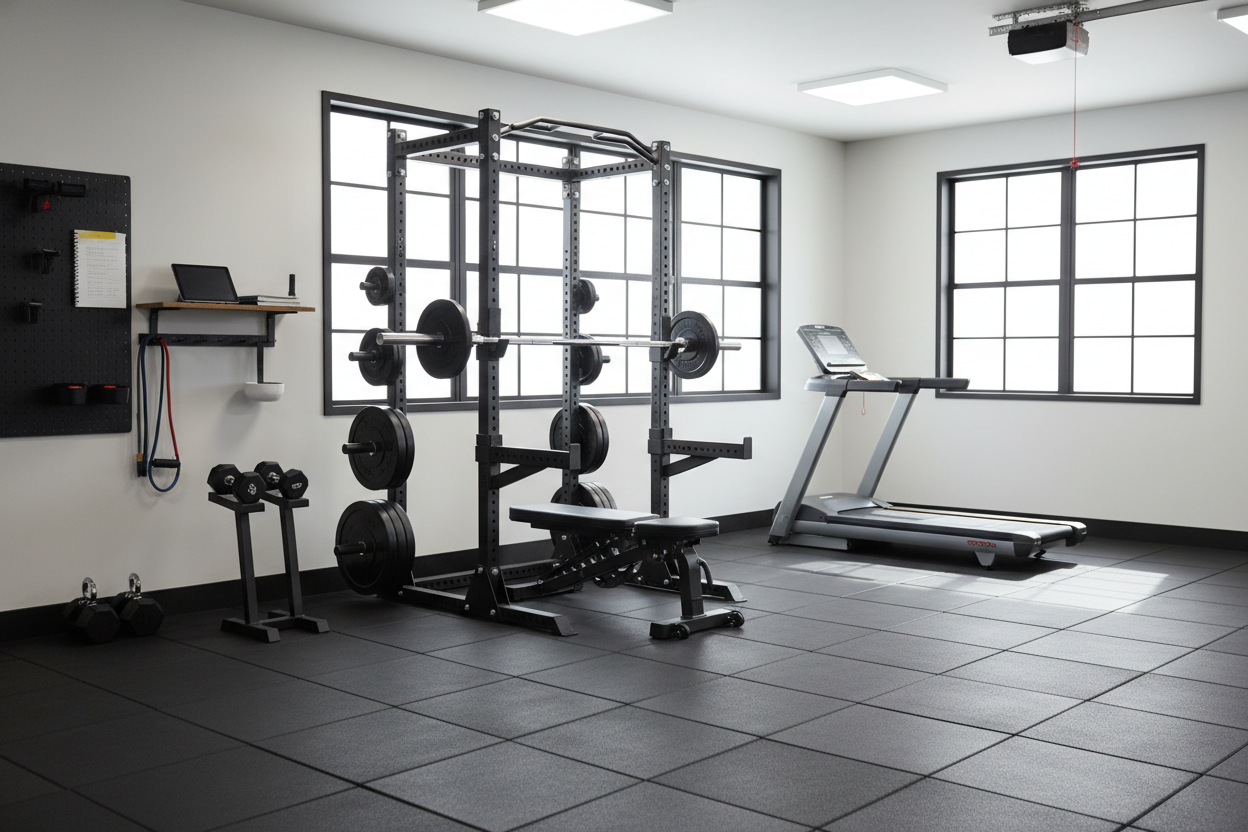
You don't need a gym full of specialized, single-use machines to get strong, but you do need gear that won't fail when you start pushing serious weight. As you move into advanced variations, the mechanical tension on your equipment increases. A cheap, bolt-together rack from a big-box store might handle a 135-pound squat, but when you start doing heavy pin presses or rack pulls, you need 3x3-inch 11-gauge steel. You need strength equipment that is overbuilt for the task.
I've seen bars bend because the owner thought a 'standard' 1-inch bar was enough for 'advanced' training. It isn't. You need a barbell with a high tensile strength (at least 190,000 PSI) and a knurling that actually bites into your skin. When you are doing 2-inch deficit pulls, the last thing you want to worry about is your grip slipping or the bar whipping uncontrollably. Invest in the foundation of your gym—the rack, the bar, and the plates—before you even think about buying specialized 'advanced' machines.
How to Program the Hard Stuff Without Wrecking Your Joints
The trap most people fall into is trying to make every single exercise 'advanced' at the same time. That is a fast track to central nervous system burnout. You should only apply these brutal constraints to the 5 training strength exercises that work the best: the squat, hinge, push, pull, and carry. If you try to do tempo-deficit-paused-everything, you'll be exhausted before you finish your first circuit.
The smart way to program is to pick one 'primary' lift to modify per session. If it's leg day, do your paused squats first while you're fresh, then move into standard accessory work. Treat these variations with respect. Because they remove momentum and increase time under tension, they take longer to recover from than standard reps. I usually rotate my 'advanced' variations every 4-6 weeks to prevent stagnation and keep my joints from getting cranky from the same repetitive stress.
My Personal Lesson in 'Advanced' Fails
A few years ago, I fell for the 'stability' hype. I bought a specialized bamboo bar that was designed to wobble and shake, thinking it would 'unlock' my bench press. I spent two months shaking like a leaf on the bench. When I went back to a standard power bar, my bench hadn't moved an inch. In fact, it felt heavier because I had lost the 'feel' for heavy loads. I sold that bar and went back to heavy close-grip benching with a 2-second pause. My chest grew more in three weeks than it had in two months of circus tricks. I learned the hard way: if you want to be strong, you have to move heavy things, not just shaky things.
FAQ
Do I need chains and bands to be advanced?
No. They are tools for specific sticking points, but they aren't a requirement. You can get 99% of the way there with just a barbell and a clock for timing your pauses.
How long should a pause actually be?
A true pause is at least two full seconds. Count 'one-one-thousand, two-one-thousand' in your head. If it feels like an eternity, you're doing it right.
Are deficit deadlifts dangerous for the back?
Only if you lack the mobility to keep a flat back at the bottom. If you have to round your spine to reach the bar, you aren't ready for deficits yet. Start with a 1-inch deficit and work your way down.