I Finally Built a Home Workout That Works (Without Jumping)
I remember the day I quit my $150-a-month functional fitness gym. I thought I could replicate the intensity in my living room with a cheap app and a can-do attitude. Two weeks of burpees and endless jumping jacks later, my knees were screaming, and I was actually losing muscle mass. I realized that if I wanted a home workout that works, I had to stop training like a cardio-obsessed teenager and start training like a lifter who understands physics.
Quick Takeaways
- Stop using sweat as a metric for success; focus on mechanical tension instead.
- Unilateral (one-sided) movements are the secret to making bodyweight feel heavy.
- Slow down your reps to 3-4 seconds on the way down to maximize muscle growth.
- A stable, non-slip floor is the most underrated piece of equipment you can own.
Why Your 'Living Room Bootcamp' Is Making You Weaker
The biggest lie in the fitness industry is that a 'good' workout requires you to be gasping for air on the floor. Most apps confuse cardiovascular fatigue with muscular failure. If you are doing 100 jumping jacks, your heart rate is spiking, but your chest and legs aren't actually getting stronger. This is the primary reason why most great workout plans to build muscle fail at home—they prioritize 'the burn' over the load.
A truly most effective at home workout needs to trigger hypertrophy. To do that, you need to put your muscles under enough stress that they are forced to adapt. Doing high-rep cardio circuits in your pajamas might burn a few calories, but it won't build the physique you're after. You need to treat your living room like a weight room, even if the only weight available is gravity.
The 4 Pillars of a Home Workout That Works
If you want a great workout at home, you have to master four concepts: mechanical tension, controlled eccentrics, stability, and progressive overload. Mechanical tension is the 'stretch' and 'squeeze' your muscles feel under load. Since you don't have a 400-lb barbell, you have to create this tension by using harder angles and slower speeds.
The top exercises at home are those that allow you to safely approach muscular failure without your lungs giving out first. If you're doing a set of 50 squats, your heart will quit before your quads do. If you do 8 slow, deep Bulgarian split squats with a 3-second pause at the bottom, your quads will be the limiting factor. That is how you grow.
The No-Nonsense Living Room Split
Finding the best workout home setup requires a logical split. Don't do full-body circuits every single day; your central nervous system will fry, and your intensity will tank. I recommend an Upper/Lower split or a Push/Pull/Legs rotation. This gives you the recovery time needed to actually push hard when it’s time to train.
Legs: Killing the 100-Rep Air Squat
Stop doing air squats. They are useless for anyone past the beginner stage. To build real legs, you need to move to unilateral work. Bulgarian split squats and slow-eccentric step-ups are the top exercises to do at home for the lower body. By putting all your weight on one leg, you effectively double the load on that muscle.
I like to use a 4-0-1-0 tempo: 4 seconds down, no pause at the bottom, 1 second up, and no rest at the top. By the time you hit rep eight, your legs will be shaking more than they ever did during a 20-minute 'HIIT' session. It’s about quality of contraction, not quantity of movement.
Pushing: Making the Floor Press Actually Heavy
Without a bench, the floor press is a staple, but it has a limited range of motion. It is an effective exercise at home, but you can make it better. Use a pair of sturdy books or blocks to create a 'deficit' push-up. This allows your chest to sink deeper than floor level, stretching the muscle fibers further.
If standard push-ups are too easy, elevate your feet on a chair or the couch. This shifts more of your body weight to your upper chest and shoulders, mimicking an incline press. You don't need a rack; you just need to understand how to manipulate your body's center of gravity.
Pulling: The Living Room's Final Boss
Pulling is the hardest part of training at home. You can't exactly 'bodyweight' a row without equipment. However, towel isometric rows—where you stand on a long towel and pull upward with max effort for 30 seconds—can create insane back thickness. For vertical pulling, a simple doorway bar remains one of the most effective home exercises you can buy. It takes up zero floor space and allows for chin-ups, which are the king of upper body builders.
Claiming Your Territory (Without Ruining the Hardwood)
You cannot execute great at home exercises if you are sliding around like a baby deer on ice. I learned this the hard way when I tried to do weighted lunges on a rug and ended up putting a knee through a drywall panel. You need a dedicated surface that offers traction and joint protection.
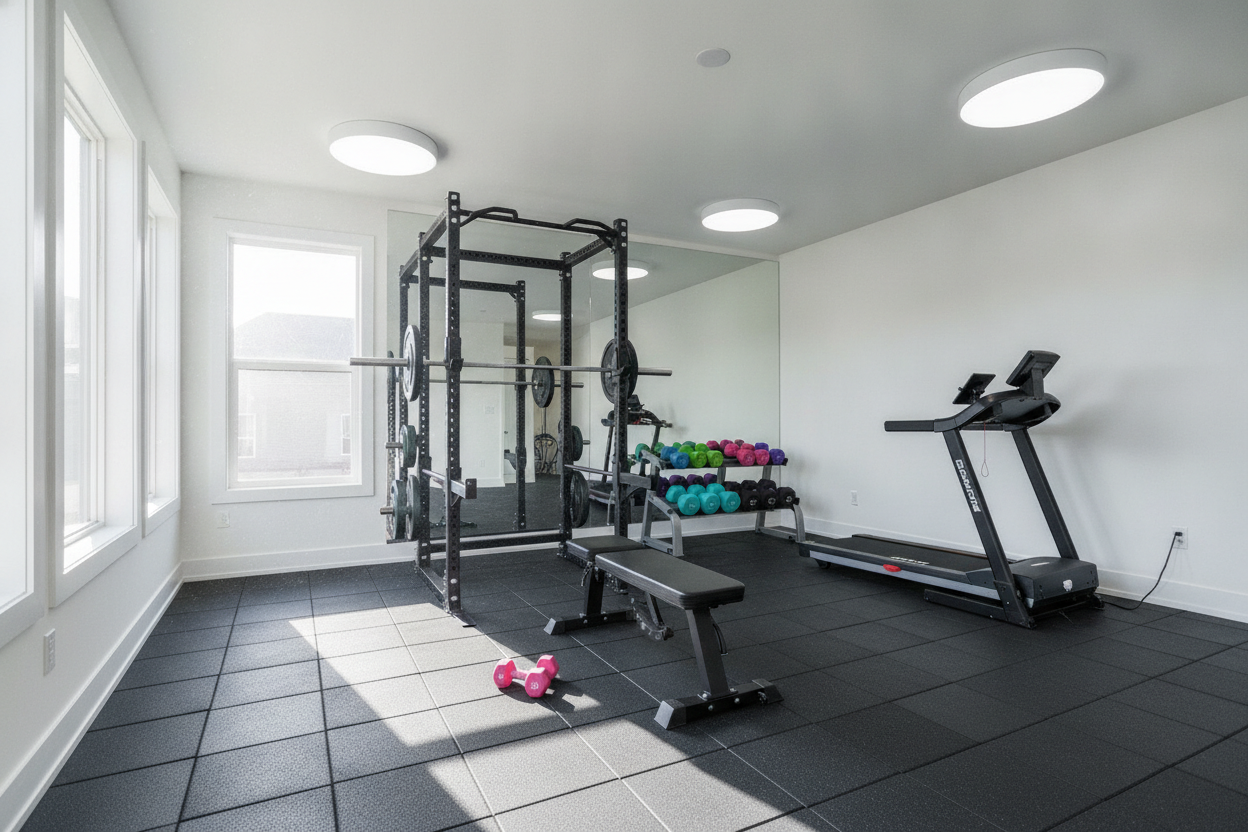
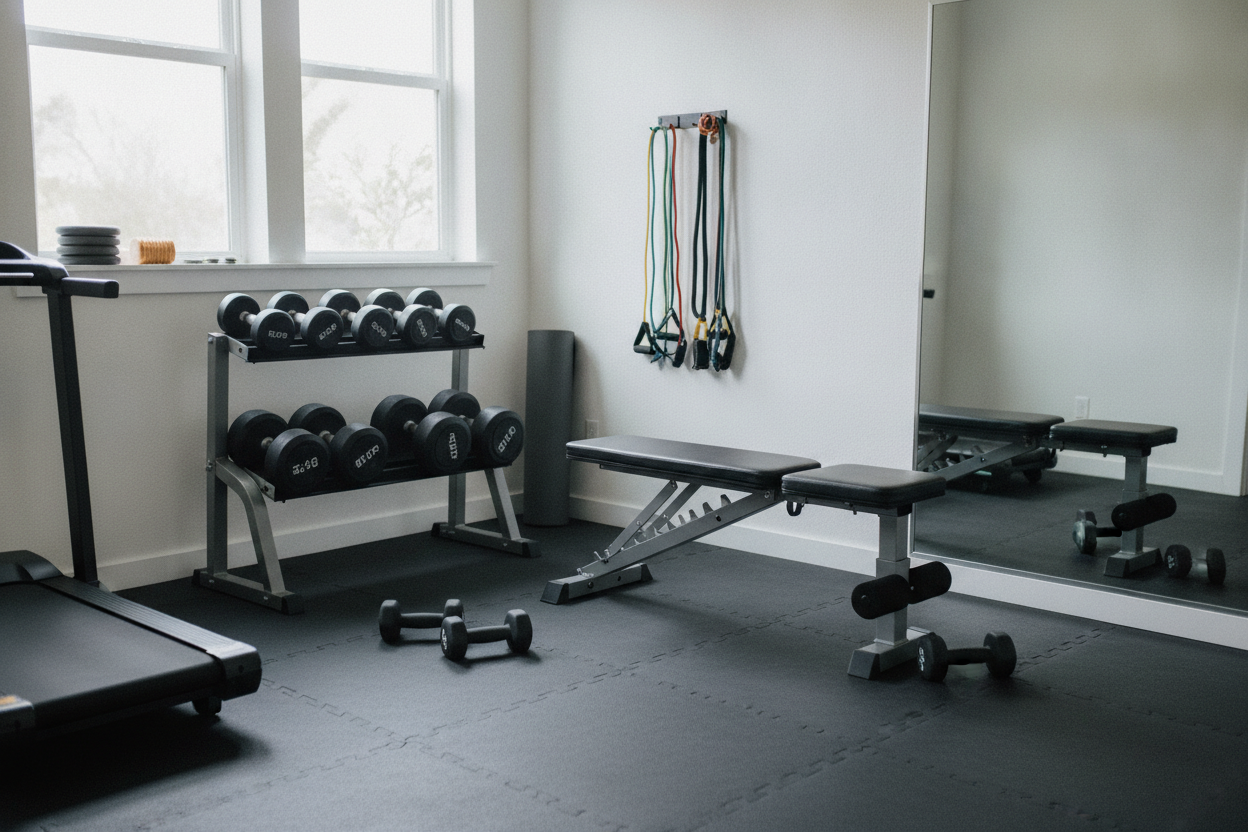
I finally invested in a large exercise mat for home gym use, and it changed everything. Specifically, a 6x8ft exercise mat is the 'sweet spot.' It's big enough that you don't fall off the edge during a floor press, and it’s thick enough to dampen the sound so your neighbors don't think you're dropping boulders.
Warming Up: Stop Stretching Cold Muscles
Don't just jump into a heavy set of split squats. Spend three minutes doing dynamic hip mobility exercises to prime the joints. Focus on opening the hip flexors and waking up the glutes. This prevents the 'stiff' feeling that often leads to lower back compensation during home sessions.
How to Force Progress When You Max Out Your Setup
Eventually, bodyweight gets easy. When that happens, don't just add reps. Add 'intensity techniques.' Use 1.5 reps (go all the way down, halfway up, back down, then all the way up). Use 5-second negatives. Use 30-second rest periods. These variables keep the best exercise in home routines challenging for months without you having to buy a single new dumbbell.
Personal Experience: My Biggest Mistake
For months, I refused to buy a mat because I thought the carpet was 'fine.' I ended up with turf burn on my elbows and a permanent dent in the floorboards from where I rested my heels during floor presses. The downside of home training is the lack of 'gym' durability in your house. Once I treated my 6x8 area like a professional platform, my mindset shifted from 'messing around' to 'training.'
FAQ
Do I really need a mat?
If you value your joints and your floor, yes. Hardwood is too slippery for lunges, and carpet provides zero stability for your ankles. A dense rubber mat is the best investment you'll make.
How many days a week should I do this?
Three to four days is the sweet spot. Because you’re focusing on high tension and slow reps, your muscles will need more recovery than they do after a standard cardio circuit.
Can I really build muscle without a squat rack?
Yes. Your muscles don't know if you're holding a $500 barbell or if you're doing a brutal Bulgarian split squat with a 5-second negative. They only respond to tension.