I Cured Gym Burnout With These Fun Upper Body Exercises
I spent three years chasing a 315-lb bench press in my garage. By the time the plates finally clanked together for that triple-plate milestone, I realized I absolutely hated my rack. I was staring at the same rusted barbell, the same chalk-stained uprights, and the same rigid spreadsheet every Tuesday at 6:00 PM. The 'grind' had stopped being a badge of honor and started feeling like a second job that didn't pay.
The problem wasn't the strength; it was the stagnation of the soul. When your training becomes a math equation of percentages and RPE scales, you lose the raw athleticism that made you want to lift in the first place. I found my way back by ditching the static movements for a few weeks and injecting fun upper body exercises that actually made me want to sweat again.
Quick Takeaways
- Static lifting is great for peak strength but can lead to mental burnout and 'stiff' athleticism.
- Novelty stimulates the nervous system, recruiting motor units that standard benching misses.
- A fun upper body workout focuses on dynamic, chaotic loads like sandbags and kettlebells.
- You don't need to quit powerlifting; just use these movements as high-intensity finishers.
- Proper flooring is non-negotiable when you start throwing heavy objects around your garage.
Why the Spreadsheet Finally Broke My Brain
Linear progression is a beautiful thing until it isn't. For months, I lived and died by my training log. If I didn't add 2.5 lbs to the bar, the session was a failure. This 'math-first' approach works for building a base, but it eventually turns the gym into a place of anxiety rather than a sanctuary. I found myself sitting on my bench for ten minutes between sets, doom-scrolling and dreading the next heavy triple. The joy of movement was gone, replaced by a rigid obsession with numbers.
In a home gym, this burnout is amplified. You don't have the energy of a commercial floor or a training partner to pull you through the slump. It's just you and the silence. When I started skipping sessions because I couldn't face another 5x5 session, I knew I had to pivot. I realized that treating my body like a forklift was making me strong, but it was also making me bored and surprisingly immobile. I needed to move in ways that weren't dictated by a straight line or a fixed plane.
I had to give myself permission to 'play' again. That doesn't mean doing bicep curls on a Bosu ball; it means choosing exercises that require reaction, stability, and explosive intent. The moment I swapped my third accessory lift for a heavy sandbag toss, the spark came back. I wasn't just checking a box; I was trying to launch a 100-lb bag over a pull-up bar. Suddenly, the gym was a playground again.
The Science of Play: Why Novelty Builds Better Muscle
Your nervous system is smarter than your program. When you perform the same bench press or overhead press for months, your body becomes incredibly efficient at those specific motor patterns. Efficiency is great for hitting a PR, but it's the enemy of new muscle growth and neurological adaptation. By introducing 'chaotic' loads, you force your brain to recruit dormant motor units. This isn't 'muscle confusion'—it's neurological demand.
When you press a barbell, the weight is balanced and predictable. When you press a kettlebell bottoms-up, your rotator cuff, forearm, and core have to fire in a frantic, coordinated dance just to keep the weight from collapsing. This high-level stabilization creates a massive amount of tension, and tension is the primary driver of hypertrophy. You're hitting the deep, stabilizing muscles that your standard isolation lifts completely ignore.
Furthermore, dynamic movements like slams and tosses tap into your Type II fast-twitch fibers. These are the fibers with the most growth potential, but they only wake up when you move with speed and intent. By moving away from the slow, grinding reps of a traditional strength block and into more athletic, explosive territory, you're giving your CNS a much-needed wake-up call. This novelty doesn't just build muscle; it refreshes your mental state, making you more resilient when you eventually return to the heavy iron.
4 Fun Upper Body Exercises That Actually Drive Gains
If you want to turn your garage sessions into a fun upper body workout, you need tools that fight back. Here are the four movements that saved my training.
1. Heavy Medicine Ball Slams: Don't use a bouncy wall ball for these. You need a dead-bounce 'slam ball'—ideally 20 to 30 lbs. Reach as high as you can, get on your tippy-toes, and try to break the floor. It’s a full-body explosive movement that hammers your lats, abs, and triceps. It’s also the best stress relief money can buy.
2. Bottoms-Up Kettlebell Presses: Take a kettlebell (start light, maybe 12kg or 16kg) and hold it upside down by the handle. Press it overhead without letting the bell flop. The 'shake' you feel is your nervous system screaming in a good way. This builds bulletproof shoulders and a grip like a vice.
3. Sandbag Over-the-Shoulder Tosses: Grab a 75-lb or 100-lb sandbag. Hinge, grab, and launch it over your shoulder behind you. This isn't just an upper body move; it's a display of raw power. It builds massive traps and posterior chain strength that a barbell simply can't replicate.
4. Weighted Bear Crawls: Put on a weighted vest or have someone place a 25-lb bumper plate on your mid-back. Crawl for 20 yards. This is an absolute torture session for your serratus anterior, shoulders, and core. It feels like a 'game' until about the 10-yard mark when your lungs and shoulders start to smoke.
How to Program a Fun Upper Body Workout (Without Losing Focus)
The danger of 'fun' is that it can quickly devolve into just messing around and wasting time. To avoid this, I use the 80/20 rule. 80% of the session is your bread-and-butter strength work, and 20% is the dynamic 'play.' Start your session with one heavy, traditional compound lift—like a standing overhead press or a weighted pull-up. Do your heavy sets while you're fresh and your focus is high.
Once the 'work' is done, swap your boring accessory circuits for a high-intensity finisher using the exercises above. For example, instead of doing 3 sets of tricep extensions and lateral raises, do a 10-minute EMOM (Every Minute on the Minute) of 5 ball slams and 5 bottoms-up presses. This keeps the heart rate up and the engagement high.
If you really want to test your mettle, you can use these movements as part of a 60-minute killer HIIT workout. Using dynamic upper body moves in a circuit format builds a level of conditioning that standard powerlifting ignores. You'll find that your work capacity skyrockets, meaning when you do go back to heavy sets of five on the bench, you aren't gassing out by the third set.
The One Prerequisite for Dynamic Garage Lifts
Before you start tossing 100-lb sandbags or slamming balls, you have to look at your floor. Most garage gyms are built on slick, dusty concrete. That is a recipe for a blown-out ACL or a smashed toe when you're doing dynamic movements. If you’re doing bear crawls or explosive tosses, you need traction and impact absorption. Concrete doesn't give; your joints will.
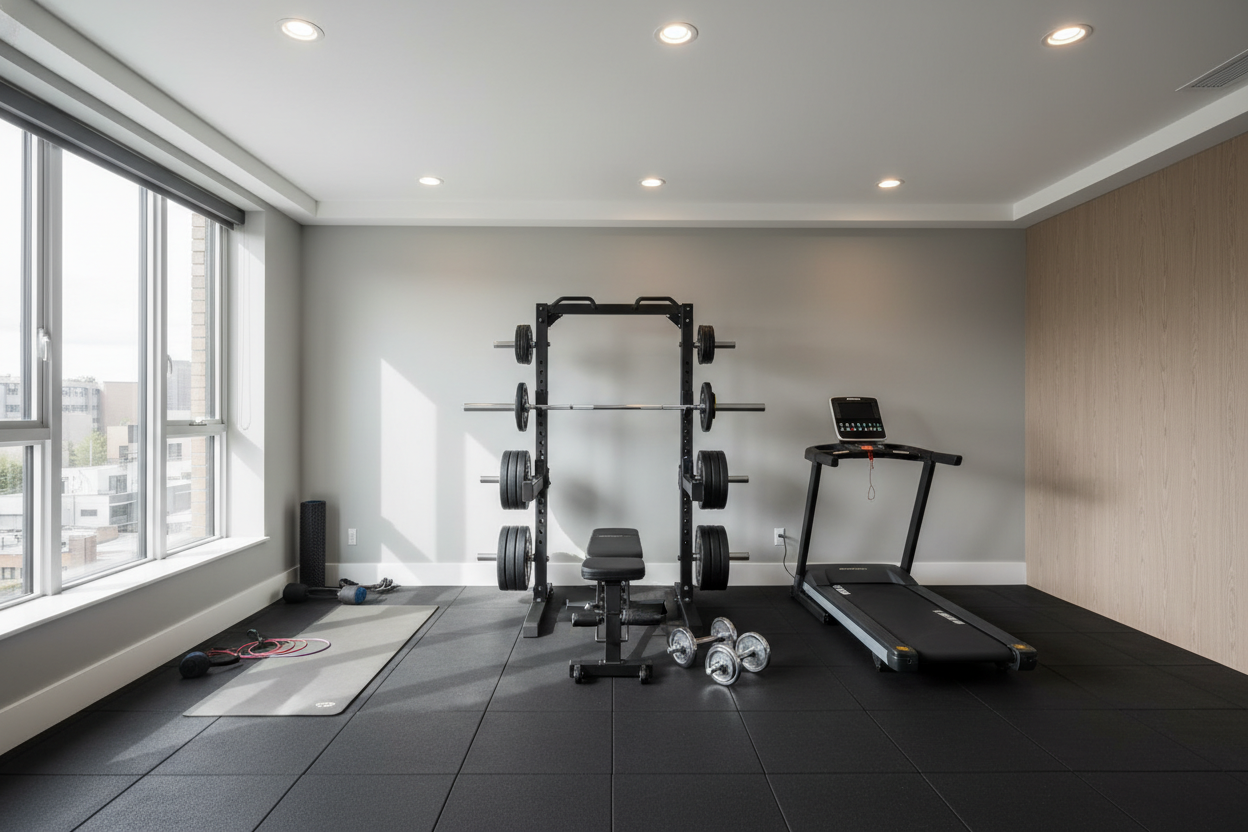
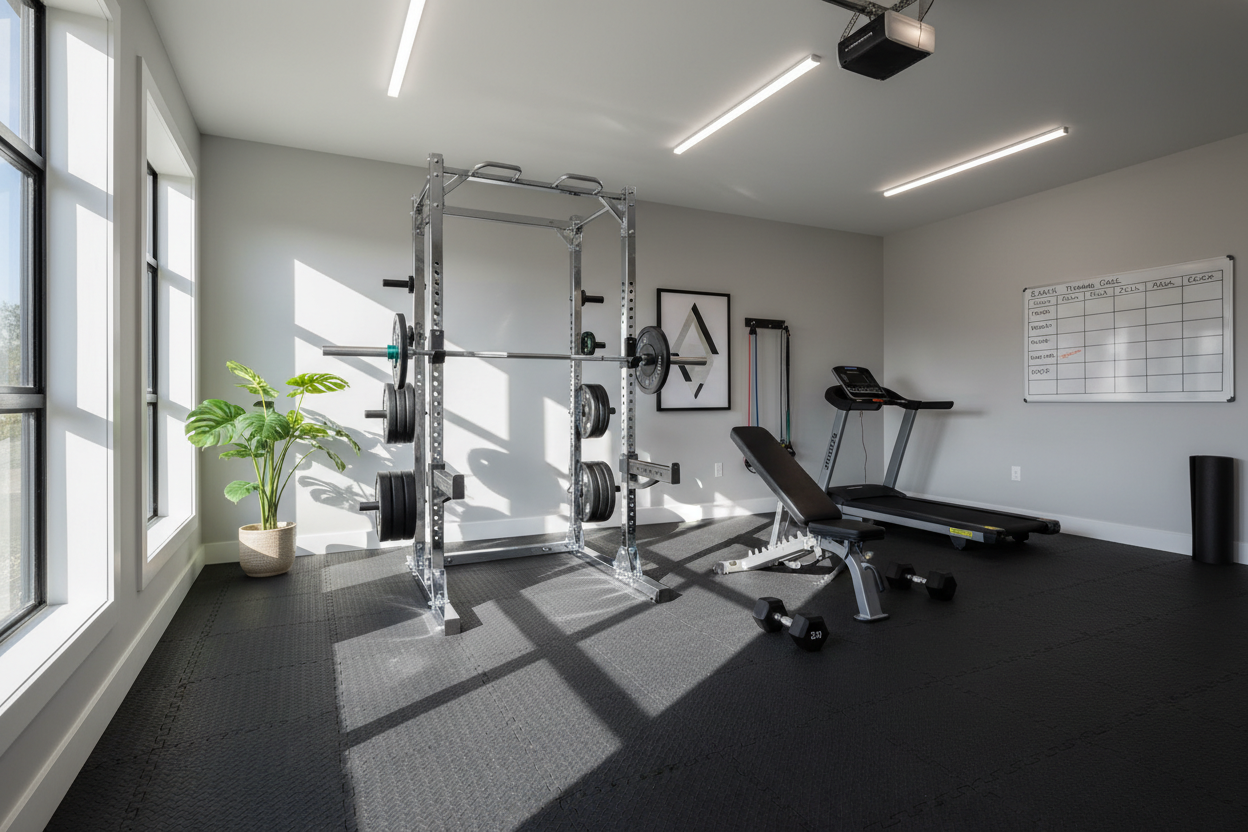
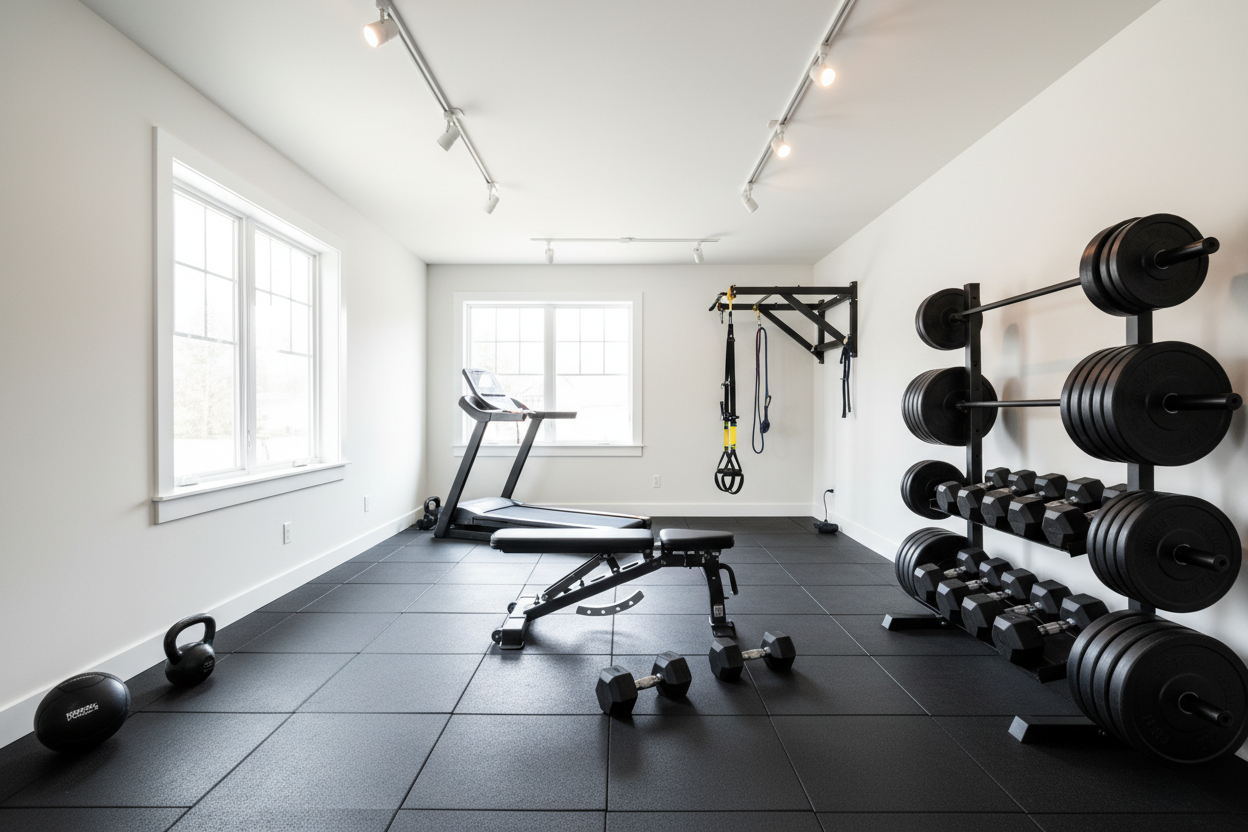
I learned this the hard way when I tried a heavy slam on bare concrete and the ball's slight vibration combined with a dusty floor caused my lead foot to slip. I nearly did the splits with a 30-lb ball in my hand. Now, I don't do any dynamic work without a durable 6x8ft gym flooring mat. It provides the grip you need for bear crawls and protects your subfloor (and your equipment) from the impact of heavy sandbags and slam balls. Plus, it defines your 'work zone,' which helps with the mental shift from 'standing in a garage' to 'training in a gym.'
Personal Experience: The Sandbag Incident
The first time I tried weighted bear crawls, I didn't have a vest. I thought I was clever and just balanced a 45-lb iron plate on my back. About five yards in, my form buckled, the plate slid forward, and it clipped the back of my heel before slamming into my concrete floor. Not only did I ruin a perfectly good pair of shoes, but I also realized that 'fun' exercises require the right gear to stay safe. I switched to a sandbag for the crawls—it molds to your back and won't kill you if it falls. Sometimes the 'fun' way has a learning curve, but it's always worth the effort to figure it out.
FAQ
Do fun upper body exercises build as much muscle as the bench press?
They build muscle differently. While a bench press is king for chest hypertrophy through heavy loading, dynamic moves like sandbag tosses and KB presses build 'thick' functional mass in the traps, shoulders, and forearms that static lifts often miss.
How heavy should my slam ball be?
For most men, a 20-lb or 30-lb ball is the sweet spot. It needs to be heavy enough to require effort but light enough that you can maintain high velocity. If you're moving slow, it's not a slam; it's just a squat with a ball.
Can I do these exercises in a small 6x8 space?
Absolutely. That’s the beauty of these movements. A bear crawl might require you to do laps, but slams, tosses, and presses can all be done within a standard 6x8 mat footprint. It's much more space-efficient than a massive cable crossover machine.