How to Train Legs at Home When Everything Feels Too Light
I remember the first time I tried to train legs at home during a snowstorm. I did 100 air squats, felt a mild burn, and then realized I had just wasted twenty minutes of my life. My legs didn't get bigger; I just got better at being bored. If you want to know how to build thigh muscle at home, you have to stop treating your leg day like a cardio session.
The reality is that your quads and hamstrings are incredibly strong. To make them grow, you need mechanical tension, not just 'the burn.' When you don't have a 500-lb rack of plates, you have to get creative with physics. You need to stop asking how to workout the legs and start asking how to make 20 pounds feel like 100.
- Prioritize Unilateral Work: Splitting the load between legs instantly doubles the resistance.
- Master the Tempo: 3-second eccentrics will expose weaknesses you didn't know you had.
- Increase Range of Motion: Use deficits to make bodyweight movements significantly harder.
- Focus on Stability: You cannot produce force if you are wobbling on a slippery floor.
The 'Endless Reps' Trap of Bodyweight Leg Days
Most people trying to figure out how to get leg muscle at home fall into the trap of doing sets of 50 or 100 reps. While high-rep work has a place in metabolic conditioning, it is a terrible way to build leg muscle at home for an experienced lifter. Once you can do more than 20-25 reps of an exercise, you are training endurance, not hypertrophy.
To build thigh muscles at home, you need to keep your sets in the 8-15 rep range. If you can do more than that, the exercise is too easy. You don't need more reps; you need a harder variation. This is the fundamental shift required for anyone wondering how to build legs at home without a commercial leg press. You have to embrace the movements that make you want to quit by rep ten.
Why Bilateral Exercises Are Failing You
Standard squats and lunges are great, but when you are limited on weight, bilateral movements (using both legs at once) simply don't provide enough stimulus. When you're trying to figure out how to build leg muscle at home, you have to prioritize mechanical tension over metabolic stress. By shifting to unilateral (single-leg) training, you effectively double the weight your working muscle has to move.
Think about the physics: If you weigh 200 lbs and do a standard squat, each leg handles roughly 100 lbs. If you do a true single-leg squat, that one leg is now handling the full 200 lbs. This is how to get stronger legs at home without buying a $3,000 power rack. It’s about manipulating leverage to force the muscle to adapt. This is how to strengthen your legs at home while keeping your equipment footprint small.
The Three Non-Negotiable Home Leg Builders
If you want to know how to train your legs effectively, you only need three primary movement patterns. You don't need a dozen different machines. You need a knee-dominant push, a hip-dominant pull, and a lunging variation that maximizes range of motion. These are the best exercises to build leg muscle at home because they allow for the most significant loading and the greatest stretch on the muscle fibers.
Rear-Foot Elevated Split Squats (The Heavy Hitter)
The Bulgarian Split Squat is the king of at-home training. By elevating your back foot on a chair or couch, you put about 80-90% of the load on your front leg. This is why at home leg strengthening exercises like the split squat are universal staples for anyone serious about growth. If you want to target the quads to build thigh muscles at home, keep your torso upright. If you want to hit the glutes, lean your torso forward at a 45-degree angle.
Slider Leg Curls (The Hamstring Fix)
Hamstrings are the hardest part of the leg to train without a machine. Most people just do hinges, but you need knee flexion. Get a pair of furniture sliders or even just use a towel on a hardwood floor. Lie on your back, hips up, and curl your heels toward your glutes. This is how to grow your legs at home by targeting the posterior chain in a way that feels almost identical to a lying leg curl machine. It is brutal, effective, and requires zero iron.
Deficit Reverse Lunges (Maximized Range of Motion)
To understand how to increase leg muscle at home, you have to understand the 'stretch-mediated hypertrophy' concept. By standing on a 2-4 inch platform (like a thick book or a sturdy block) and stepping back into a lunge, you allow your front knee to go into a deeper range of motion. This extra inch or two of travel puts a massive stretch on the quad and glute, making bodyweight or light dumbbells feel incredibly heavy. This is a staple for how to make your legs stronger at home without needing a 100-lb dumbbell set.
Setting Up Your Space for Heavy Unilateral Training
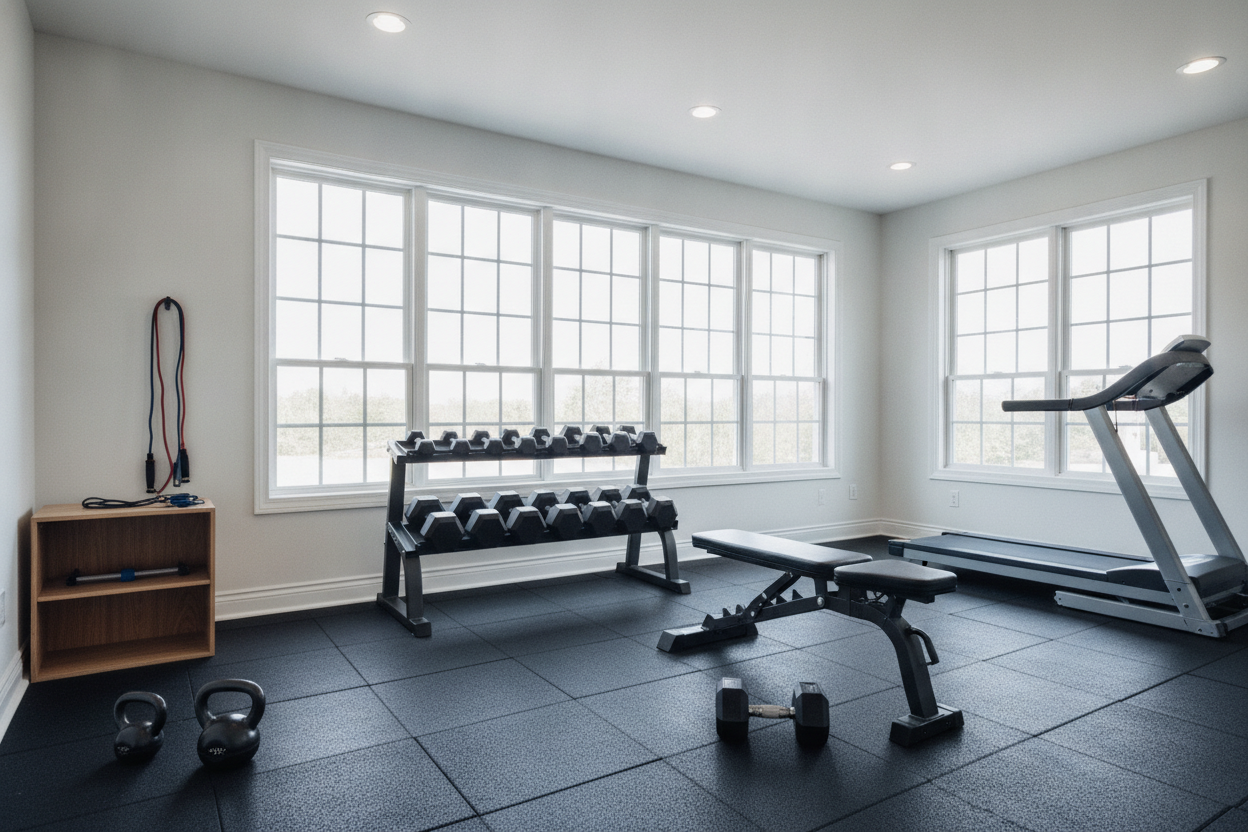
Stability is the hidden key to how to build strong legs at home. If your front foot is sliding or you're worried about your back foot slipping off a chair, your brain will 'gate' your strength to keep you from getting injured. You need a high-traction surface. I suggest a dense 6x8 exercise mat that won't bunch up when you drive your heel down. A squishy yoga mat is your enemy here; you want something firm that mimics a commercial gym floor.
If you're converting a spare bedroom, browsing a large exercise mat collection is the first step to saving your carpet and your ankles. Once you have a stable base, you can focus entirely on the muscle contraction rather than trying to balance like a tightrope walker. This is how to build leg strength at home safely and effectively.
Putting It Together: The 4-Week Progression
Knowing how to do leg exercises at home is only half the battle; you need a plan. For the next four weeks, stop doing random leg home exercises to build muscle and follow this structure twice a week:
- A1: Rear-Foot Elevated Split Squats: 3 sets of 8-12 reps. Use a 3-second descent.
- B1: Deficit Reverse Lunges: 3 sets of 10-15 reps. No rest between legs.
- C1: Slider Leg Curls: 3 sets to failure. Focus on a slow 5-second eccentric.
Progress by adding one rep to each set every week. Once you hit the top of the rep range, add a backpack with some books or hold a gallon of water. This is how to build muscle in your legs at home systematically. Don't chase the pump; chase the progression. That is how to build your leg muscles at home for the long term.
Personal Experience: The Office Chair Incident
Early in my training career, I tried to do Bulgarian split squats using a rolling office chair as my rear-foot elevator. It was a disaster. About three reps in, the chair rolled backward, I did an accidental split, and nearly went through the drywall. The lesson? Stability is non-negotiable. Use a couch, a bed, or a dedicated bench. If you're wondering how to build muscle in legs at home, start by ensuring your environment doesn't try to kill you.
FAQ
How do I build thigh muscle at home without weights?
Focus on unilateral movements and tempo. A slow, 3-5 second eccentric (lowering) phase increases time under tension, which is the primary driver for how to build leg muscle at home when you lack heavy resistance.
Can I get big legs with just bodyweight?
Yes, but you have to move toward advanced variations like pistol squats, shrimp squats, and high-volume deficit lunges. Eventually, you will need to add some form of external load, even if it's just a weighted vest or a heavy backpack, to continue how to gain leg muscle at home.
How often should I do a leg workout at home to build muscle?
For most people, twice a week is the sweet spot. This allows for enough volume to trigger growth while giving your central nervous system time to recover from the high-intensity unilateral work required for how to strengthen leg muscles at home.