How to Survive Glute Day With a Modified Hip Thrust Setup
I spent twenty minutes yesterday just hunting for my barbell collars and another ten loading plates for one set of heavy thrusts. By the time I was actually ready to lift, my pre-workout was wearing off and I was already eyeing the door. If you are training in a 10x10 garage or a spare bedroom, the modified hip thrust isn't just a backup plan—it's a survival strategy.
You don't need a massive commercial leg machine taking up half your floor space to build real posterior chain strength. Sometimes, the most effective workouts happen when you stop trying to mimic a powerlifting meet and start focusing on the actual muscle contraction. I've built more glute density with a single heavy dumbbell and some grit than I ever did with a cumbersome barbell setup that took more energy to build than to lift.
- Barbell setups are momentum killers in small home gyms.
- Dumbbells and bands provide more constant tension for many lifters.
- Single-leg variations cut your weight requirements in half while doubling the intensity.
- Progression doesn't always require adding more plates to the bar.
Why I Stopped Fighting the Heavy Barbell Setup
Loading a 300-pound barbell in a cramped garage is a nightmare. You're constantly bumping the ends of the bar against your squat rack or your lawnmower. It is a total momentum killer. I found that by the time I finished the setup, I was mentally checked out. Pivoting to a modified setup isn't quitting; it's being efficient with your limited training time.
Whether you're training in a home gym or trying to figure out how to work out without a hip thrust machine in a crowded commercial spot, the goal remains the same: mechanical tension. You can get that same stimulus with a 50-pound dumbbell and the right intent. I've actually found my glute isolation improved once I ditched the ego-lifting barbell and focused on the squeeze at the top rather than just moving the weight from point A to point B.
3 Hip Thrust Modifications That Actually Build Muscle
You don't need a $500 dedicated unit to get the job done. These three variations cover the bases of heavy loading, peak tension, and maximum range of motion using gear you likely already own in your rack or closet.
The Heavy Dumbbell Floor Bridge
If you hate the bench sliding across the floor dance, just get on the ground. The floor bridge limits the range of motion slightly, but it forces a brutal posterior pelvic tilt. I usually grab my heaviest 80-lb hex dumbbell and place it right in the hip crease. To do a dumbbell hip thrust without crushing your pelvis, I highly recommend using a folded yoga mat or a thick squat pad between you and the handle. Focus on driving your lower back into the floor at the bottom and screaming through the glutes at the top. It is simple, effective, and requires zero setup time.
The Band-Resisted Couch Setup
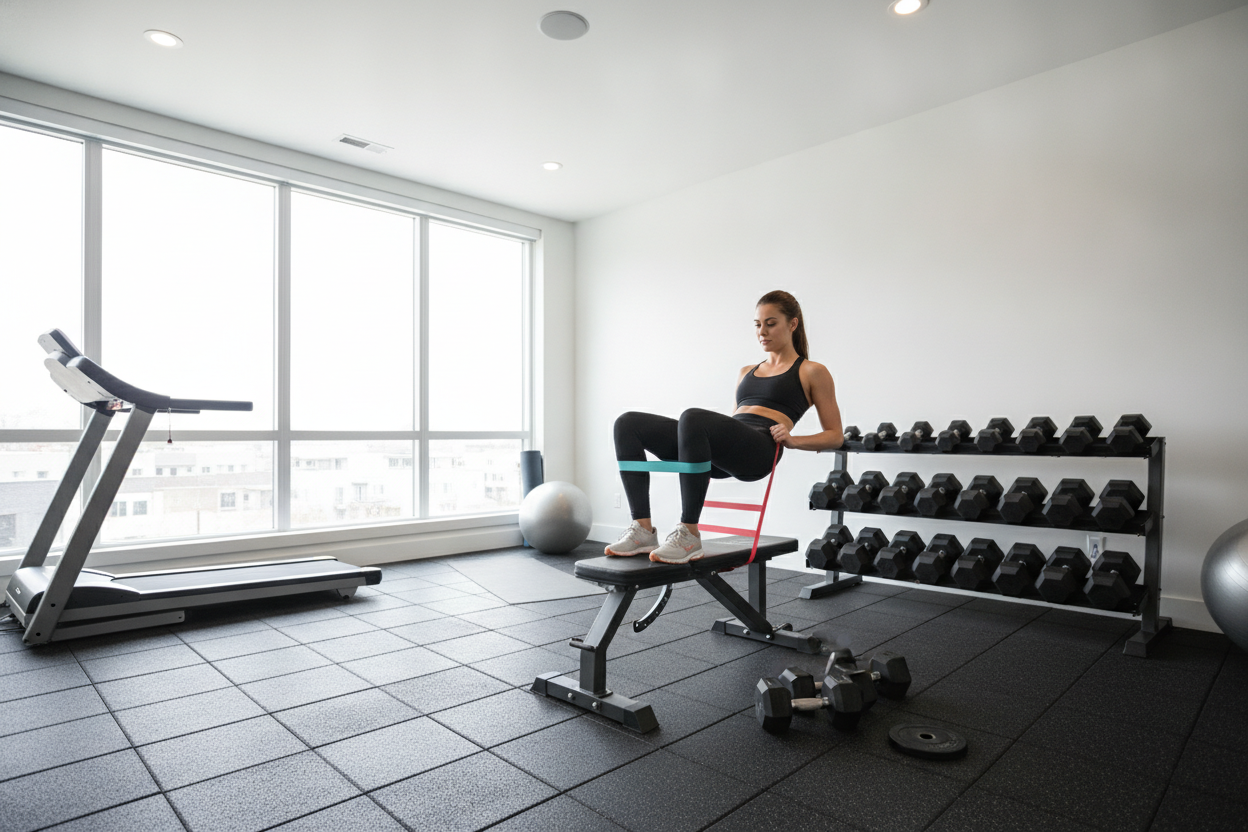
Resistance bands are the most underrated tool for glutes because the tension is highest at the peak contraction—exactly where you want it. I anchor a heavy 100-lb loop band under a pair of heavy dumbbells on the floor and loop it over my hips while leaning against my living room couch. If you find the couch is too squishy and it is ruining your form, upgrading to a dedicated Gxmmat Hip Thrust Bench is the move. It is grippy, stable, and won't slide when you are pushing max effort, plus it stores easily in a corner.
The Single-Leg Deficit Thrust
When you are limited on weight, you have to get creative with mechanics. By placing your working foot on a 45-lb bumper plate or a small step, you increase the distance your hips have to travel. This extra range of motion makes a 25-lb dumbbell feel like a 100-lb barbell. I tried these for the first time when I was traveling and only had access to a hotel gym with 20-lb max weights. My glutes were sore for three days. It turns out that a deep stretch is a better growth stimulus than a heavy, short-range ego lift anyway.
How to Progress When You Run Out of Weight
Eventually, you'll outgrow your heaviest dumbbell. Instead of buying more iron, change the tempo. I am a huge fan of 3-second negatives and 2-second pauses at the top. If you can do 15 reps with a 50-lb dumbbell, try doing 1.5 reps—go all the way up, halfway down, back up, then all the way down. That’s one rep. It is a total burn that makes light weights feel incredibly heavy.
I once made the mistake of thinking I needed a full powerlifting setup to keep my gains. I spent $400 on a specialty bar I barely use now because these modifications are just faster to set up and just as effective for hypertrophy. I've realized that the best equipment is the stuff that actually gets used. If the barbell is so annoying to set up that you skip glute day, the barbell is the problem, not your lack of strength. Focus on the mind-muscle connection, keep your chin tucked, and stop worrying about the number on the side of the weight.
FAQ
Can I use a kettlebell instead of a dumbbell?
You can, but it is awkward. The center of gravity on a kettlebell is higher, meaning it wants to roll toward your stomach or your legs. Stick to dumbbells or bands if you have the choice for better stability.
How do I stop my bench from sliding?
Put it against a wall or a heavy power rack. If that is not an option, place a couple of heavy sandbags or plates behind the feet of the bench. Or just use a dedicated thrust bench designed with a non-slip base.
Are modified thrusts as good as the barbell version?
For pure strength (1-rep max), no. For building a better-looking backside and improving hip stability? Absolutely. Most people actually get better glute activation with moderate-weight modifications than they do struggling under a heavy bar that they can barely balance.