How to Structure Exercise at Home Gym Spaces
I've seen it a hundred times. A client clears a 10x10 space in their living room, buys a pair of 5-52.5 lb adjustable dumbbells, and expects to instantly transform into a focused athlete the second they step off the couch. But three weeks later, they are sitting on a bench scrolling through their phone, completely derailed by the sight of their TV or a pile of laundry.
Executing exercise at home gym spaces requires more than just buying equipment; it requires a psychological shift. When you try to execute a rigorous gym home exercise routine in the exact same spot where you eat takeout and watch Netflix, your brain gets confused. The solution isn't more discipline. It is spatial zoning.
Quick Takeaways
- Physical boundaries create mental boundaries: strictly separate your lifting zone from your relaxation zone.
- Lighting and audio cues can increase your heart rate and shift your mindset before you even touch a weight.
- A dedicated mobility station prevents you from skipping crucial warm-ups and cool-downs.
- Proper flooring dictates the layout and protects your subfloor from heavy deadlift drops.
The Psychology of Space: Why Your Living Room Kills Your Drive
Environmental cueing is a psychological concept that dictates how our brains react to physical spaces. Think about it: when you walk into a commercial facility, the smell of rubber, the clanking of iron, and the sight of heavy racks instantly tell your nervous system it is time to work. But at home? Your living room screams relaxation. This is exactly Why Exercise in a Gym Feels Different.
If you try to hit a heavy set of squats two feet away from your favorite recliner, your brain will naturally down-regulate your central nervous system. You will feel sluggish, unmotivated, and easily distracted. To fix this, we need to artificially manufacture those environmental cues. You cannot rely on sheer willpower to transition from home mode to training mode.
When I design spaces for my clients, the first rule is establishing a hard boundary. Even if you only have a 150-square-foot spare bedroom, we draw an invisible line. Once you cross that line, you are no longer at home. You are in the facility. This mental separation is the secret to maintaining high intensity during your gym home workouts. Without it, you will constantly fight the urge to cut your sessions short.
Establishing Your Primary Lifting Zone
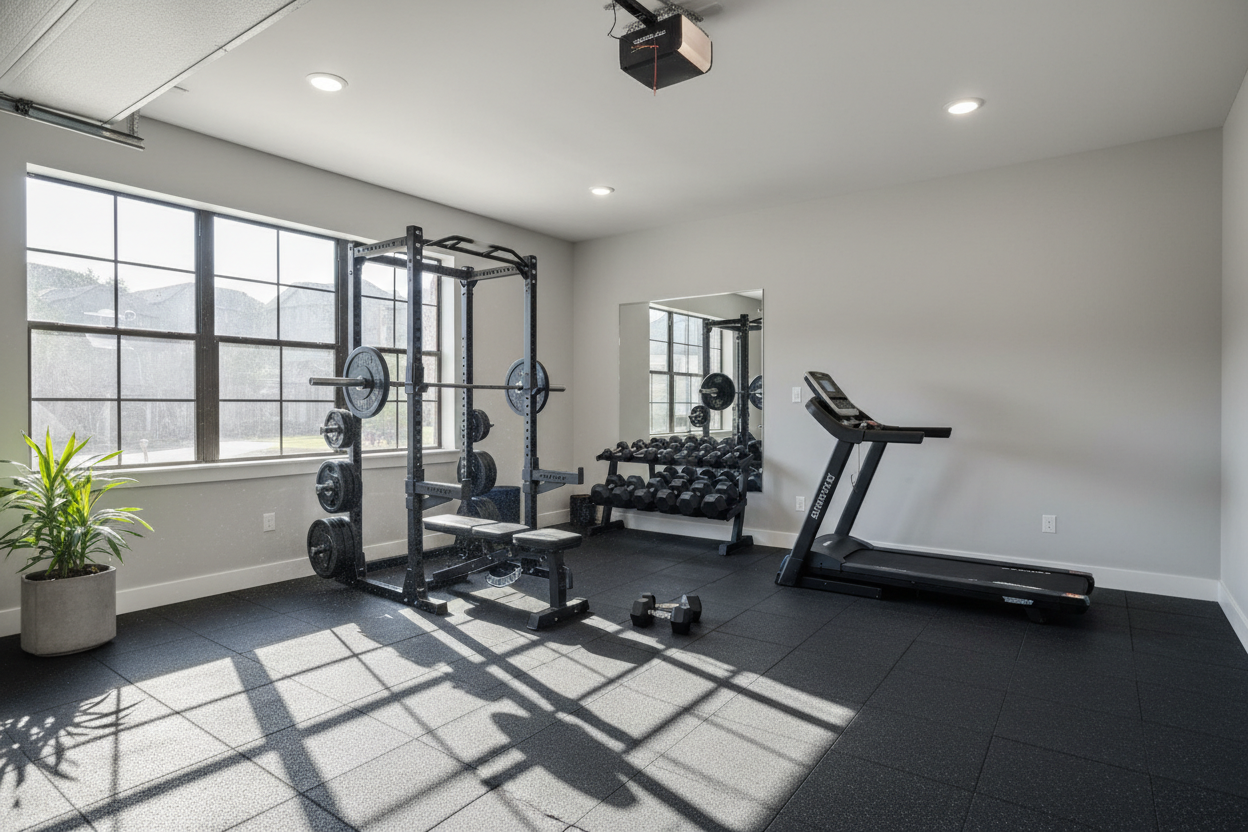
The core of your setup is the primary lifting zone. This is where the heavy, high-intensity work happens. Think barbell squats, heavy dumbbell presses, and explosive kettlebell swings. Because this area handles the most abuse, it needs a distinct physical footprint. I always start by laying down a high-density 6x8ft exercise mat.
This specific dimension is large enough to accommodate a standard power rack, which usually takes up about 4x4 feet, while leaving enough runway for deadlifts or walking lunges. More importantly, a heavy-duty mat acts as the visual anchor for your primary zone. When your feet step onto that 7mm thick high-density foam, the tactile feedback tells your brain it is time to lift.
For the equipment, keep it strictly to the essentials. A flat-to-incline bench, a set of adjustable dumbbells ranging from 5 to 80 lbs, and perhaps a half-rack. Do not clutter this zone with resistance bands, foam rollers, or yoga blocks. If you are doing a heavy gym workout in home, you need zero trip hazards.
When I built my own garage setup, I made the mistake of leaving my jump rope and mobility tools scattered around the rack. Mid-set on a 315-lb squat, I had to awkwardly step around a foam roller to rack the weight. It was dangerous and broke my focus. Now, my primary lifting zone is completely sterile. Only the iron, the bench, and the heavy flooring exist in this square footage.
Creating the Mobility and Active Recovery Station
One of the biggest mistakes I see trainees make is ignoring their warm-up because they don't have a comfortable place to do it. If your only floor space is the hard concrete next to your squat rack, you are going to skip your 90/90 hip stretches and shoulder dislocates. That is why you need a secondary, smaller zone strictly dedicated to mobility, core work, and active recovery.
I recommend setting up a 6x4ft yoga mat in a corner adjacent to your primary lifting zone. This creates a softer, more inviting area for floor work. This station should house your foam rollers, lacrosse balls, light resistance bands, and ab wheel. By corralling these smaller items into a designated recovery zone, you keep your heavy lifting area clean while ensuring your warm-up tools are instantly accessible.
Having this structured flow is vital for successful at home gym workouts. You start your session in the mobility station, priming your joints and raising your core temperature. Once you are sweating and prepped, you physically step off the smaller mat and walk over to the primary lifting zone. This physical transition mimics the experience of walking from the stretching turf at a commercial facility over to the free weight area.
Sensory Triggers for Better Gym Home Workouts
Spatial zoning isn't just about where you put your equipment; it is also about how the space feels. You can have the best power rack in the world, but if you are lifting under warm, dim, relaxing living room lights, your energy will tank. You need sensory triggers to tell your nervous system that it is time to work.
First, address the lighting. Swap out warm bulbs (2700K) for daylight bulbs (5000K or higher) in your training area. Bright, cool light suppresses melatonin and increases alertness. If you train in a garage, open the door or install bright LED shop lights. Second, manipulate the temperature. A room that is 72 degrees feels great for watching TV, but it is too warm for a high-intensity session.
If possible, drop the thermostat to 65 degrees or set up a high-velocity floor fan pointing directly at your primary lifting zone. The blast of cool air will wake you up and help regulate your core temperature during heavy sets. Finally, use audio cues to build a wall between your home life and your training time. Put on over-ear headphones and play a specific, high-tempo playlist that you only listen to when you lift.
Flowing Through Your At Home Gym Workouts
Let's put this all together into a practical session. Imagine it is 6:00 AM. You walk into your spare room. You don't just wander around aimlessly. You immediately head to your 6x4ft mobility station. You spend eight minutes doing dynamic stretches and glute activation work. Your heart rate is up, and your joints are lubricated.
Next, you step off the mobility mat and walk over to your primary lifting zone. Because you invested in a large exercise mat for home gym use, your heavy zone is clearly defined. You load up your adjustable dumbbells for goblet squats. You hit your working sets, and during your 90-second rest periods, you stay inside the perimeter of that large mat. You do not walk into the kitchen. You do not sit on the couch.
Once the heavy lifting is done, you transition back to the mobility station for some light core work and static stretching. By treating these zones as distinct physical locations, you maintain momentum. You avoid the mid-workout trap of checking the fridge or folding a towel you saw on the floor.
My Experience Testing Space Layouts
When I first started training clients in their homes, I noticed a massive drop-off in their performance compared to our commercial gym sessions. I tested this on myself by moving my 50-lb adjustable dumbbells into my living room. The result? My rest periods doubled, and I cut my sets short. The honest downside to training at home is the overwhelming comfort of your surroundings. It wasn't until I taped off a specific 8x8 section in my garage and added rigid, high-density foam flooring that my intensity returned. The tactile feel of the floor was the trigger I needed.
Frequently Asked Questions
How much space do I actually need for a primary lifting zone?
For most free-weight routines utilizing dumbbells and a bench, a 6x6 foot area is the absolute minimum. If you plan to use a barbell and a power rack, you will need at least an 8x8 foot space to safely load the bar and step back for squats.
Can I combine my lifting and mobility zones if my room is tiny?
Yes, if space is incredibly tight, you can use one large mat. However, you should still mentally zone the space. Store your heavy weights on one side and your foam rollers on the other, and physically face different directions for different parts of your workout.
Do I really need specialized lighting for my garage gym?
While not strictly mandatory, swapping standard warm bulbs for 5000K daylight LEDs is one of the cheapest and most effective ways to boost your energy levels. Dim, warm lighting signals your brain to produce melatonin, which is the exact opposite of what you want before a heavy set of deadlifts.
Conclusion: Respecting Your Training Environment
Building a functional training space is about more than just buying heavy iron. It requires intention. If you treat your spare room or garage like a dumping ground for laundry and old boxes, your workouts will reflect that chaotic, lazy energy. But if you respect your space, it will respect your efforts.
By implementing spatial zoning, you command your environment instead of letting it command you. Establish your heavy lifting zone, carve out a dedicated mobility station, and use sensory triggers to flip the switch in your brain. When you treat your setup with the same reverence as a high-end commercial facility, your consistency will skyrocket. Lock in your zones, protect your focus, and start getting the results you actually deserve.