How to Sculpt the Teardrop With Targeted Exercises for Lower Thighs
You have likely stared at the mirror and noticed a lack of definition just above your knee. It is a common frustration. You do heavy squats and lunges, yet that specific area remains stubborn. The truth is, most standard leg movements distribute the load across the entire quadriceps or the hips, often bypassing the specific muscle fibers you are trying to target.
To fix this, we need to shift our focus to the Vastus Medialis Oblique (VMO), often called the "teardrop" muscle. This guide covers the biomechanics and the specific exercises for lower thighs necessary to develop that aesthetic sweep and bulletproof your knees against injury.
Key Takeaways for VMO Development
- Target the VMO: The "lower thigh" is anatomically the Vastus Medialis; training it requires maximizing knee flexion.
- Heels Up: Elevating your heels during squats shifts bias from the glutes to the lower quads.
- Terminal Knee Extension: Full lockout is crucial for activating the muscle fibers closest to the knee joint.
- Volume Over Load: The VMO often responds better to higher repetition ranges and constant tension than heavy singles.
Understanding the Anatomy: The "Teardrop" Muscle
Before grabbing weights, you need to understand the machinery. There is no isolated muscle called the "lower thigh." What you are actually looking to build is the distal end of the quadriceps, specifically the Vastus Medialis.
This muscle is responsible for the final degrees of knee extension and stabilizing the kneecap (patella). If your knees cave inward during a squat, or if you lack definition above the joint, your VMO is likely underactive. Training this area isn't just about aesthetics; it is the single best insurance policy for long-term knee health.
The Best Lower Thigh Workout Protocol
To hit this area, we must prioritize movements that drive the knee over the toe or force a hard contraction at full extension.
1. The Poliquin Step-Up (Peterson Step-Up)
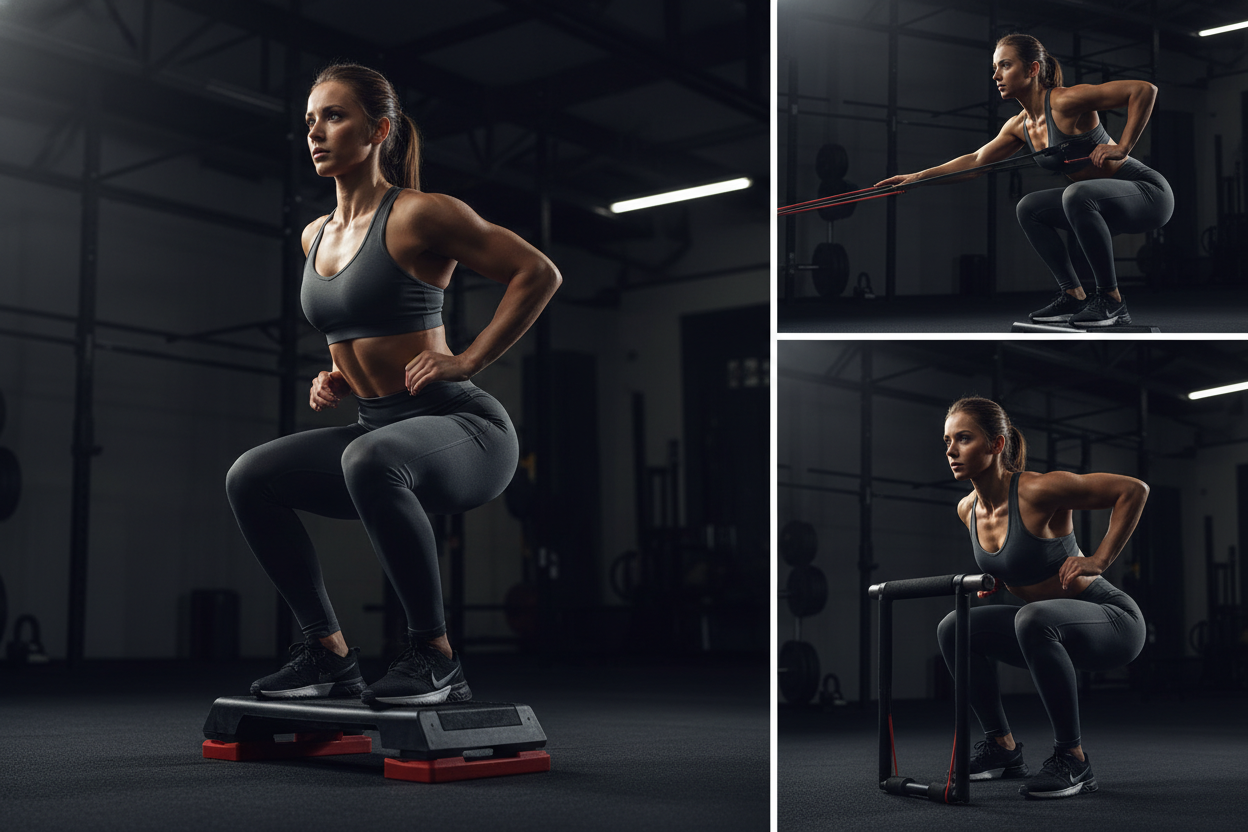
This is arguably the most effective isolation movement for the VMO. Unlike a standard step-up, you start with the working leg elevated on a low box (or bumper plate) and the non-working heel touching the floor.
The Technique: Drive the working knee forward over the toe while keeping the heel flat on the box. The goal is to lower the other foot to the floor under control, then drive back up. This places immense tension directly on the lower quad structure.
2. Heel-Elevated "Cyclist" Squats
By elevating your heels significantly (using a wedge or plates) and keeping a narrow stance, you remove the hips from the equation. This forces the knees to travel far forward.
Why it works: This position maximizes knee flexion. The deeper the knee bend while keeping the torso upright, the more the load shifts to the lower thigh. Keep the weight lighter here; the leverage is disadvantageous, which is exactly what we want for hypertrophy.
3. Terminal Knee Extensions (TKEs)
This is a finisher, not a mass builder, but it is essential for activation. You attach a resistance band to a rack and loop it behind your knee.
The Focus: Let the band pull your knee into a bent position, then drive your heel down and flex the quad hard to straighten the leg against the resistance. That final "squeeze" is pure VMO activation.
Common Mistakes to Avoid
The biggest error people make when attempting exercises for lower thighs is ego lifting. If you load up the bar and turn a Cyclist Squat into a "Good Morning" (bending at the waist), you immediately shift the tension back to your glutes and lower back.
Another mistake is stopping short of full range of motion. The VMO is most active at the very bottom of a squat and the very top of an extension. If you work only in the middle range, you will never develop the teardrop.
My Training Log: Real Talk
I want to be transparent about the reality of training the VMO because it feels very different from a standard leg day.
The first time I committed to a dedicated lower thigh cycle, I started with the Poliquin Step-Ups. I remember feeling a distinct, almost stinging burn on the inside of my knee cap—not inside the joint, but the muscle right next to it. It wasn't the deep, breathless fatigue of a heavy back squat; it was a localized, acidic burn that made my leg shake uncontrollably.
I also learned the hard way about shoe choice during Cyclist Squats. I tried doing them in cushioned running shoes, and the instability was a nightmare. The moment I switched to a flat-soled shoe (and eventually just socks) on the slant board, the connection to the muscle instantly improved. If you don't feel stable, your body won't let you contract the muscle fully.
Conclusion
Building the lower thigh requires patience and a willingness to drop the heavy weights in favor of better mechanics. By focusing on knee-over-toe movements and terminal extension, you will carve out that teardrop definition and build knees that can handle athletic abuse. Start with the step-ups and TKEs, be consistent, and the results will follow.
Frequently Asked Questions
Can I spot-reduce fat from my lower thighs?
No. While these exercises will build the muscle underneath, revealing the definition requires a low enough body fat percentage. You cannot burn fat specifically from the knee area, but building the VMO will improve the visual shape of the leg.
How often should I train my VMO?
The VMO is a postural muscle with high endurance capabilities. It recovers relatively quickly. You can train these movements 2 to 3 times per week, ideally at the start of your leg workout as a warm-up or at the very end as a finisher.
Are knees-over-toes exercises dangerous?
Generally, no. The old myth that your knees shouldn't pass your toes has been debunked. However, you must scale the load. If you have existing knee pain, start with bodyweight and partial range of motion before progressing to loaded deep squats.