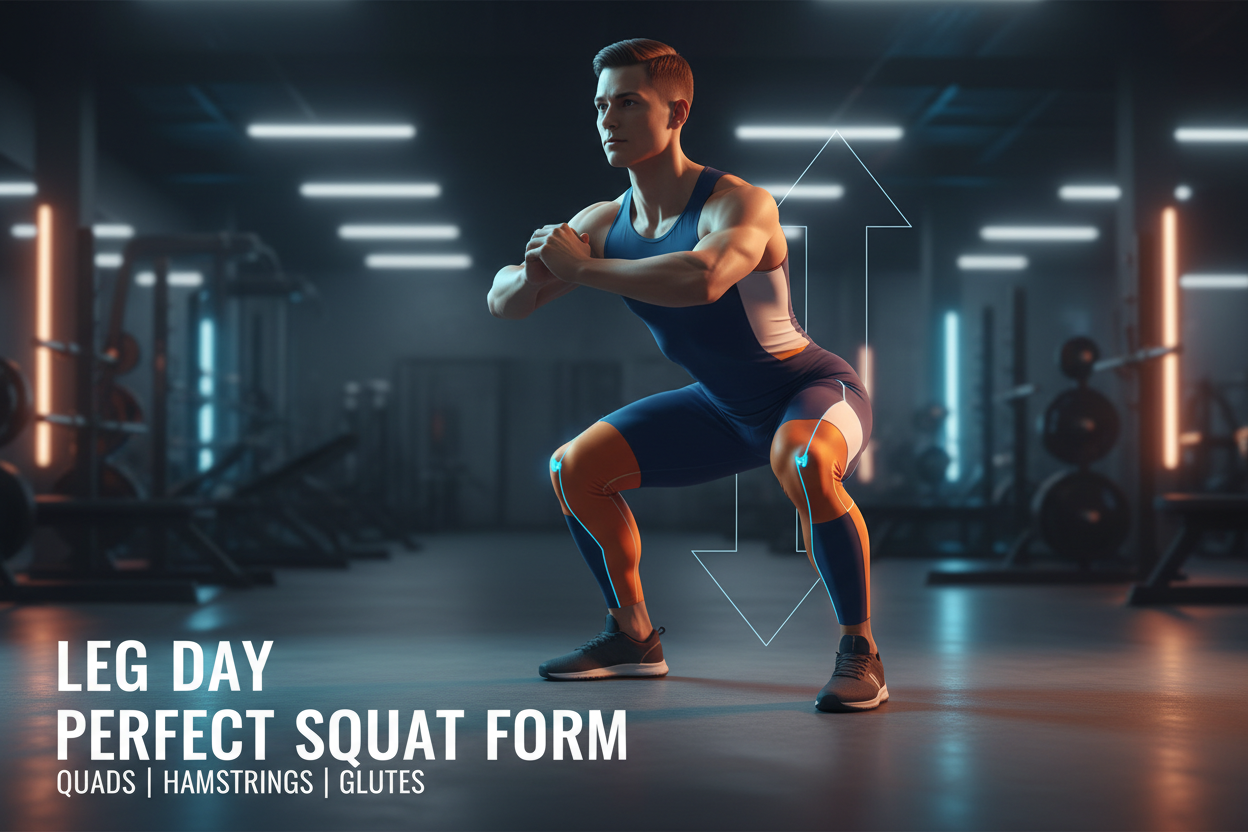
How to Master the Perfect Squat Workout for Total Leg Growth
You can’t cheat gravity, and you certainly can’t fake a heavy squat. It is the king of exercises for a reason. While machines and isolation movements have their place, a proper squat workout triggers a systemic hormonal response that drives growth across your entire body, not just your legs.
But most people in the gym are leaving gains on the table—or worse, inviting injury—due to poor mechanics and lackluster programming. If you want tree-trunk quads and a bulletproof core, you need to stop treating the squat like just another leg exercise and start respecting it as a skill.
Key Takeaways
- Mechanics First: Prioritize hip mobility and ankle stability before loading heavy weight to prevent injury.
- The Brace: Learning the Valsalva maneuver (breathing technique) is non-negotiable for spine safety.
- Depth Matters: Hitting parallel ensures full muscle activation, specifically in the glutes and hamstrings.
- Frequency: For most lifters, squatting 2-3 times a week offers the best balance of volume and recovery.
- Variation: Rotate between back squats, front squats, and goblet squats to address different weak points.
The Biomechanics of a Strong Squat
To get the most out of your workout for squats, you need to understand what is happening under the hood. It isn't just about bending your knees.
The Setup and Stance
Your foot position depends on your hip anatomy. There is no universal "perfect stance." Start slightly wider than shoulder-width with your toes pointed out about 15 to 30 degrees. This opens up the hips and allows the femur to track properly in the socket.
Before you even descend, create tension. Screw your feet into the floor as if you are trying to spread the ground apart. This engages the glutes immediately and creates a stable base.
The Descent and The Hole
Don't just drop. Pull yourself down. Think about actively engaging your hip flexors to pull your torso between your legs. This maintains tension throughout the eccentric (lowering) phase.
When you reach the bottom—often called "the hole"—you shouldn't lose tightness. If you bounce off your joints, you risk injury. Instead, rely on the stretch reflex of your muscles to drive back up.
Programming Your Squat Training
Randomly throwing weight on the bar isn't a strategy. Effective squat training requires progressive overload and sensible volume management.
If your goal is hypertrophy (muscle growth), aim for 3 to 4 sets of 8–12 reps. This range keeps the muscles under tension long enough to stimulate growth without frying your central nervous system.
For strength, drop the reps to the 3–5 range and increase the intensity. However, never sacrifice form for weight. A ugly rep doesn't count; it just adds wear and tear.
Common Mistakes That Kill Progress
The "Good Morning" Squat
If your hips shoot up faster than your chest coming out of the hole, you turn the movement into a lower-back lift. This usually happens because your quads are weak or your bracing failed. Focus on driving your upper back into the bar as you ascend.
Knee Valgus (Caving In)
When the knees collapse inward, you lose torque and risk ligament damage. This often stems from weak glutes or poor foot pressure. Cue yourself to "push your knees out" constantly during the lift.
My Training Log: Real Talk
I’ve spent over a decade under the bar, and I can tell you that the textbooks leave out the gritty details. I remember specifically when I finally broke through my 315lb plateau. It wasn't pretty.
The thing nobody mentions is the specific, almost claustrophobic pressure you feel in your head when you brace correctly for a max effort. It feels like your eyes might pop out. I also vividly remember the feeling of the center knurling on a cheap commercial gym bar—it wasn't just rough; it scraped a raw patch of skin right on my C7 vertebrae that stung every time I showered for a week.
But the biggest reality check? The "wobble" during the walkout. When you have a true max on your back, those two steps back feel like walking on a tightrope during an earthquake. If you don't respect that walkout, the set is over before you even bend your knees.
Conclusion
Building a massive squat takes time, patience, and a willingness to grind through uncomfortable sessions. Focus on your bracing, respect the mechanics, and don't let your ego dictate the weight on the bar. Consistency in your technique will always outperform intensity in the long run.
Frequently Asked Questions
How deep should I squat?
Ideally, the crease of your hip should drop below the top of your knee (breaking parallel). This ensures maximum activation of the glutes and hamstrings. However, only go as deep as your mobility allows without your lower back rounding (butt wink).
Are squats bad for your knees?
No, not if performed correctly. In fact, proper squatting strengthens the tendons and ligaments surrounding the knee joint. Knee pain usually stems from poor form, such as allowing the heels to lift or the knees to cave inward.
Can I squat every day?
While programs like "Squat Every Day" exist, they are designed for advanced lifters with high recovery capacity. For the average person, squatting heavy every day will lead to burnout and injury. Stick to 2-3 times per week to allow for adequate recovery.