How to Crush Leg Curls Home Gym Style for Bigger Hamstrings
Let's be honest: building an impressive posterior chain without commercial machinery is tough. Most of us have a rack, a barbell, and some plates, but we often neglect isolation work because we simply don't have the space or budget for a dedicated machine. However, skipping this movement is a mistake. Mastering leg curls home gym setups is essential for knee health, sprinting speed, and aesthetic balance.
You don't need a $2,000 selectorized machine to get the job done. With a little creativity and the right cues, you can torch your hamstrings just as effectively in your garage as you could at a commercial facility.
Key Takeaways: Home Hamstring Solutions
- Dumbbell Lying Leg Curls: The most accessible method requiring only a bench and a dumbbell.
- Resistance Band Curls: Best for high-repetition metabolic stress and constant tension.
- Slider/Swiss Ball Curls: Focuses heavily on the eccentric (lengthening) portion of the lift.
- Rack Attachments: The closest feel to a commercial machine using leverage arms or specific rack add-ons.
Why You Can't Just Deadlift
A common misconception is that deadlifts are enough for complete hamstring development. While deadlifts are king for the hip extension function of the hamstrings, they don't fully address knee flexion.
To fully develop the short head of the biceps femoris, you need to bend the knee against resistance. If you ignore this movement pattern, you leave gains on the table and increase your risk of injury during explosive movements.
Method 1: The Dumbbell Lying Leg Curl
This is the classic old-school bodybuilding approach. It requires zero extra gear, but the setup requires some finesse.
The Setup
Lie face down on a flat bench. Place a dumbbell on the floor near the foot of the bench. Reach back with your feet and clamp the handle of the dumbbell between the arches of your feet. Once secure, curl your heels toward your glutes.
The "Science" of the Movement
Because gravity acts vertically, the resistance profile here is unique. The movement is hardest when your legs are parallel to the floor (mid-rep) and becomes easier at the top. To maximize this, control the lowering phase for a count of three seconds. Don't let gravity do the work for you.
Method 2: Banded Hamstring Curls
If the dumbbell method feels too awkward, bands are your best friend. This is arguably the most joint-friendly home gym hamstring curl variation available.
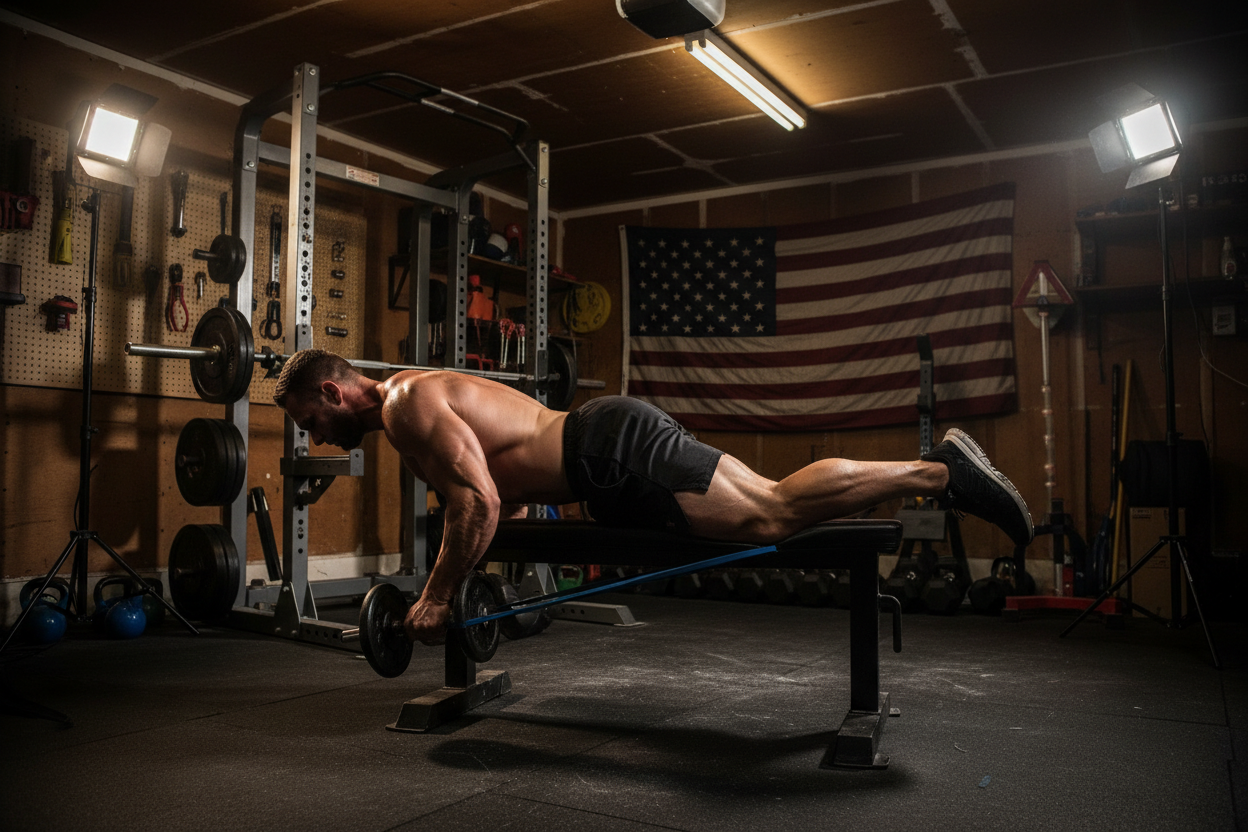
Anchor a heavy resistance band to the bottom of your power rack. Place a bench a few feet away. Loop the band around your ankles and lie face down. The further the bench is from the rack, the more tension you create at the start of the rep.
Unlike the dumbbell version, the tension increases as you contract the muscle (peak contraction). This creates a massive pump and is excellent for finishing a leg workout.
Method 3: Floor Sliders (The Eccentric Killer)
You can buy furniture sliders for a few dollars at a hardware store, and they are brutal for hamstrings.
Lie on your back on a smooth surface (wood or concrete) with your heels on the sliders. Bridge your hips up so your body forms a straight line. Slowly slide your heels out until your legs are straight, then curl them back in while keeping your hips elevated.
This engages the glutes and hamstrings simultaneously. If you find the concentric (curling in) too hard, curl in with two legs and slide out with one. This eccentric overload is fantastic for preventing hamstring tears.
My Training Log: Real Talk
I want to share my personal experience with leg curls home gym setups because it's not always pretty. For years, I relied solely on the dumbbell-between-the-feet method.
The reality? It's awkward. I can distinctly remember the specific, sharp pressure of the knurling digging into the soft arch of my foot when I tried to go heavy (over 50lbs). There is also that terrifying moment when your socks slip, and you feel the weight start to drift. I actually dropped a 40lb dumbbell on the bench support rail once—loud, scary, and it chipped the paint.
Eventually, I bought a "Monkey Foot" attachment, which straps a dumbbell to one foot. It changed the game for me because it removed the stability focus and let me just grind out reps. If you are serious about this, stop fighting the dumbbell wobble and invest in a strap attachment or a dedicated rack add-on. The friction and setup time you save is worth every penny.
Conclusion
Building massive hamstrings at home requires intent. You can't just go through the motions. Whether you choose the dumbbell clamp, the band tension, or the slider burn, the key is progressive overload. Pick one method, stick to it for 6 weeks, add reps or weight, and watch your legs grow.
Frequently Asked Questions
1. Can I build big hamstrings without a machine?
Absolutely. Hypertrophy occurs through mechanical tension and metabolic stress. As long as you are taking your sets near failure using dumbbells or bands, your muscles cannot tell the difference between a $3,000 machine and a $50 band setup.
2. How often should I train leg curls at home?
Since the hamstrings are a fast-twitch dominant muscle group, they respond well to frequency. Aim for 2 sessions per week. You might do heavy RDLs (hip extension) on one day and higher rep leg curls (knee flexion) on the other.
3. Why do my calves cramp during leg curls?
This is common. It usually happens because you are pointing your toes (plantar flexion), which engages the gastrocnemius. To fix this, pull your toes toward your shins (dorsiflexion) before you start the curl. This inhibits the calf and forces the hamstring to do the work.