How to Build Wider Hips With Just Weighted Side Leg Raises
Most leg days focus heavily on the quads and hamstrings, leaving the outer hips neglected. If you want that rounded, athletic look and better pelvic stability, you need to isolate the gluteus medius. This is where weighted side leg raises come into play.
This isn't just an aerobics warmup move from the 80s. When you add resistance, this exercise becomes a serious hypertrophy tool. It targets the muscles responsible for hip abduction, which are crucial for preventing knee cave during squats and giving your lower body a wider appearance.
Quick Summary: Mastering the Move
- Target Muscle: Gluteus Medius and Minimus (Side Glutes).
- Equipment Needed: Ankle weights, a dumbbell, or a cable machine.
- Key Cue: Keep your heel higher than your toes to prevent quad dominance.
- Rep Range: 12–15 reps for hypertrophy; heavy weight is less important than tension.
- Common Error: Rolling the hips backward to use momentum.
Why You Need to Add Resistance
Bodyweight leg lifts are fine for activation, but they rarely provide enough stimulus for growth. To force the muscle to adapt, you need progressive overload. Performing a side leg raise with weight increases the mechanical tension on the glute medius.
When these muscles are weak, your body compensates by using the TFL (tensor fasciae latae) or lower back. Strengthening them with load fixes your squat mechanics and helps alleviate lower back pain caused by pelvic instability.
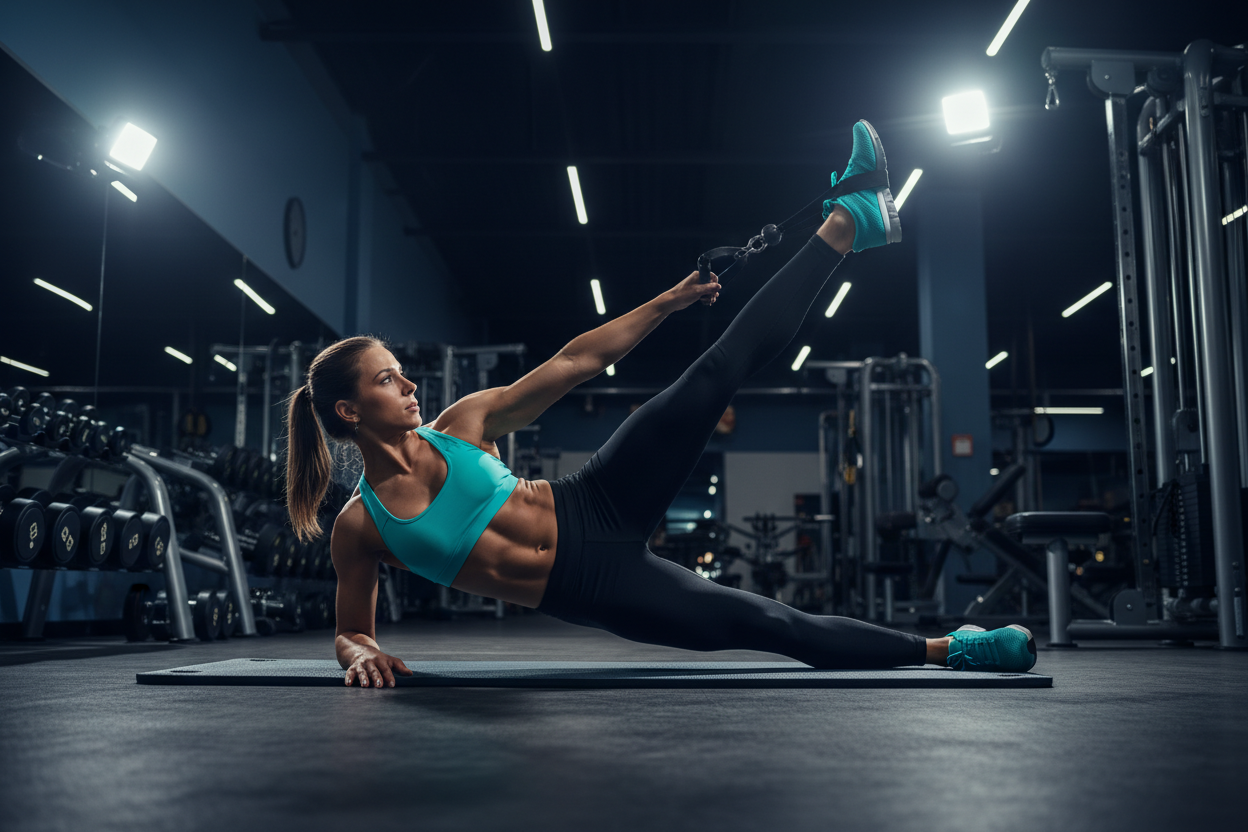
How to Perform Lying Side Leg Raises
The lying variation offers the most stability, allowing you to focus purely on the muscle contraction without worrying about balance.
The Setup
Lie on your side on a mat. Stack your hips directly on top of one another. If you are using a dumbbell, hold it resting on your outer thigh. If you are using ankle weights, strap them on securely.
The Movement
Keep your bottom leg bent for stability. Extend the top leg fully. Initiate the side leg lift with weight by driving through the heel. Lift until you feel a hard contraction in the side of your buttock.
Crucial Tip: Internally rotate your foot slightly (point your toes down toward the floor). This disengages the hip flexors and isolates the glute.
Standing Variations for Functionality
If you want to train your balance simultaneously, standing side leg raises with weights are the superior choice. This forces your standing leg to stabilize while the working leg moves.
Using a Cable Machine
Attach a cuff to your ankle. Stand perpendicular to the machine. Hold the frame for support and sweep the leg out. The cable provides constant tension throughout the entire range of motion, which gravity-based free weights cannot do.
Using Free Weights
For standing side leg raises with weight (dumbbell), hold the weight against your outer thigh. As you lift the leg, your hand moves with it. This can be awkward for some, but it works well if you lack gym equipment.
Common Mistakes to Avoid
The Hip Roll: As you get tired, the tendency is to roll the top hip backward. This turns the movement into a hip flexion exercise, working the front of the leg instead of the side. Keep your core braced and hips stacked vertically.
Going Too High: You don't need to lift your leg to 90 degrees. Once your hip bone starts to hike up toward your ribs, you are using your obliques (waist muscles), not your glutes. Stop the movement before your waist crunches.
My Training Log: Real Talk
I’ve cycled through every variation of this movement, and I have to be honest about the standing dumbbell variation: it can be annoying.
When I first started doing standing side leg raises with weights, I tried holding a 20lb dumbbell against my thigh. The issue wasn't the weight; it was the knurling. As the rep count got high and my grip fatigued, the dumbbell would slide and dig into my IT band. It creates a specific type of friction burn that is distracting.
I found that if you don't have ankle weights, the "sandwich" method works better. I wrap a small towel around the dumbbell handle before pressing it against my leg. It kills the friction and stops the weight from rolling around, so I can actually focus on the glute burn rather than the metal digging into my quad.
Conclusion
Building the side glutes takes patience and precise form. By upgrading to weighted side leg raises, you stop spinning your wheels with high-rep calisthenics and start building actual muscle density. Start light, focus on that internal rotation, and watch your hip stability improve.
Frequently Asked Questions
Can I use a resistance band instead of weights?
Yes, bands are excellent for this. However, bands provide peak tension only at the top of the movement. A side leg lift with weight (like a dumbbell or ankle weight) provides consistent resistance against gravity, which can be better for hypertrophy in the stretched position.
How heavy should I go?
The glute medius is a small muscle group. If you go too heavy, your body will recruit the lower back and TFL to help. Stick to a weight that allows you to perform 12–15 reps with perfect control and zero swinging.
Why do I feel this in my lower back?
This usually happens if you are swinging the leg too high or arching your back. Brace your abs as if you are about to be punched in the stomach. This locks the pelvis in place and forces the hip muscles to do the work.