
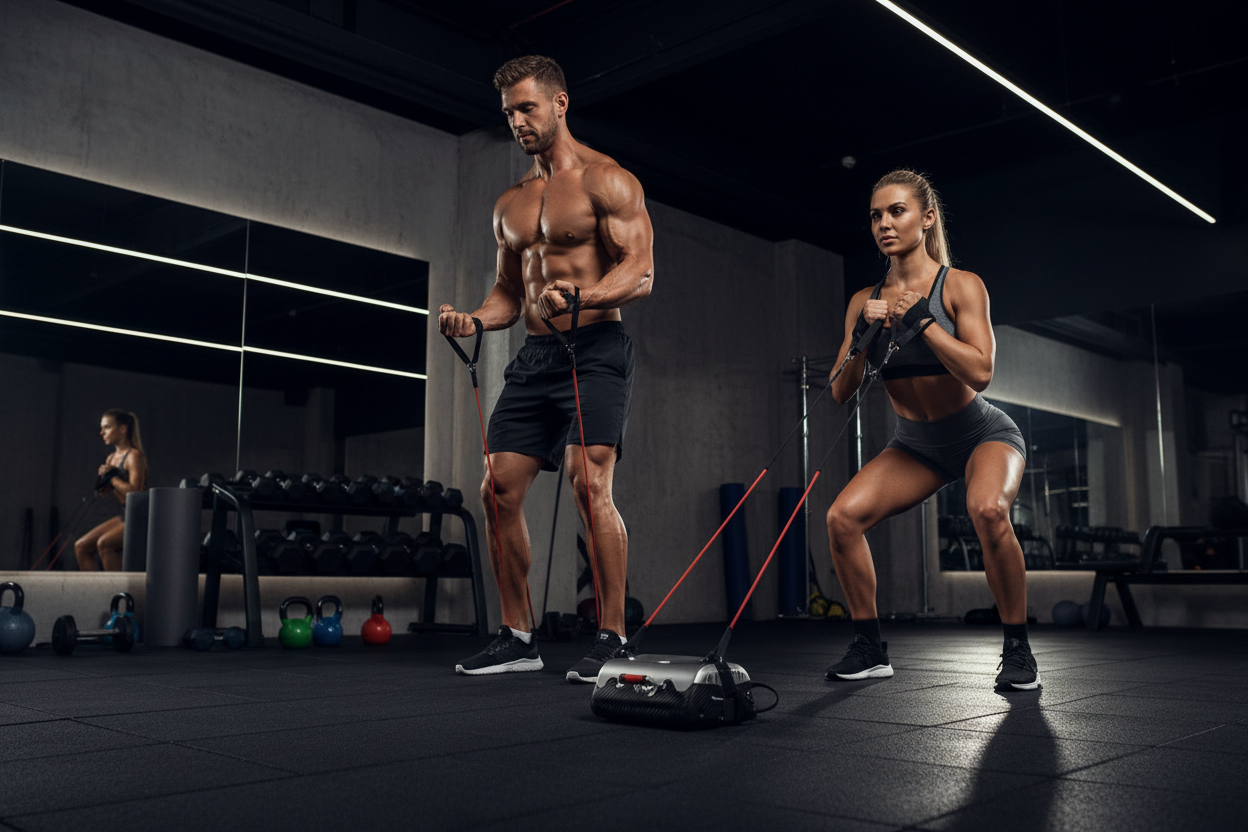
How to Build Real Muscle With the Best Portable Gym System
You cannot build a serious physique if you only train when the stars align. The reality for most of us is that consistency beats intensity, but life—travel, work, limited space—often kills consistency. This is where finding the best portable gym system becomes not just a convenience, but a necessity for long-term growth.
Forget the infomercials promising six-pack abs in three minutes. We are looking at legitimate equipment that replicates the biomechanics of a barbell or cable machine, fitting into a carry-on bag. Let’s break down how to choose a setup that actually provides progressive overload.
Key Takeaways: Choosing Your System
- Resistance Curve Matters: Look for variable resistance that mimics the strength curve of your muscles (easier at the start, harder at the peak).
- Bar Quality is Non-Negotiable: To handle heavy loads, you need a steel alloy bar, not plastic. It prevents wrist strain during heavy presses.
- Platform vs. Anchor: Floor plates allow for heavy deadlifts and squats; door anchors limit you to pushing and pulling movements.
- Band Material: Layered latex offers a smoother pull and safety snap-protection compared to molded rubber tubes.
The Mechanics of Portable Resistance
The biggest misconception about portable gear is that it cannot build mass. This is false, provided you understand tension. The best portable resistance gym setups utilize Linear Variable Resistance (LVR).
When you lift a static weight (like a dumbbell), the load is constant. However, your muscles are mechanically stronger at different points in the lift. With high-quality bands found in premium systems, the resistance increases as you extend. This forces your muscle to recruit more fibers at the peak contraction—something dead weight often fails to do effectively.
The "Bar" Factor
If you are transitioning from a commercial gym, you need a system that includes a bar. Why? Because holding bands directly in your hands limits your grip strength and can cause friction burns on your wrists.
A knurled, rotating bar allows you to perform compound movements—bench press, overhead press, squats—with the same neural patterns you use with iron. The rotation is critical; without it, the bands will twist your wrists, leading to joint pain rather than muscle fatigue.
Durability and Safety: What to Look For
I have seen cheap bands snap. It sounds like a gunshot and leaves a welt that lasts for weeks. When evaluating a system, ignore the color of the bands and look at the construction.
You want multi-layered latex. If one layer tears, the others hold, giving you time to replace it before catastrophic failure. Additionally, examine the connection points. Heavy-duty carabiners are essential. If the connection point is plastic, walk away. It cannot handle the force required for a 300lb equivalent deadlift.
My Training Log: Real Talk
Let me share a specific detail you won't find on a product sales page. Last year, I spent three weeks working out of a hotel room using a high-end bar-and-plate system.
The marketing photos always show people training on hardwood floors or concrete. But in that hotel room, on thick plush carpet, I ran into a unique stability issue. When I hit the top of a heavy overhead press, the base plate actually had a slight "wobble" because the carpet compressed unevenly under my heels.
It forced me to slow my tempo down drastically—3 seconds up, 3 seconds down—to maintain balance. The result? My core was more sore than my shoulders the next day. Also, the knurling on portable bars is often sharper than gym bars because they assume you won't use chalk. If you have soft office hands, you might actually need gloves, or you'll tear your calluses on the first heavy deadlift session.
Conclusion
The best portable gym system isn't just a backup plan; for many, it becomes the primary method of training. By focusing on variable resistance, bar quality, and safety features, you can replicate a 300lb squat rack experience in a space smaller than a yoga mat. Don't buy a toy; buy a tool that respects your strength goals.
Frequently Asked Questions
Can you actually build mass with a portable gym?
Yes, provided the system offers enough resistance to facilitate progressive overload. You must treat the bands like heavy iron—tracking your reps and increasing the resistance (using thicker bands) over time to force muscle adaptation.
What is the difference between tube bands and loop bands?
Loop bands generally offer higher resistance ceilings and durability. Tube bands are often cheaper and prone to snapping at the handle connection points. For heavy lifting (squats/deadlifts), flat loop bands are superior.
Do I need a floor plate?
If you plan to perform heavy squats or deadlifts, a floor plate is highly recommended. Standing directly on high-tension bands can be uncomfortable for your feet and causes uneven wear on the latex. A plate distributes the force evenly.


