
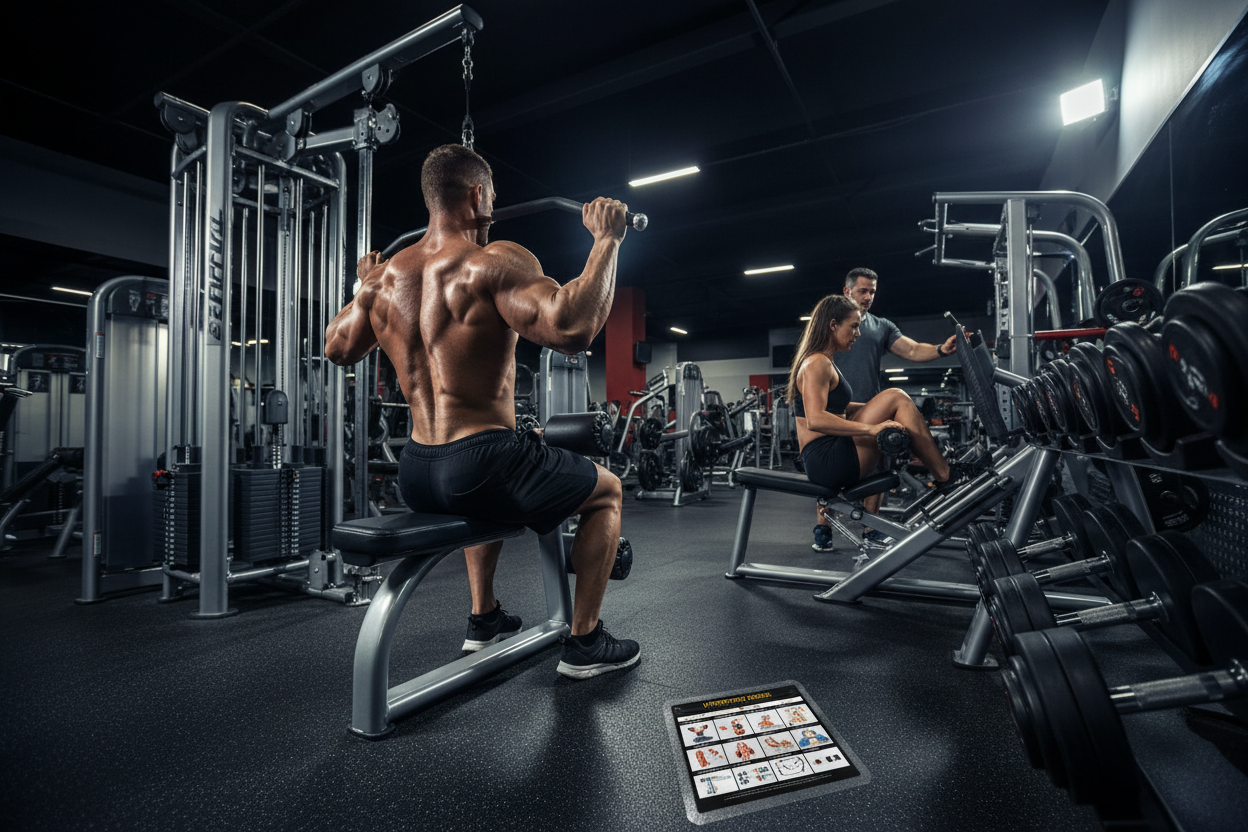
How to Build Real Muscle Using Only Weight Machines at the Gym
There is a persistent myth in the fitness community that you cannot build a serious physique unless you are grinding under a heavy barbell. While free weights have their place, ignoring weight machines at the gym is a strategic error. If your goal is hypertrophy (muscle growth), machines offer a level of stability and isolation that dumbbells simply cannot match.
When you remove the need to balance a load, you can direct 100% of your neural drive into contracting the target muscle. This guide breaks down how to utilize these tools effectively, moving beyond the basics of just sitting down and pushing.
Key Takeaways: Machine Training Basics
- Stability Equals Output: Machines provide external stability, allowing for greater force production without stabilizer fatigue.
- Controlled Eccentrics: The friction in weight stacks often allows for a smoother negative (lowering) phase, crucial for growth.
- Safety at Failure: You can push to absolute mechanical failure safely without a spotter.
- Constant Tension: Unlike free weights, many machines maintain tension on the muscle through the entire range of motion.
The Science of Stability: Why Machines Work
The primary advantage of weight training machines at the gym is the removal of stability constraints. When you squat with a barbell, your body spends significant energy just keeping you upright. Your core, lower back, and stabilizers often fatigue before your quads do.
Machines solve this. By locking your body into a fixed path, you eliminate the "wobble." This allows you to overload the specific muscle belly without your balance becoming the limiting factor. It is not "cheating"; it is targeted biomechanics.
Understanding the Resistance Curve
Free weights are bound by gravity—the resistance is always pulling straight down. Machines use cams and pulleys to redirect resistance. This means the weight can feel heavy at the top of a rep, where you are strongest, and lighter at the bottom, where you are weakest. This matches your muscles' natural strength curve, keeping tension constant.
Mastering the Push and Pull Dynamic
To build a balanced physique, you need to categorize your machine work. Most setups are intuitive, but the mechanics matter.
Gym Machines Pull Movements
When executing gym machines pull exercises, such as the lat pulldown or seated cable row, the setup is critical. A common error is setting the thigh pad too loose on pulldowns. If your body lifts off the seat as the weight goes up, you lose leverage. Lock yourself in tight. The goal is to drive the elbows down and back, not just to yank the handle to your chest using momentum.
Lifting Machines Gym: The Push
For pushing movements like the chest press or shoulder press, align the handles with your active joints. If the handles on a chest press are too high (aligned with your neck), you place unnecessary strain on the rotator cuff. Adjust the seat until the handles align with your mid-chest.
Common Mistakes That Kill Gains
Even the best lifting machines gym setups won't help if you ignore the axis of rotation. Most leverage machines (like leg extensions) have a red dot or a pivot point sticker.
This pivot point must align perfectly with your joint (e.g., your knee). If your knee is three inches in front of the pivot point, you introduce shearing force on the joint and reduce the effectiveness of the lift. Take the extra ten seconds to adjust the back pad.
My Training Log: Real Talk
I want to be honest about the reality of using these machines. I remember vividly the first time I truly committed to a machine-only leg day. I was using an older plate-loaded leg press—the kind with the textured footplate that feels like sandpaper against your soles.
The specific thing nobody tells you about machines is the "sticking point" friction. On this particular machine, the sled would shudder slightly at the bottom of the rep if I didn't grease the rails. I learned the hard way that you have to inspect the equipment. I also recall the distinct smell of the vinyl seat warming up under my back during a high-rep set. That feeling of being totally locked in, where my legs were screaming but my lower back felt completely safe, was the moment I stopped looking at machines as "easy work." The burn was actually worse than squats because there was zero respite at the top of the rep.
Conclusion
Machines are not a crutch; they are precision tools. By stabilizing your body and directing tension exactly where you want it, you can achieve hypertrophy levels that rival any free-weight program. Stop worrying about what looks "hardcore" and start focusing on the mechanical tension required to grow.
Frequently Asked Questions
Can I get big using only weight machines at the gym?
Yes. Your muscles do not know if you are holding a metal bar or pushing a padded handle; they only detect tension. As long as you apply progressive overload (increasing weight or reps over time), you can build significant muscle mass using only machines.
Are machines safer than free weights?
Generally, yes. Machines guide your motion, reducing the risk of dropping weights or moving into compromised positions. However, overuse injuries can still occur if the machine is not adjusted to your body's specific dimensions.
How often should I use gym machines for pull exercises?
You can train pulling movements 2-3 times per week. Because machines are less taxing on the central nervous system than heavy deadlifts or barbell rows, you can often handle higher volume and frequency with machine-based training.


