How to Build Powerful Hips With the Glute Leg Lift
You might associate floor-based leg exercises with 80s aerobics videos, but don't let the vintage reputation fool you. The glute leg lift—often called the quadruped hip extension or donkey kick—remains a staple in hypertrophy programs for a reason. It creates targeted isolation that heavy compound lifts sometimes miss.
However, most people get this wrong. They swing their legs wildly, using momentum and their lower back rather than their hip extensors. If you aren't feeling a distinct cramping sensation at the top of the movement, you aren't engaging the right fibers. Let’s break down the mechanics to turn this simple movement into a mass builder.
Key Takeaways: Mastering the Glute Leg Lift
- Isolation is King: This move targets the gluteus maximus and medius with minimal hamstring involvement if the knee is bent.
- Spine Neutrality: 90% of errors come from arching the lower back. Brace your core to lock the ribcage down.
- Tempo Matters: Momentum kills the gains. Use a 2-second lift, 1-second hold, and 2-second lower cadence.
- Progression: Bodyweight is just the start. Add resistance bands or ankle weights to continue driving adaptation.
Why Leg Lifts for Glutes Are Non-Negotiable
Compound movements like squats and deadlifts are fantastic, but they recruit a massive amount of quad, hamstring, and erector muscle. When you specifically want to target the posterior chain without systemic fatigue, leg lifts for buttocks development are superior.
The science here is about the length-tension relationship. When you perform a glute leg lift exercise on all fours, you are working the glute against gravity in a shortened position. This creates a peak contraction that is difficult to replicate with standing exercises.
Do Leg Lifts Work Glutes Effectively?
Yes, but with a caveat. Do leg lifts work glutes if you just flail your leg around? No. They only work if you maintain a posterior pelvic tilt (tucking your tailbone slightly). This takes the lumbar spine out of the equation and forces the glute max to do the heavy lifting.
How to Execute the Perfect Glute Leg Raise
Forget about how high you can lift your leg. Height is often an illusion created by hyperextending your lower back. Here is the strict form guide.
1. The Setup
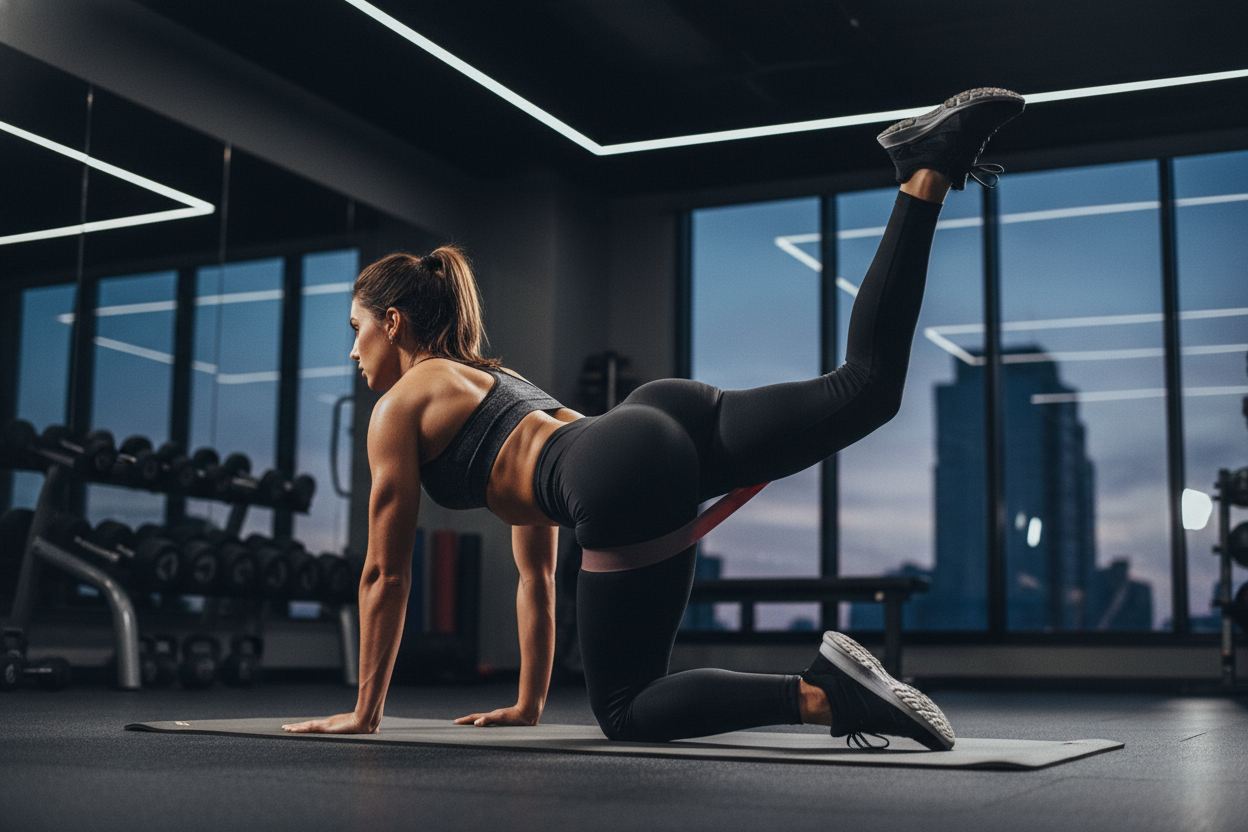
Get on all fours (quadruped position). Your hands should be directly under your shoulders and knees under hips. Brace your abs as if someone is about to punch you in the stomach. This is your anchor.
2. The Lift
Keep your knee bent at 90 degrees. Drive your heel toward the ceiling. Focus on initiating the movement from the crease of your hip, not your lower back. Stop the movement the moment you feel your lower back wanting to arch. For most, this range of motion is shorter than expected.
3. The Squeeze
At the top, pause for a full second. Squeeze your glute hard. This is the "money" portion of leg raises glutes rely on for growth.
Advanced Variations for Progressive Overload
Once you can perform 20 reps with perfect form, bodyweight leg raises for glutes won't provide enough stimulus for growth. You need to increase the intensity.
Weighted Donkey Kicks
Place a dumbbell in the crook of your knee and squeeze your calf against your hamstring to hold it in place. This not only adds load to the glute but forces your hamstring to contract isometrically, increasing the overall intensity of the glute leg raises.
Straight Leg Lifts for Glutes
Extending the leg straight out increases the lever arm, making the leg feel heavier. This variation recruits slightly more hamstring but is excellent for the upper glute shelf. Keep the toe pointed slightly out to better engage the gluteus medius.
Common Mistakes That Kill Progress
If you feel pain in your lower back, stop immediately. This usually means you are sacrificing core stability for range of motion. Another common error is shifting your weight to the supporting side. When performing leg lifts for glutes, try to stay centered. If you lean too far to the left while working the right leg, you rob the working muscle of tension.
My Training Log: Real Talk
I want to be honest about my relationship with this exercise. For years, I skipped floor work because I thought it wasn't "hardcore" enough. I assumed if I wasn't under a barbell, I wasn't growing.
When I finally added these into my rotation to fix a glute imbalance, the first thing I noticed wasn't the pump—it was the cramp. Specifically, when doing the dumbbell variation, the skin behind my knee would get pinched by the weight, and my hamstring would scream before my glute did. I had to learn to wrap a small towel around the handle of the dumbbell to stop it from digging in.
Another detail most guides miss: the mat matters. Doing these on a thin yoga mat on a concrete garage floor bruised my knees instantly. I had to start doubling up the mat or using a foam pad under the supporting knee. It’s these small annoyance factors—the slipping weight, the bruised knee—that make people quit the exercise. Fix your setup comfort first, or you won't focus on the squeeze.
Conclusion
The glute leg lift is not a warm-up; it is a legitimate builder of posterior strength when treated with respect. By locking down your spine and focusing on a high-tension contraction, you can transform this bodyweight staple into a mass-building tool. Stop swinging, start squeezing, and watch your hips respond.
Frequently Asked Questions
1. How often should I perform glute leg raises?
Because this is a low-impact isolation movement, the recovery curve is short. You can perform them 3 to 4 times a week. They work exceptionally well as a "finisher" at the end of a heavy leg day to fully exhaust the muscle fibers.
2. Can leg lifts replace squats?
No. Squats are a compound movement that builds overall lower body mass and strength. Leg lifts for buttocks are an isolation exercise. They should complement your heavy lifting, not replace it, unless you are working around an injury.
3. Should I keep my leg straight or bent?
Both have value. A bent knee (donkey kick) takes the hamstring out of the movement, focusing almost entirely on the glute max. A straight leg variation increases the lever length and involves the hamstrings more. For maximum glute development, rotate between both styles.