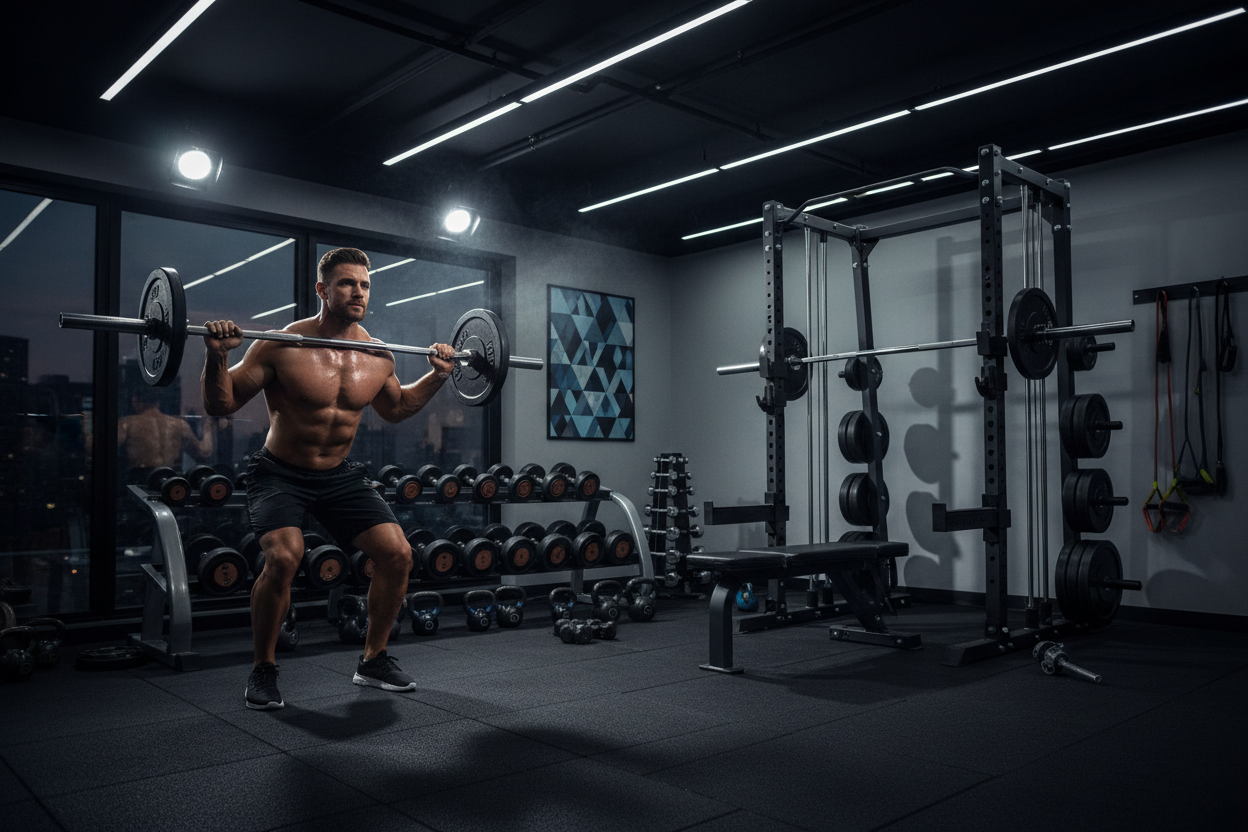
How to Build Power with the Best Exercise for Buttocks and Thighs
You want results, not just a sweat. You are likely tired of doing endless kickbacks or machine circuits with minimal visual return. Finding the best exercise for buttocks and thighs isn't about discovering a new, secret movement; it is about mastering the biomechanics of the human body. To truly change the shape and strength of your lower body, you must prioritize compound movements that force the hip and knee joints to work in unison.
Quick Summary: The Core Principles
- The Winner: The Barbell Back Squat (or Goblet Squat for beginners) is scientifically the most efficient move for recruiting maximum muscle fibers in the glutes and quads simultaneously.
- The Runner Up: Lunges (specifically Walking Lunges) address muscle imbalances and increase time under tension.
- Volume Matters: For hypertrophy (growth), aim for 3-4 sets of 8-12 reps.
- Depth is Key: Partial reps yield partial results. Breaking parallel is essential for full glute activation.
Why The Squat Reigns Supreme
If you were stranded on a desert island and could only perform one movement, it should be the squat. It is widely regarded as the best workout for buttocks and thighs because it is a closed-chain kinetic exercise. This means your feet are fixed on the ground, allowing you to move the load through space.
When you perform a deep squat, you engage the quadriceps during the knee extension phase and the gluteus maximus during the hip extension phase. No other exercise allows you to load these two massive muscle groups as heavily or as safely.
The Science of Depth
Many gym-goers cheat themselves by stopping halfway down. Electromyography (EMG) studies consistently show that glute activation increases significantly the deeper you go. If you stop before your thighs are parallel to the floor, you are primarily working your quads and neglecting the posterior chain (the bum). To get the most out of the best exercises for thighs and buttocks, you must mobilize your hips to achieve full depth.
Adapting for Equipment: Gym vs. Home
You don't always need a heavy barbell. The principles of tension apply regardless of the tool you use.
In the Gym: The Barbell Back Squat
This is the gold standard best exercise for thighs and bum. By placing the bar on your upper back, you can load the posterior chain effectively. Keep your chest up, brace your core, and drive through your heels.
At Home: The Goblet Squat
For the best exercise for buttocks and thighs at home, the Goblet Squat is unmatched. Hold a kettlebell or dumbbell at chest height. This front-loaded weight acts as a counterbalance, allowing you to sit deeper into the squat with an upright torso. It is safer for the lower back and excellent for learning proper form.
The Supporting Cast: Lunges and Deadlifts
While the squat is the king, a complete best butt and thigh workout requires variety to prevent plateaus.
Walking Lunges: These are arguably the best workouts for thighs and glutes when it comes to fixing asymmetry. Because you are training one leg at a time (unilateral training), your dominant side cannot compensate for the weaker one. This ensures balanced development.
Romanian Deadlifts (RDL): While squats hit the quads and glutes, RDLs focus on the hamstrings and glutes. This creates that distinct separation between the thigh and the glute, often referred to as the "glute-ham tie-in."
My Training Log: Real Talk on Squats
I want to be honest about what it feels like to actually commit to the squat as your primary movement. When I first transitioned from leg presses to high-frequency squatting, the hardest part wasn't the leg soreness—it was the central nervous system fatigue.
There is a specific, gritty feeling when you are at the bottom of a heavy squat (the "hole"). The waistband of my shorts always seems to roll down slightly right at that point of maximum tension, which is annoying, but it's a cue that I'm deep enough. More importantly, the day after a heavy session, I don't just feel it in my quads. There is a deep, dull ache right in the center of the glute that makes sitting on a hard chair uncomfortable. That specific soreness is how I know I hit the depth required. If you only feel it in your knees or lower back, you need to check your form, not add more weight.
Conclusion
The best exercise for buttocks and thighs is the one you can perform with progressive overload and perfect form. For most, that is the Squat. Stop chasing the "burn" from resistance bands and start chasing the strength gains from compound movements. Consistency with these basics will always outperform variety.
Frequently Asked Questions
Can I get results with the best exercise for buttocks and thighs at home without weights?
Yes, but you will eventually need to increase intensity. Start with bodyweight squats and lunges. To keep progressing, you must increase the reps, decrease rest times, or slow down the tempo (e.g., 3 seconds down, 1 second up) to simulate a heavier load.
Will doing the best exercises for thighs and buttocks make my legs bulky?
This is a common myth. Building significant muscle mass ("bulk") requires a specific hormonal environment and a massive caloric surplus. For most people, heavy squats and lunges will result in a tighter, stronger, and more sculpted lower body, not excessive bulk.
How often should I perform the best butt and thigh workout?
Legs are large muscle groups that require recovery. A good frequency for most lifters is twice a week with at least 48 to 72 hours of rest between sessions. This allows for maximal effort during the workout and sufficient repair time afterward.