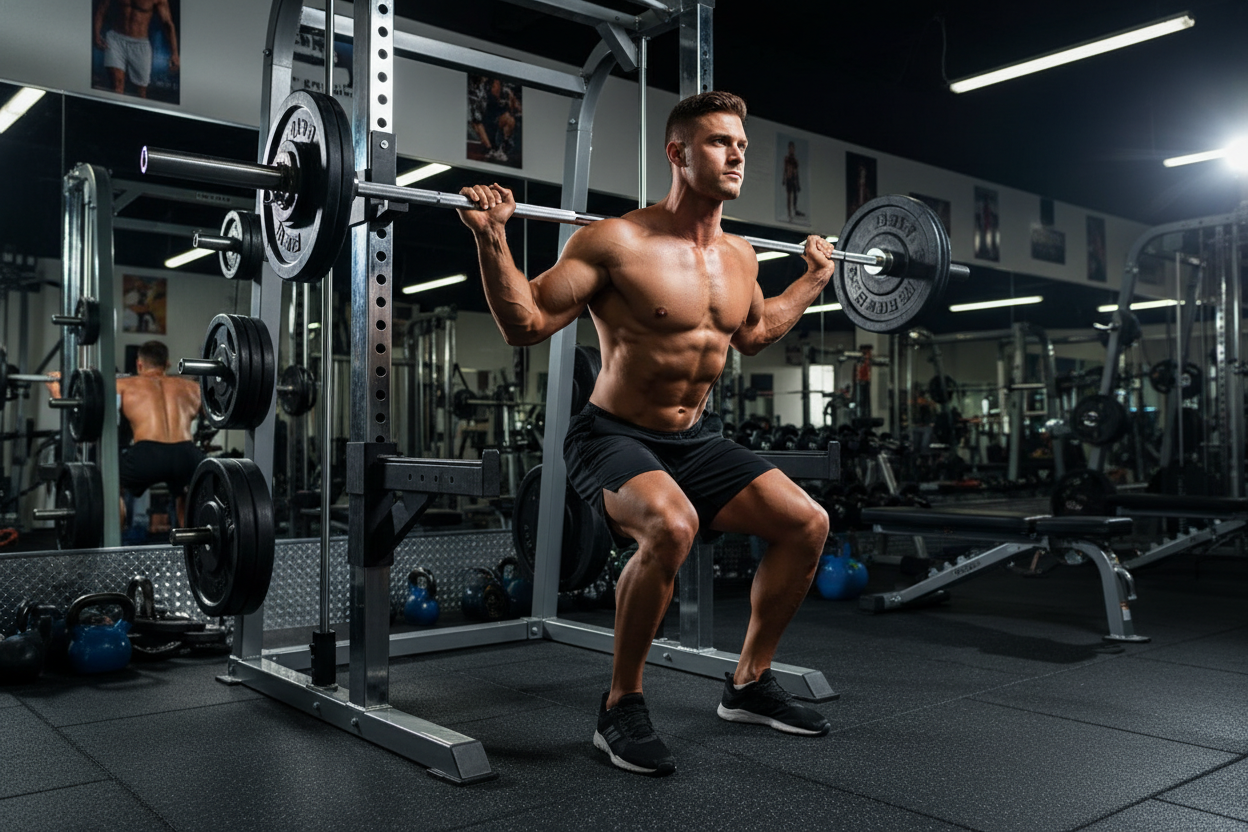
How to Build Massive Quads With the Perfect Front Squat Superset
You are in the rack, the barbell resting across your deltoids, threatening to cut off your air supply. You want to increase density, burn more calories, or simply get out of the gym faster. The logical solution is a front squat superset.
However, pairing the wrong movements with this lift is a recipe for injury. Unlike the back squat, the front squat demands immense thoracic rigidity and core stability. If you fatigue the wrong stabilizers during your rest period, your form will crumble.
This guide cuts through the noise to explain exactly how to program supersets that enhance performance rather than hinder it.
Key Takeaways: Quick Summary
- Avoid Axial Loading: Do not pair front squats with other exercises that compress the spine (e.g., overhead press).
- Decompress the Spine: Hanging exercises like pull-ups are the gold standard for pairing.
- Antagonist Training: Hamstring isolation movements work well via reciprocal inhibition.
- Core Caution: Avoid direct core work that fatigues the stabilizers needed to keep your torso upright.
The Anatomy of a Safe Superset
When deciding what to pair with squats, specifically the front variation, you must respect the unique demands of the movement. The front squat is anterior-chain dominant. It places a heavy load on the quads, but the limiting factor is often the upper back and core.
If your upper back rounds, the bar slides forward, and the lift fails. Therefore, your superset choice must not fatigue the rhomboids or erectors to the point of failure.
1. The "Spine Decompression" Pairing
The absolute best exercises to pair with front squats are vertical pulling movements. Think chin-ups, pull-ups, or neutral grip pull-ups.
Here is the science: The front squat compresses the spine under load. Hanging from a bar does the opposite—it decompresses the vertebrae. This allows your lower back to recover while you continue to work. Furthermore, the lats act as stabilizers during the squat. Keeping them activated (but not exhausted) can actually help keep the bar close to your center of mass.
2. The Antagonist Pairing
If your goal is leg hypertrophy, you should look at exercises to pair with squats that target the opposing muscle group: the hamstrings. This utilizes a physiological phenomenon called reciprocal inhibition.
When the quads contract (during the squat), the hamstrings must relax. By performing a hamstring isolation movement like a Lying Leg Curl or a Glute-Ham Raise immediately after, you flush blood into the opposing muscle group without taxing the central nervous system (CNS) as heavily as a compound deadlift would.
3. Mobility Fillers
For those focused on strength rather than conditioning, "active rest" is the best strategy. Instead of a strength movement, perform a mobility drill that addresses your specific restrictions.
If you struggle with depth, pair your squats with ankle dorsiflexion drills. If your elbows drop, use a lat stretch. This keeps you moving without spiking your heart rate, allowing for maximum output on the next set of squats.
Common Mistakes to Avoid
I see athletes trying to turn their workout into a metabolic conditioning circuit by pairing front squats with burpees or kettlebell swings. This is generally a mistake if your goal is strength or hypertrophy.
High-rep cardiovascular movements spike your heart rate too high. When you return to the bar, you are breathing heavy. In a front squat, you need to hold a massive brace in your abdomen. If you are gasping for air, you cannot brace effectively, putting your lower back at risk.
My Training Log: Real Talk
I learned the hard way that not all supersets are created equal. A few years ago, I decided to pair heavy front squats with Bent Over Barbell Rows. On paper, it looked like a solid "push-pull" setup for the legs and back.
By the third set, disaster struck. I unracked the bar for my squats, stepped back, and as I hit the bottom of the hole, my upper back just gave out. The rows had fried my rhomboids. I couldn't keep my elbows up. The bar started rolling down my delts, pulling me forward.
I had to dump the bar onto the safeties—a loud, embarrassing clatter that stopped the whole gym. The worst part wasn't the noise; it was the specific, burning fatigue in my mid-back that lingered for three days. It felt like I had been kicked between the shoulder blades. Since then, I strictly stick to chin-ups or hamstring curls. The difference in spinal stability is night and day. You need those upper back muscles fresh to fight the gravity of the front rack position.
Conclusion
The front squat is a high-maintenance lift. It requires patience, mobility, and a rigid torso. When programming a front squat superset, prioritize exercises that decompress the spine or target non-competing muscle groups. Treat the superset as a tool for density, not a method to induce exhaustion.
Frequently Asked Questions
Can I superset front squats with back squats?
Generally, no. This is known as a mechanical drop set and is extremely taxing on the Central Nervous System. While advanced bodybuilders might use this for shock training, for 99% of lifters, it leads to form breakdown and potential injury.
What is the best rep range for the secondary exercise?
Keep the secondary exercise (the superset pairing) sub-maximal. If you are doing front squats for 5 reps, keep your pull-ups or leg curls in the 8–12 rep range, leaving 2–3 reps in the tank. You don't want to hit total failure on the secondary move.
Does supersetting reduce my strength gains?
If programmed correctly (using antagonist or non-competing muscle groups), studies suggest supersets do not significantly reduce strength and can actually increase work capacity over time. However, rest intervals must be managed—ensure you have caught your breath before getting back under the bar.