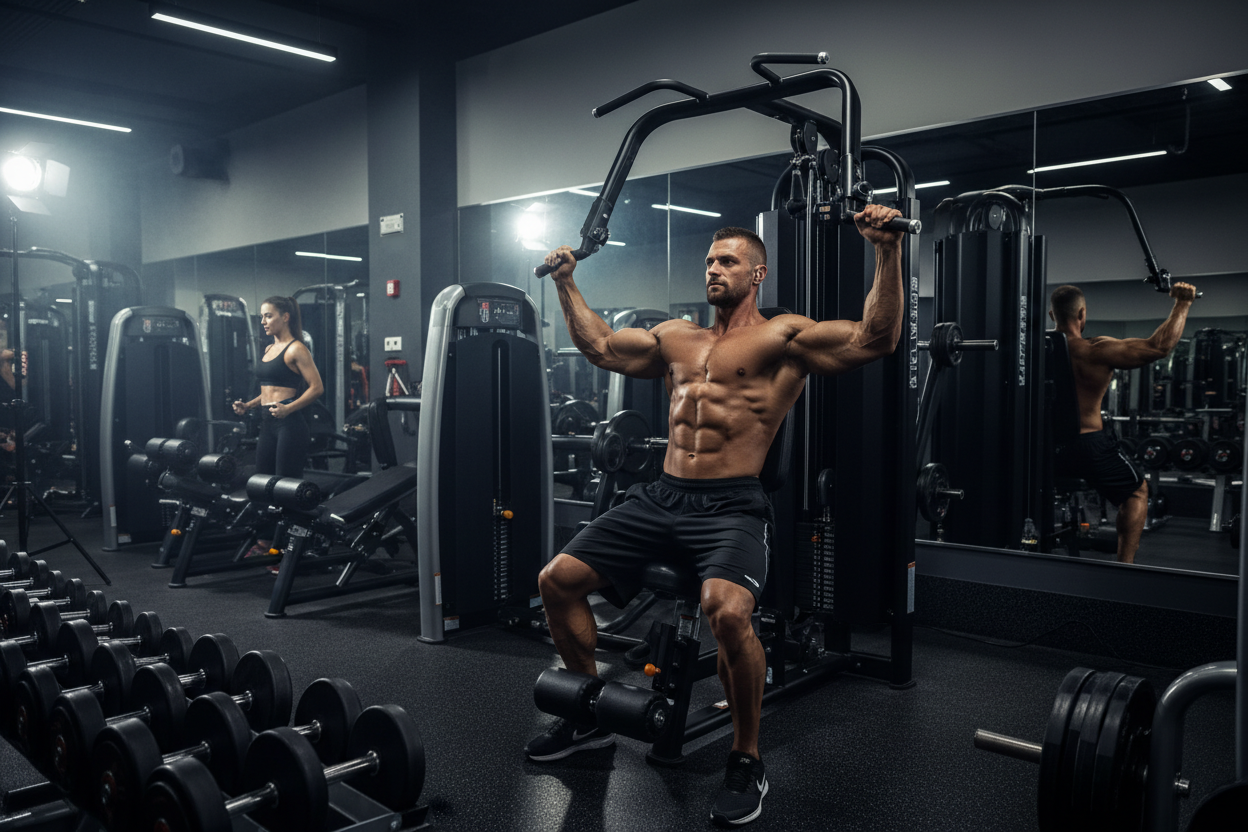
How to Build Massive Pecs With Just a Chest Workout Using Machines
For years, gym purists have shouted from the squat racks that free weights are the only path to growth. They claim that if you aren't balancing a heavy barbell over your neck, you aren't training hard enough. That perspective is outdated and, frankly, leaves a lot of muscle growth on the table.
The truth is, stability is the currency of hypertrophy. When you remove the need to balance a load, your output potential skyrockets. A structured chest workout using machines allows you to drive mechanical tension directly into the pectoral fibers without your stabilizers failing first.
Key Takeaways
- Stability Equals Output: Machines remove the stabilization factor, allowing you to push closer to true muscular failure safely.
- Constant Tension: Unlike dumbbells, cables and machines provide consistent resistance throughout the entire range of motion.
- Safety on Solos: You can train to failure without a spotter, making machines ideal for solo sessions.
- Metabolic Stress: Machines are superior for drop sets and partial reps to maximize the pump.
Why Stability is King for Hypertrophy
Here is the science most old-school lifters ignore. Your brain has a built-in safety mechanism. When it senses instability (like a wobbling dumbbell), it limits the neural drive to the prime movers—in this case, your pecs—to prevent injury.
Machines provide a fixed path of motion. Because your body feels stable, your nervous system takes the brakes off. You can recruit high-threshold motor units much faster. This isn't "cheating"; it's precision engineering for your muscles.
The Ultimate Machine Chest Workout Routine
You don't need to hop randomly from seat to seat. You need a plan. This machine chest workout routine is designed to hit the clavicular (upper), sternal (mid), and costal (lower) fibers.
1. Converging Chest Press (The Heavy Hitter)
Standard machine presses are okay, but converging machines (where your hands come together at the top) are superior. They mimic the natural adduction function of the chest.
The Cue: Don't just push forward. Imagine you are trying to bring your biceps together to crush a walnut between your pecs. Keep your elbows tucked slightly, not flared out at 90 degrees.
2. The Pec Deck (Isolation)
This is arguably better than dumbbell flys. With dumbbells, you lose tension at the top of the rep (gravity pulls down, not across). The Pec Deck keeps the tension constant.
The Cue: Keep a slight bend in your elbows but lock that angle in. Do not turn this into a press. Focus on the deep stretch; pause for a full second when your hands meet.
3. Smith Machine Incline Press (Upper Chest)
Set the bench to a 30-degree incline. The Smith Machine allows you to grind out reps safely. If you fail, you just twist the hooks.
The Cue: Control the eccentric (lowering) phase for 3 seconds. Stop an inch above your chest to keep tension on the muscle, then drive up explosively.
Common Mistakes to Avoid
Even with a fixed path, you can mess this up. The biggest error is setting the seat height incorrectly. If the handles are lined up with your front delts, you are training shoulders, not chest.
Always align the handles with your mid-chest (nipple line) for flat presses. If you feel pain in the front of your shoulder, your elbows are likely flaring too wide or the seat is too low.
My Training Log: Real Talk
I want to be honest about the transition to machines. The first time I swapped my bench press for a pure machine rotation, my ego took a massive hit. I sat down on an old Hammer Strength Iso-Lateral press—the kind with the chipped yellow paint and the sticky vinyl seats.
I loaded it up with four plates per side, thinking it would be easy. It wasn't. The specific friction of that machine, combined with the fact that I couldn't use my legs or back arch to cheat the weight up, humbled me instantly. I remember the distinct smell of the rubber handles on my palms because I wasn't wearing gloves, and that gritty feeling of the weight sled sliding up the metal pole.
But the biggest difference was the next day. Usually, after heavy benching, my front delts and triceps are sore. After that session, the soreness was localized entirely in the center of my pecs. It felt like I had been ripped apart at the sternum. That was the moment I realized the "machine wobble"—or lack thereof—was the secret weapon I'd been ignoring.
Conclusion
Free weights have their place, but they aren't the only tool in the shed. If your goal is pure aesthetics and size, a chest workout using machines offers safety, intensity, and isolation that gravity-dependent weights simply cannot match. Check your ego at the door, adjust the seat height correctly, and force those fibers to grow.
Frequently Asked Questions
Can you build a big chest with only machines?
Absolutely. Muscles respond to mechanical tension and metabolic stress, not the type of equipment used. Machines often allow for greater isolation and intensity, leading to significant hypertrophy without the systemic fatigue of free weights.
How often should I perform this machine workout?
For most lifters, training chest twice a week is optimal. This allows for sufficient recovery while keeping the muscle protein synthesis signal elevated. Ensure you have at least 48 to 72 hours of rest between sessions.
Is the Smith Machine considered a machine workout?
Yes. The Smith Machine acts as a hybrid. It moves on a fixed vertical or angled path, removing the need to stabilize the bar horizontally. This makes it an excellent tool for safely overloading the chest muscles.