How to Build Massive Legs With a Compact Leg Machine Home Gym
Let’s be honest: training legs at home usually means an endless cycle of goblet squats, lunges, and maybe some deadlifts if you have the floor space. While free weights are king for systemic strength, they often lack the stability required to truly isolate the quads and hamstrings for hypertrophy. If you are serious about lower body development, adding a dedicated leg machine home gym setup is the game-changer you’ve been looking for.
Key Takeaways: Quick Summary
- Stability equals Output: Machines provide external stability, allowing you to push closer to failure safely without balance being the limiting factor.
- Space Efficiency: A small leg press machine (specifically vertical models) can fit in corners where a squat rack cannot.
- Versatility: Look for an all in one leg machine that combines extensions and curls to maximize ROI per square foot.
- Biomechanics Matter: Not all leg machines for home are built equally; check pivot points and adjustability to ensure they match your limb length.
Why You Need Mechanical Tension (Beyond the Barbell)
There is a misconception that machines are "soft" or "easy." This is false. Muscle growth relies heavily on mechanical tension. When you squat with a barbell, your lower back or core often fatigues before your quads do. This is the limiting factor.
A high-quality home leg machine removes the balance component. This allows you to drive mechanical tension directly into the target muscle. If you want teardrop quads, you need to isolate the knee extension without worrying about falling over.
Navigating the Hardware: What Actually Fits?
Browsing leg equipment for sale can be overwhelming. Here is the breakdown of what actually works in a residential setting.
1. The Vertical Leg Press
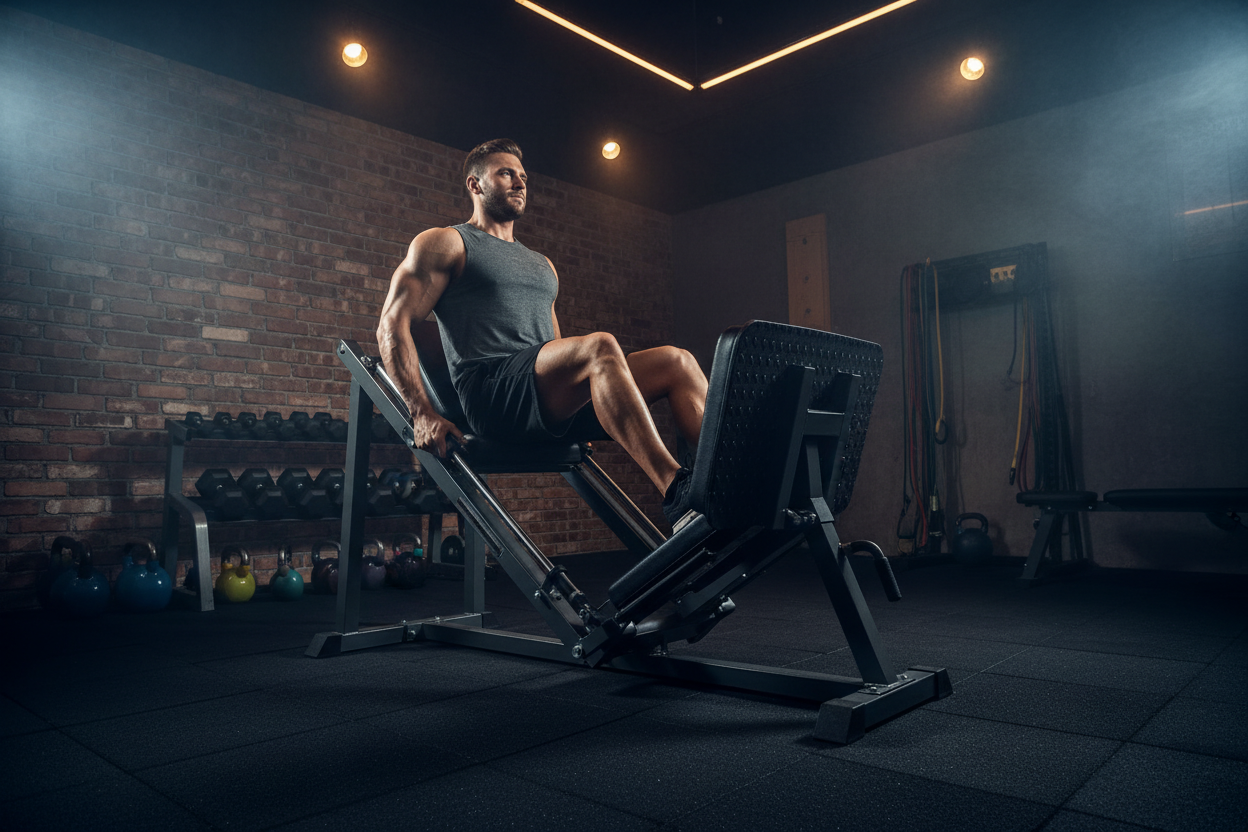
Commercial 45-degree leg presses are massive. They take up half a garage. For a leg machine at home, the vertical leg press is superior. You lie on your back and press the weight straight up. It requires a footprint of roughly 4x4 feet. It loads the spine differently, so start light, but it is the most space-efficient way to move heavy loads safely.
2. The All In One Leg Machine (Extension/Curl)
If you have limited space, look for a unit that swaps between leg extensions (quads) and prone or seated leg curls (hamstrings). These are often plate-loaded. The key here is the "cam" or pivot point. Ideally, the machine's pivot should align perfectly with your knee joint. If it doesn't, you will feel shearing force on the knee rather than tension in the muscle.
3. Leverage Squat Machines
These are becoming popular leg machines for home gym setups. They mimic the squat pattern but on a fixed path. This is excellent for those with lower back issues who still want to squat heavy, as the weight is often loaded on the hips or shoulders with a guided trajectory.
Common Mistakes When Buying Home Gear
The biggest error I see is buying multi-gyms that claim to do everything but do nothing well. Avoid the cheap, cable-based home gym leg machines that use resistance bands or low-quality weight stacks. The resistance curve is usually terrible.
Stick to plate-loaded machines. They are generally cheaper, less prone to breaking (fewer moving parts), and allow you to micro-load with the weights you already own.
My Training Log: Real Talk
I need to be real with you about the transition to home machines. My first purchase was a budget-friendly, plate-loaded leg extension/curl combo I found online. In the photos, it looked commercial-grade.
The reality? The first time I loaded it up with anything over 100lbs, the foam roller pads started spinning on the metal tube. Instead of locking my shins in place, the pad would roll up my leg mid-rep, pinching the hair on my shins and bruising my ankles. Plus, because it used plastic bushings instead of bearings, there was this gritty, friction-heavy feeling on the eccentric (lowering) phase. It wasn't smooth; it stuttered.
I learned the hard way that you have to grease the guide rods regularly with silicone spray, or the machine fights you more than the weight does. Now, I wrap a small towel around the ankle pad for grip. It’s not pretty, but it stops the slip. Don't expect commercial smoothness from a $300 unit, but with some DIY tweaking, you can get a killer pump.
Conclusion
Building a leg machine home gym is an investment in longevity and hypertrophy. It allows you to train to failure safely without a spotter. Whether you opt for a small leg press machine or a dedicated extension unit, focus on footprint and biomechanics over fancy features. Your quads will thank you.
Frequently Asked Questions
Is a compact leg press machine as effective as a commercial one?
Yes, but the resistance curve feels different. A vertical leg press (common for homes) has a 1:1 weight ratio, meaning 200lbs feels like 200lbs. Commercial 45-degree sleds distribute weight differently, so you might move "less" weight at home for the same muscle stimulus.
Can I build mass with just a leg extension/curl machine?
Absolutely. While compound movements are great, isolation movements like extensions and curls are premier for hypertrophy. They target the muscle in its fully shortened and lengthened positions, which is difficult to replicate with free weights alone.
How much space do I need for a home leg machine?
For a vertical leg press or a leg extension/curl combo, you typically need a 4x5 foot area. Always account for the "working space"—you need room to load and unload the plates on the sides, which many people forget to measure.