How to Build a Work Home Exercise Routine That Doesn't Suck
I have spent the last three years staring at the same four walls, trying to figure out how to stay fit without my boss thinking I have defected to a rival company every time I disappear for an hour. Most advice on work home exercise is garbage, suggesting you do jumping jacks in your khakis or buy a treadmill desk that makes your typing look like you are having a seizure. Nobody actually does that. It is awkward, you get sweaty, and your heart rate gets too high to answer a Slack message without sounding winded.
We have all been there: scrolling through Amazon at midnight, comparing the knurling on different pull-up bars because your back feels like a dried-out piece of leather. I have tested the cheap door-frame bars that ruin your trim and the high-end power racks that take up half the bedroom. The reality is that staying active while working from home does not require a commercial-grade facility, but it does require a plan that accounts for the fact that you still have to, you know, work.
If you are tired of the midday slump and the 'desk-bound hunch,' you need a system. This is about how to stay active working from home without turning your living room into a high-intensity CrossFit box. We are going for consistency and joint health, not a puddle of sweat on your keyboard.
Quick Takeaways
- Stop doing high-intensity cardio between meetings; it kills your focus and makes you sweat through your clothes.
- Adopt the 'Greasing the Groove' method—low-rep, high-frequency strength work.
- Set up a dedicated movement zone right next to your desk so there is zero friction.
- Focus on 'anti-sitting' movements like the couch stretch and glute bridges to save your posture.
The 'Random Push-Up Between Meetings' Trap
You have probably tried this. You finish a stressful call, feel a burst of guilt about your sedentary lifestyle, and drop for 30 burpees. By the time you are done, your face is beet red, you are breathing like a freight train, and your next meeting starts in two minutes. This is the worst way to approach a workout in home. It treats exercise as a punishment rather than a physiological reset, and it usually leads to burnout by Wednesday.
The problem with the 'random' approach is that it lacks progression. You are just doing junk volume. There is no warm-up, so your cold joints take a beating, and there is no cool-down, so your nervous system stays fried. This is exactly how to exercise while working from home the wrong way. You end up exhausted, not energized. When you spike your heart rate that aggressively, your brain switches from 'productivity mode' to 'survival mode,' making it nearly impossible to focus on that spreadsheet you were just working on.
Instead of these frantic bursts, we need to look at working from home exercise breaks as a way to maintain mobility and build strength incrementally. You want to finish a set feeling like you could do ten more, not like you need a nap. This keeps your blood flowing and your joints lubricated without triggering a massive cortisol spike that ruins your afternoon output.
Greasing the Groove: The Secret to WFH Fitness
If you want to know how to stay fit while working from home, you need to learn the concept of 'Greasing the Groove.' Popularized by strength coach Pavel Tsatsouline, this method involves doing very low-rep sets of a movement frequently throughout the day. If your max number of pull-ups is 10, you do 3 or 4 reps. You do them every hour. By the end of the day, you have done 30 or 40 high-quality reps without ever getting tired or sweaty.
This is the ultimate wfh workout strategy. It treats strength as a skill. By performing the movement perfectly while you are fresh, you are training your nervous system to be more efficient. It is how to stay fit working from home without needing a shower every two hours. I use this for kettlebell presses and chin-ups. I might hit a total of 50 presses a day, but I never do more than 5 at a time. My shoulders have never felt stronger, and I can still hop on a Zoom call immediately after a set.
This approach also solves the problem of staying active while working from home during long shifts. It turns your house into a strength lab. You aren't 'working out'; you are just moving. This consistency beats a 45-minute gym session that you skip half the time anyway. When you spread the volume out, the work at home workout becomes an integrated part of your life rather than another chore on your to-do list.
Fixing Your Home Office Environment
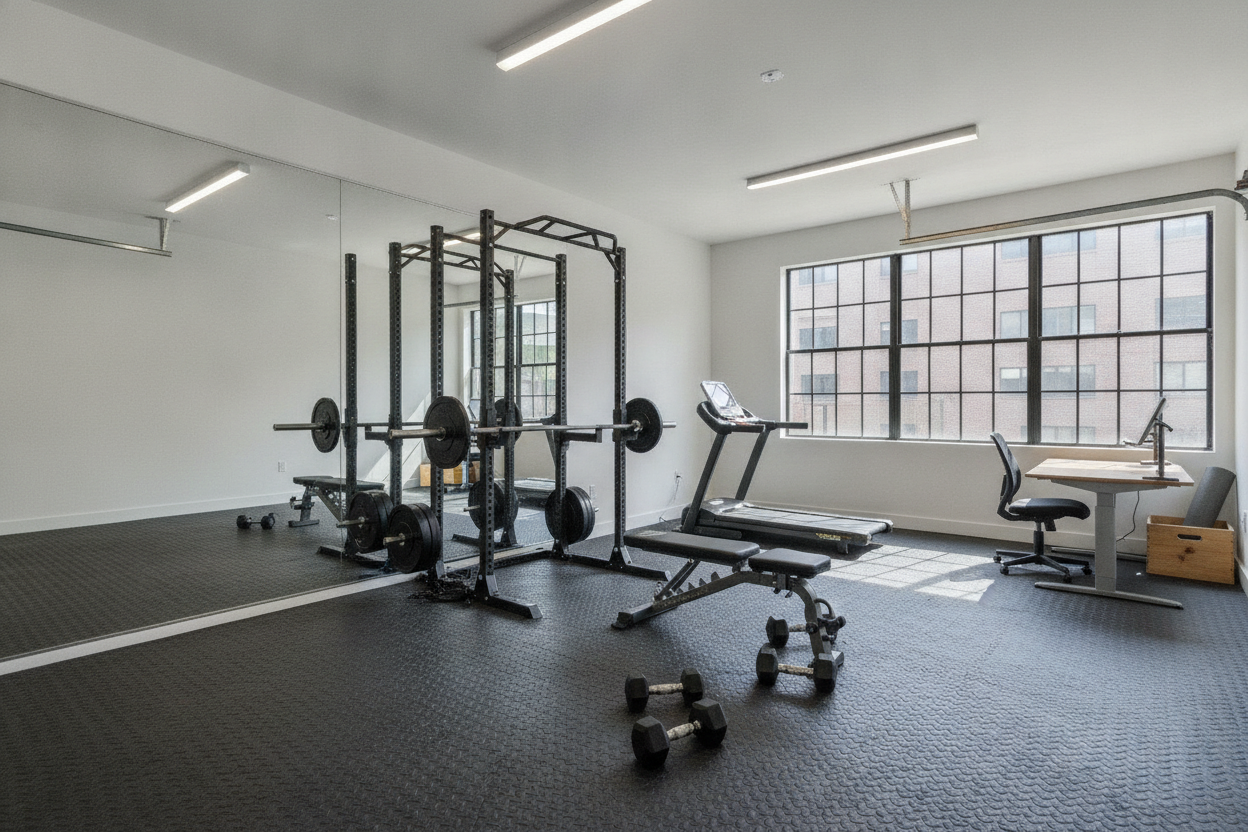
Visual cues drive habits. If your equipment is tucked away in a closet or out in a cold garage, you will not use it at 2 PM when your energy dips. You need a dedicated space within eyesight of your monitor. I cleared out a corner of my office and laid down a large exercise mat for home gym use. Having that designated 'no-shoes' zone makes a massive difference. It is a constant reminder to stretch or hit a set of squats.
Don't try to exercise on a hardwood floor or a dusty rug; your knees will hate you, and you will eventually stop doing it. A high-quality mat provides the grip and cushioning needed for exercise to do from home, like planks or mountain climbers, without sliding around. It also defines the space. When I step onto that mat, my brain knows it is time for a 5-minute movement break, not for checking emails on my phone.
A Realistic Work Home Exercise Schedule
A work from home exercise routine needs to be anchored to your existing schedule. Don't rely on willpower; rely on the clock. Here is a blueprint that has worked for me and several clients who manage wfh fitness while balancing heavy workloads.
9:00 AM: The Mobility Check. Before you even open your laptop, spend five minutes on your mat. Focus on the 'World's Greatest Stretch' and some cat-cow movements. You want to prime your spine before you sit for three hours. I usually do this on my 6x8ft exercise mat because it gives me enough room to sprawl out without hitting the legs of my desk. This is how to move more when working from home right from the start.
11:00 AM - 1:00 PM: The Strength Phase. This is where 'Greasing the Groove' happens. Every time you go to the kitchen for water or coffee, do one sub-maximal set of your chosen movement. Push-ups, air squats, or kettlebell swings. This is your primary work from home workout plan. No sweat, just tension.
3:00 PM: The Decompression Flow. This is when the 'afternoon slump' hits. Instead of a third cup of coffee, do five minutes of glute bridges and bird-dogs. This re-activates the muscles that have gone dormant from sitting and is a key part of how to be more active working from home. It clears the brain fog better than caffeine ever could.
Counteracting the 'Desk Jockey' Posture
Sitting is a specialized skill, and most of us are Olympic-level at it. Unfortunately, it leads to 'gluteal amnesia' and hip flexors that are tighter than a piano wire. If you want to know how to exercise while working from home effectively, you have to prioritize the muscles that sitting destroys. Your glutes, upper back, and core are likely deactivated.
I recommend incorporating the 'Couch Stretch' twice a day. It is brutal but necessary. It opens up the hip flexors and prevents that permanent forward lean. If you are already feeling aches, check out this guide on exercise from home without wrecking your joints. Many working from home exercises can actually make things worse if you have poor form or existing imbalances, so focus on quality over quantity.
Strengthening your posterior chain is how to stay active when working from home without ending up in physical therapy. Face pulls (even with a resistance band tied to your desk) and goblet squats are your best friends here. They pull your shoulders back and force your hips to work. This is the core of any functional work from home fitness strategy.
Stop Pretending You'll Work Out at 6 PM
Let's be honest: by the time the clock hits 6 PM and you close your laptop, the last thing you want to do is drive to a gym or start a grueling wfh exercise routine. Your decision-making fatigue is at an all-time high. This is why staying active at work is the only sustainable way to maintain your health long-term. If you have already hit 40 push-ups and 60 squats by the time you 'clock out,' you have already won the day.
The most successful work from home exercise is the one that actually happens. Stop waiting for the 'perfect' time and start using the micro-gaps in your day. Whether it is how to workout while working from home during a muted conference call or doing calf raises while your coffee brews, these moments add up. Integrated movement is the future of remote work health.
Personal Experience: The Pull-Up Disaster
I once decided to do 100 pull-ups every day during my shift to 'get shredded.' I didn't use the sub-maximal approach; I did sets of 10 every time I felt stressed. By Tuesday afternoon, my elbows were screaming with tendonitis, and I couldn't even type without pain. I had ignored the 'no sweat' rule and treated my work at home exercise like a competition. I learned the hard way that staying active working from home is a marathon, not a sprint. Now, I keep my reps low, my form perfect, and I haven't had an injury in two years.
FAQ
Can I do this in my work clothes?
Yes, as long as you aren't wearing a stiff suit. Most modern 'performance' chinos or leggings are perfect for sub-maximal wfh exercise. The key is to keep the intensity low enough that you don't break a sweat.
Do I need expensive equipment?
Not at all. A kettlebell and a solid mat are enough for a complete work from home exercise routine. You can do wonders with just bodyweight movements if you focus on time under tension and perfect form.
What if I have back-to-back meetings?
Use the 'one-minute' rule. Even 60 seconds of stretching or a single set of squats between calls can reset your posture. It is about how to stay fit while working from home in the margins, not finding a dedicated hour.