How to Build a Defined Upper Body With the Chest Press Machine
If you have ever walked past the weight section and felt like the equipment wasn't built for you, you aren't alone. Many female clients I coach avoid upper body training because they fear looking "bulky" or simply don't know how to adjust the equipment to fit their frame. However, the chest press machine for woman lifters is arguably one of the most underrated tools for improving posture, upper body strength, and overall aesthetics.
It provides a safe, stable environment to challenge your muscles without the instability of dumbbells. By the end of this guide, you will understand exactly how to set this machine up for your specific biomechanics and why it deserves a permanent spot in your routine.
Key Takeaways: Quick Summary
- The "Natural Lift": Developing pectoral muscles adds structural support underneath breast tissue, creating a natural lifting effect.
- Seat Height is Critical: The most common error is sitting too low. Handles must align with the middle of your chest, not your shoulders.
- Control Over Heavy Lifting: For most women, controlled time-under-tension yields better results than simply maxing out the weight stack.
- Safety First: The machine stabilizes the weight path, making it safer than free weights if you are training to failure without a spotter.
Why You Should Stop Skipping Chest Day
There is a persistent myth that chest exercises are only for men who want a massive barrel chest. This couldn't be further from the truth. When we talk about the chest press machine for women, we are talking about structural balance.
The Posture Correction Factor
Most of us spend our days hunched over phones or keyboards. This causes our shoulders to roll forward. While you need to train your back to pull them back, you also need a strong chest to support the shoulder girdle. A weak chest can actually contribute to that rounded-shoulder look just as much as a weak back does.
The Aesthetic Benefit
Let's be direct about the aesthetics. You cannot change the shape of breast tissue through exercise, as it is composed mostly of fat and glands. However, the pectoral muscles sit directly underneath that tissue. Building density in the pectorals pushes the tissue forward and up, providing a firmer foundation.
Setting Up the Machine: The "Fit" Problem
Standard gym equipment is often designed with an average male frame in mind. This makes the setup phase crucial for effective chest press machine women workouts. If you get this wrong, you will feel the burn in your shoulders, not your chest.
1. Adjusting the Seat Height
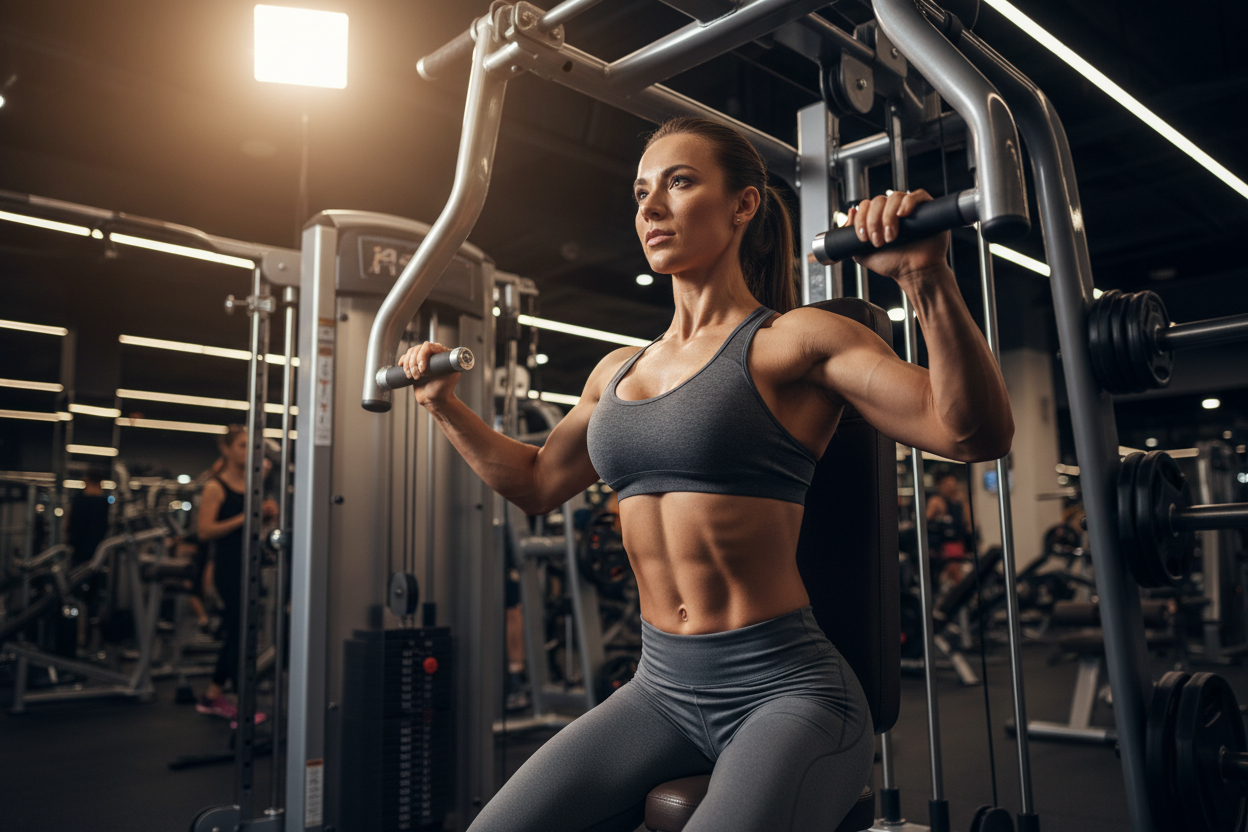
Sit down and look at the handles. If they are level with your shoulders/neck, you are too low. This puts immense strain on the rotator cuff. Adjust the seat upward until the handles align with your armpits or the middle of your chest (the nipple line).
2. Check the Start Position
Many modern machines have a foot pedal specifically designed to help you bring the handles forward before you start pressing. Use it. If the machine lacks a foot pedal, the handles might sit too far back, forcing you to overstretch your shoulder capsule just to grab them. If this happens, ask a spotter to hand you the handles, or start with one arm at a time.
Execution: Perfecting the Rep
Once you are locked in, the movement is about control, not momentum. Slamming the weight stack is a sign of poor technique.
The Scapular Retraction
Before you push, pinch your shoulder blades together against the back pad. Imagine you are trying to hold a pencil between your shoulder blades. Keep them pinned there throughout the entire set. This isolates the chest and prevents the shoulders from taking over.
The Elbow Path
Do not flare your elbows out to 90 degrees (t-shape). This is a fast track to shoulder impingement. Instead, tuck your elbows slightly at a 45-degree angle. This aligns with the natural fibers of the pecs and allows for a safer, stronger press.
My Training Log: Real Talk
I want to share a specific detail from my own experience with the chest press machine for woman lifters that manuals usually skip. I have a shorter arm span (wingspan), and I remember vividly using an older Hammer Strength machine where the handles were fixed in a wide position.
The first few reps felt fine, but by rep eight, I felt a distinct, sharp grinding in the front of my shoulder—not a muscle burn, but a joint pinch. I realized that because the handles were too wide for my frame, I was unable to reach full extension without my shoulders rolling forward off the pad.
If you ever feel that specific "roll" where your back leaves the pad as you push, the machine doesn't fit you correctly. My fix was to stop using the standard handles and instead grip the machine on the inner metal frame (neutral grip) where the bars curve in. It felt gritty—the metal wasn't knurled there, so my hands got sweaty and slipped—but the engagement shifted immediately back to my chest and off my joints. Don't be afraid to alter your grip width if the "standard" handles feel like they are tearing your shoulders apart.
Conclusion
The chest press machine is not reserved for bodybuilders. It is a fundamental tool for upper body health, posture, and strength. By adjusting the seat correctly and focusing on keeping your shoulder blades pinned, you can safely integrate this movement into your routine. Start light, focus on the squeeze, and watch your upper body strength skyrocket.
Frequently Asked Questions
Will using the chest press machine make my breasts shrink?
No. Breast size is determined by fat tissue and genetics. Chest exercises build the muscle underneath the fat. While extreme fat loss (often associated with intense fitness) can reduce breast size, the exercise itself does not cause shrinkage.
How often should women do the chest press?
For most general fitness goals, training chest 1-2 times per week is sufficient. Aim for 3 sets of 10-15 repetitions to focus on muscular endurance and hypertrophy (tone).
Is the machine better than dumbbells for women?
One isn't strictly "better," but they serve different purposes. The machine is superior for learning the movement pattern safely and pushing to failure without a spotter. Dumbbells are better for fixing muscle imbalances and engaging stabilizer muscles.