How to Align Hips at Home: Movement Frameworks, Reset Drills, and Floor Staging
When posture feels uneven or one side of your lower body carries more tension than the other, learning how to align hips through controlled movement provides a structured, sustainable alternative to aggressive self-manipulation. The pelvic girdle serves as the central junction for force transfer between the torso and legs. When surrounding muscle groups develop asymmetric tone, the pelvis can tilt, rotate, or shift out of its functional neutral position.
Understanding how to realign hips at home does not require forceful joint cracking. Instead, it relies on gentle isometric contractions, joint mobilization, and a supportive workout surface that stabilizes your foundation during floor exercises.
Understanding Pelvic Alignment: Functional Imbalance vs. Joint Fixation
Before attempting any hip reset routine, it helps to distinguish between a structural joint issue and a functional muscular imbalance. In most everyday training contexts, perceived hip misalignment stems from asymmetric muscle pull across the hips, glutes, lower back, and abdominal wall.
Anterior, Posterior, and Rotational Pelvic Torsion Patterns
The pelvis can deviate from neutral along several planes of motion:
- Anterior Pelvic Tilt: The front of the pelvis dips downward while the back rises, often accompanied by shortened hip flexors and lengthened hamstrings.
- Posterior Pelvic Tilt: The pelvis tucks under, flattening the lumbar curve and shifting load toward the lower spine.
- Rotational Pelvic Torsion: One iliac crest sits slightly forward or higher than the other (an upslip or rotational shift), frequently caused by asymmetrical sitting habits, leg dominance, or unilateral lifting patterns.
When these shifts occur, surrounding muscles tighten reflexively to stabilize the region, creating the sensation that a hip joint is out of alignment.
Why Controlled Resets Outperform Forceful Self-Adjustments
Attempting to aggressively pop or twist your own hips can place unnecessary strain on the sacroiliac ligaments and lumbar spine. Controlled isometric resets rely on reciprocal inhibition: when you intentionally contract one muscle group against static resistance, the opposing muscle group receives a neurological cue to relax. This mechanism allows the pelvis to re-center naturally through muscular balance rather than manual force.
Floor-Based Hip Reset Drills: Step-by-Step Isometric Protocols
These floor-based exercises for misaligned hips help re-level the pelvic girdle by engaging the adductors, hamstrings, and hip flexors in balanced opposition.
The Supine Pelvic Neutral Bridge and Adductor Squeeze
This drill helps level the pelvis horizontally by engaging the inner thighs and glutes simultaneously.
- Lie flat on your back on a firm workout mat with your knees bent and feet flat on the floor, hip-width apart.
- Place a yoga block, firm foam roller, or small cushion between your knees.
- Gently press your lower back into the mat to establish a neutral pelvic position.
- Squeeze the block between your knees with moderate tension (around 50 to 60 percent effort) and hold for 5 seconds while exhaling smoothly.
- Maintain that gentle squeeze and slowly raise your hips into a shallow glute bridge, keeping your hips level left to right.
- Hold at the top for 3 to 5 seconds, lower down under control, and repeat for 6 to 8 repetitions.
Reciprocal Isometric Hip Flexor and Extensor Reset
This opposing push-pull movement targets rotational imbalances in the pelvic bones (innominates).
- Lie supine on your mat with both knees bent toward your chest at roughly 90 degrees.
- Place one hand against the front of your right knee and your other hand behind your left thigh.
- Simultaneously push your right knee forward into your right hand while pulling your left knee back against your left hand.
- Resist both movements with your hands so your legs remain stationary, creating an isometric contraction for 5 to 6 seconds.
- Relax for 2 seconds, switch hand placements (left hand on front of left knee, right hand behind right thigh), and push-pull in the opposite direction.
- Complete 3 to 4 rounds per side, maintaining a calm breathing rhythm.
Mobilization and Stretches for Long-Term Pelvic Alignment
Once you complete isometric reset drills, dynamic stretching and targeted mobility work help maintain length in the deep hip rotators and anterior hip capsules.
The Supported Half-Kneeling Psoas and Hip Flexor Stretch
The psoas and rectus femoris exert strong forward pull on the pelvis when shortened. Performing a half-kneeling stretch with proper pelvic tucking restores anterior balance.
- Adopt a half-kneeling stance with your back knee resting on a cushioned mat and your front foot planted firmly.
- Before shifting forward, actively tuck your tailbone under into a slight posterior pelvic tilt and brace your lower abdominals.
- Gently glide forward an inch or two while keeping the glute of the trailing leg squeezed tightly.
- Hold the position for 30 to 45 seconds while breathing deeply into your belly, avoiding any arching in your lower back. Switch sides and repeat.
Figure-Four and 90-90 Hip Mobility Frameworks
Rotational freedom in both internal and external ranges helps keep the hips from pulling out of alignment during compound movements.
- Supine Figure-Four: Lie on your back, cross your right ankle over your left knee, and gently draw your left thigh toward your chest to stretch the deep external rotators and piriformis.
- 90-90 Seated Rotations: Sit on your mat with your lead leg bent at 90 degrees in front of you and your trail leg bent at 90 degrees behind you. Sit tall through the spine to work internal rotation on the rear hip and external rotation on the front hip, holding for 30 to 60 seconds before transitioning sides.
Home Gym Floor Staging for Pelvic Drills and Mat Work
The ground surface beneath you plays a major role in how effectively you can perform alignment exercises. Practicing on an overly soft bed allows your pelvis to sink unevenly, while unpadded hard floors can cause discomfort against bony prominences such as the sacrum, spine, and knees.
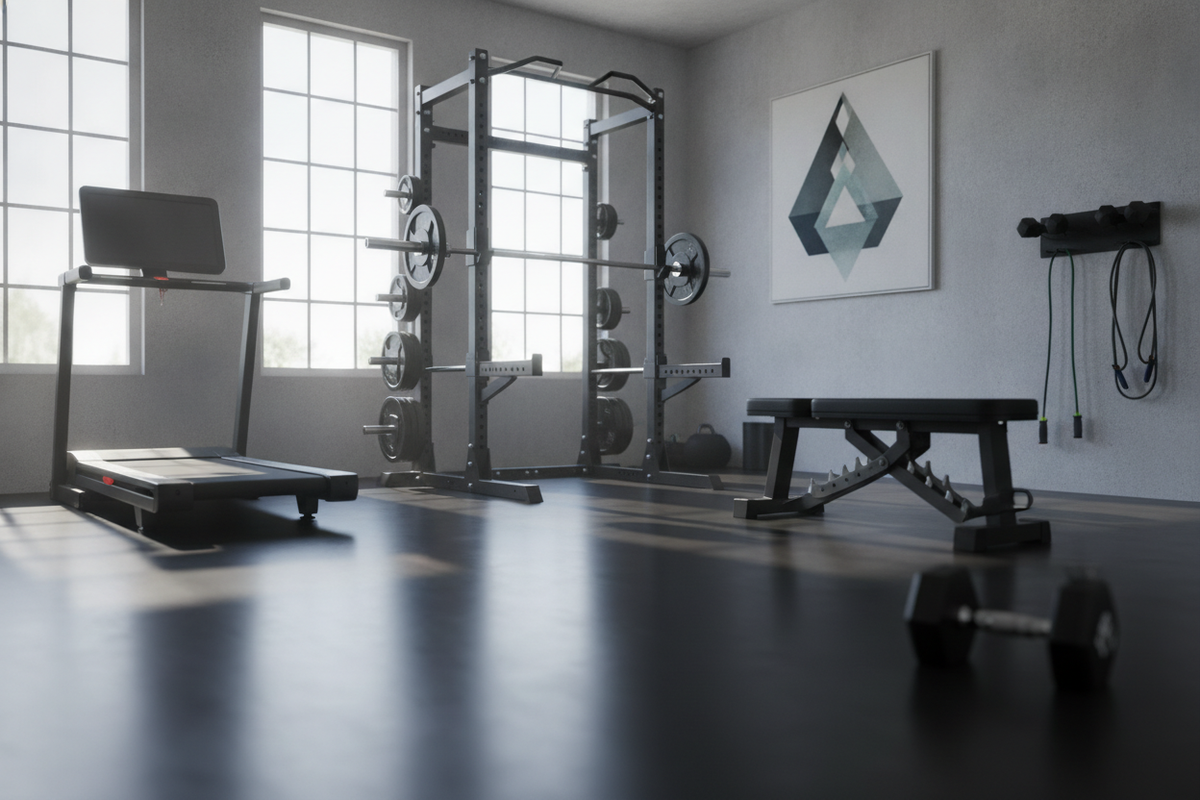
Setting up your floor space with dedicated gym equipment, such as a large exercise product designed for bodyweight drills and mobility routines, provides consistent support throughout multi-angle movements.
Surface Density and Sacral Cushioning
For supine alignment protocols, high-density padding is essential. A surface with too much give distorts pelvic feedback, making it difficult to feel whether your hips are level. Using a structured exercise collection mat gives you the firm tactile feedback needed to monitor spine positioning while offering ample joint cushioning.
Traction Requirements for Half-Kneeling and Unilateral Drills
Half-kneeling hip flexor stretches and rotational transitions require reliable ground grip. Mats that slide or bunch under foot pressure compromise joint stability. Exploring an expanded exercise collection allows you to perform wide-stance hip openers, rolling transitions, and half-kneeling drills without stepping off the padded boundary or losing traction.
Integrating Alignment Drills into Strength Training and Daily Habits
Resetting pelvic symmetry is an ongoing practice supported by balanced strength work and mindful everyday posture.
Unilateral Accessory Work for Sustained Symmetry
Once you restore baseline alignment, single-leg exercises reinforce equal force production across both hips. Incorporating split squats, step-ups, and single-leg Romanian deadlifts helps prevent dominant limbs from pulling the pelvis out of line. For detailed movement selections and training structures, consult our leg exercise that guide to target bilateral discrepancies effectively.
Daily Postural Checkpoints and Sitting Strategies
Sustained hip alignment depends heavily on what you do outside your workout sessions:
- Avoid Habitual Leg Crossing: Sitting with the same leg crossed for hours at a time encourages persistent pelvic rotation.
- Distribute Weight Evenly When Standing: Resist the urge to lean heavily into one hip while standing in line or working at a standing desk.
- Take Frequent Movement Breaks: Stand, walk, or perform a light standing hip extension every 45 to 60 minutes to prevent hip flexor shortening.
By pairing gentle isometric resets with structured mat staging, unilateral strength work, and mindful daily habits, you can build a resilient, balanced foundation for your hips at home.