Home Workout Plans for Beginners: Why Partial Reps Work Best
I still remember a client who decided to get fit in her cramped one-bedroom apartment. She cleared a tiny space between her sofa and coffee table, loaded up a popular fitness app, and tried to keep pace with an instructor demanding deep lunges and chest-to-floor pushups. By day two, her knees throbbed. By day three, she couldn't walk down her stairs without wincing. She quit before the week was over. This is the exact reason why most home workout plans for beginners fail right out of the gate.
When you are completely new to fitness, your muscles might have the raw potential to lift, but your tendons, ligaments, and joints are entirely unprepared for the sudden stress. Instead of forcing your body into deep, painful ranges of motion, the smartest approach is what I call the Range-Expansion Strategy. By intentionally cutting your movements in half, you build a bulletproof foundation without the crippling soreness that derails so many newcomers.
Quick Takeaways
- Forcing a full range of motion too early is the leading cause of joint pain and high dropout rates in beginners.
- Starting with 50-percent partial reps builds essential tendon strength and neuromuscular confidence.
- A supportive, high-density floor surface is mandatory to protect knees and wrists during home training.
- Gradually expanding your range of motion over four weeks creates sustainable, pain-free progress.
The Hidden Danger of 'Full Range' for New Trainees
If you spend five minutes looking for fitness advice online, you will hear the same aggressive cues: squat ass-to-grass, touch your chest to the floor on pushups, and lock out every rep. For advanced athletes, this is sound advice. For someone starting workout routine at home after years of being sedentary, it is a recipe for disaster.
Your muscles adapt to stress relatively quickly, bringing fresh blood and nutrients to repair tissue. Tendons and ligaments, however, have poor blood supply. They take much longer to strengthen. When you drop into a deep squat on day one, you place massive shearing force on unprepared knee joints. The resulting Delayed Onset Muscle Soreness (DOMS) hits roughly 48 hours later, leaving you so stiff that just sitting on a chair feels like an Olympic event.
I have seen dozens of clients push through this pain, assuming it was just a normal part of getting into shape. It isn't. Extreme soreness is your body signaling trauma, not progress. If your routine leaves you dreading the next session, you simply won't stick with it. We need to dial back the depth to keep you coming back.
What is the Range-Expansion Strategy?
The Range-Expansion Strategy is incredibly straightforward: for your first four weeks, you only perform 50 percent of a movement's full range. If a standard squat requires your hips to drop below your knees, you will only drop halfway down. If a pushup requires your chest to hover an inch above the floor, you stop halfway and push back up.
This might look like cheating to a seasoned gym-goer, but it is actually the most effective beginner muscle building workout plan at home. Partial reps keep the tension strictly on the muscle belly while avoiding the extreme end-ranges where vulnerable joints are stretched to their limits. You still trigger a hypertrophy response and build strength, but you bypass the severe micro-tearing that causes debilitating DOMS.
More importantly, partial reps build neuromuscular confidence. Your brain learns the firing pattern of a squat or a pushup in a safe, controlled zone. Once you master this half-range, you can naturally progress to a workout routine at home for beginners that prioritizes feeling energized rather than feeling wrecked.
Creating a Safe Surface for Joint Protection
Even if you are only doing partial reps, the environment you train in matters immensely. A major oversight in any simple workout plan at home is the floor itself. Doing modified pushups from your knees or holding a half-plank on bare hardwood or thin carpet places direct, localized pressure on your patella and wrist bones.
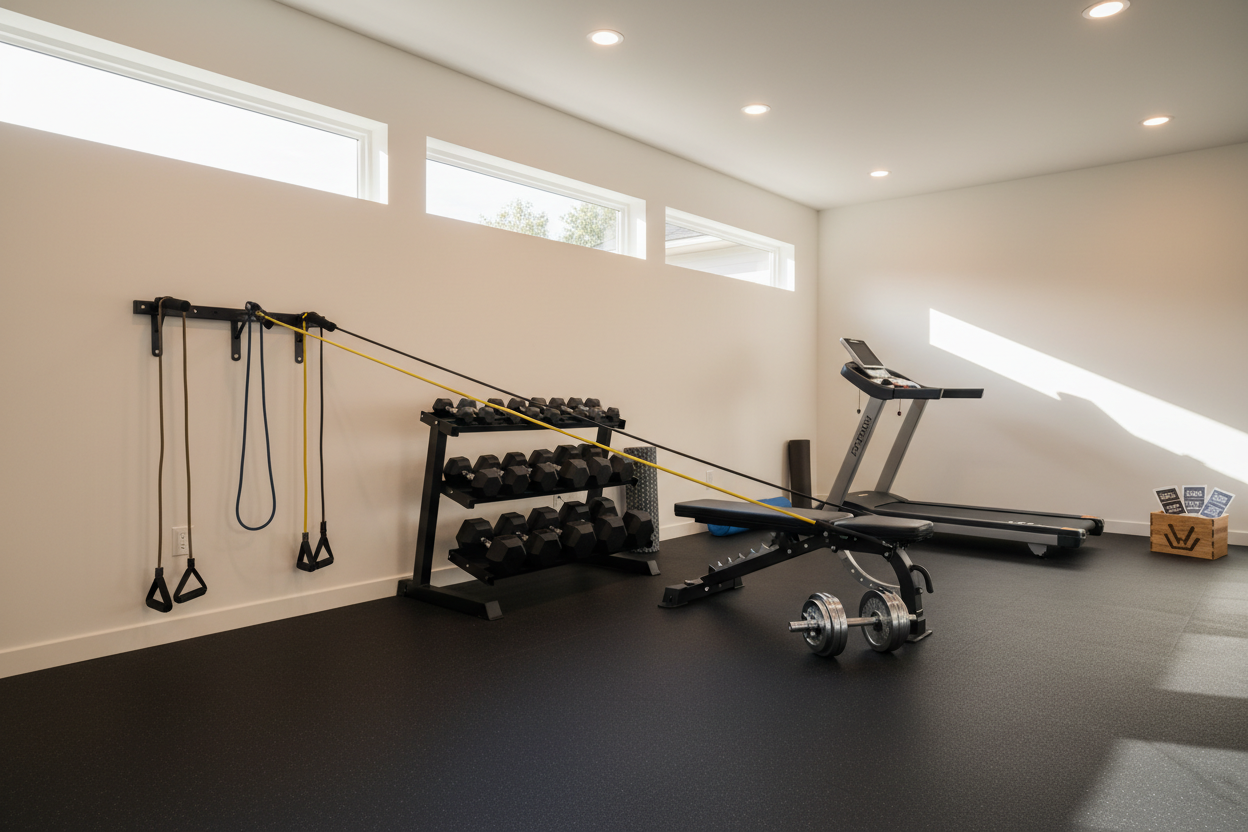
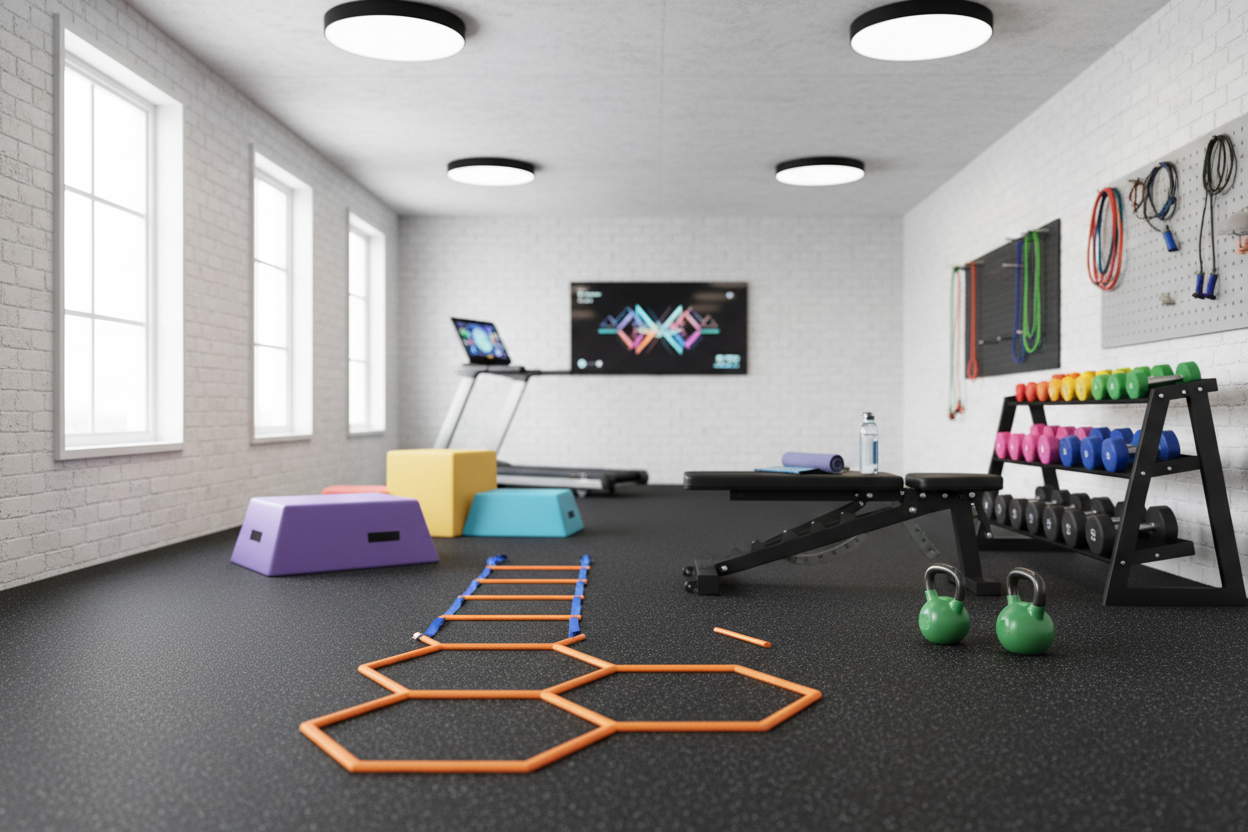
Over the years, I have tested dozens of home gym setups for clients. One thing I always insist on is upgrading the floor space. You need a dedicated, high-density surface that absorbs impact but doesn't compress so much that you lose your balance. I usually recommend laying down a large exercise mat for home gym use, specifically looking for something around 7mm thick with a textured grip.
In my own garage gym, I initially tried saving money by using cheap, interlocking foam tiles. It was a mistake. They separated during lateral lunges, and after about 1,000 reps of various exercises, the foam permanently compressed into hard divots. Upgrading to a single, heavy-duty mat solved the joint pain instantly. The only honest downside is that high-quality, dense mats are heavy to unroll and move, so you will want to pick a permanent spot for it in your room.
The 4-Week Range-Expansion Schedule
To put this into practice, we are going to use a four-week progression block. You don't need a massive garage to do this; clearing a space large enough for a 6x8ft exercise mat is plenty of room to execute these movements safely. We will train three days a week, focusing entirely on bodyweight control and joint preparation.
Weeks 1-2: Mastering the 50-Percent Threshold
During the first two weeks, your only goal is to find your halfway point and own it. This is the foundation of your new home gym routine for beginners. For squats, pull a dining chair or a high box (roughly 20 to 24 inches tall) behind you. Slowly sit back until your glutes just barely tap the seat, then stand back up. Do not relax your weight onto the chair.
For upper body, skip the floor entirely. Perform your pushups with your hands resting on a kitchen counter or a sturdy table. This aggressive incline automatically reduces the load and limits how far your shoulders can stretch. Aim for 3 sets of 10 to 12 reps per movement. If you feel a deep stretch or any joint pain, you are going too far.
Weeks 3-4: Bridging the Gap to Full Range
By week three, your tendons have adapted and your nervous system is firing efficiently. Now, we expand the range by literally an inch or two per session. Swap the 24-inch chair for an 18-inch coffee table or a lower box. You will feel your glutes and quads working much harder to stabilize that extra depth.
For pushups, move from the kitchen counter down to a lower sofa arm or the seat of a sturdy chair. You are systematically lowering the angle, forcing your chest and triceps to handle more of your body weight through a deeper range. Keep your sets and reps exactly the same. By the end of week four, you will be shocked at how easily you can transition to the floor without the joint pain that usually plagues beginners.
Graduating Your Routine: Adding Time and Volume
Once you have successfully completed the four-week Range-Expansion schedule, you will have earned the right to perform full-range movements. Your knees won't ache when you squat, and your wrists won't scream when you set up for a pushup. This is the exact moment you transition from joint-preparation into traditional muscle building.
Your sessions during the first month likely only took 15 to 20 minutes. Now, you can safely introduce more volume, adding extra sets and introducing new movement patterns like lunges and rows. Stepping up to a 45 minute workout routine for beginners is the next logical step. You will use the exact same controlled tempo you learned during your partial reps, but now you will reap the full benefits of deep, strength-building ranges of motion.
Frequently Asked Questions
Will partial reps still build muscle?
Yes. While full range of motion is optimal for long-term hypertrophy, partial reps keep constant tension on the muscle. For a beginner, this stimulus is more than enough to trigger muscle growth and strength adaptations.
How do I know if I am doing 50 percent?
Use physical targets. Place a chair behind you for squats, or use a wall or counter for pushups. Having a physical barrier prevents you from accidentally dropping too deep and entering the pain zone.
Should I use weights during the first 4 weeks?
I highly recommend sticking entirely to bodyweight for the first month. Your primary goal is tendon conditioning and joint resilience. Adding dumbbells or kettlebells too early complicates the movement and increases the risk of injury before your form is locked in.