Got Limited Weights? Chain Your db shoulder exercises Like This
I remember staring at my lone pair of 35-pounders during the 2020 lockdown, wondering how the hell I was going to get a decent pump without a full commercial rack. Most db shoulder exercises rely on you having a gradient of weights—5s for raises, 50s for presses—but when you're in a garage, you've got what you've got. You don't need a wall of chrome to grow; you just need to stop thinking like a commercial gym lifter and start thinking about leverage.
- Focus: Mechanical drop sets for maximal hypertrophy.
- Equipment: One pair of dumbbells and a bench.
- Difficulty: High intensity, low technical entry point.
- Key Benefit: Forces growth without needing heavy 100-lb dumbbells.
The Home Gym Dilemma: Missing the Dumbbell Rack
Commercial gyms spoil us. If your lateral raises get hard, you just grab the 5-lb lighter pair and keep going. At home, if you've only got 25s or 35s, you hit a wall fast. You can't just 'run the rack' when your rack consists of two weights and a pile of laundry. This is where most guys fail; they just stop when the weight gets heavy or their form breaks down on a single dumbbell shoulder exercise.
The reality of training shoulders at home is that you have to be more creative than the guy at the local big-box gym. Instead of changing the weight, we're going to change your leverage. By manipulating how your body interacts with the weight, you can turn a pair of dumbbells that feels 'too heavy' for isolation into the perfect tool for a high-rep mass builder. It’s about making the weight feel heavier when you're fresh and lighter when you're fatigued.
What is a Mechanical Drop Set?
A mechanical drop set is the smart man's way to suffer. In a traditional drop set, you strip weight off the bar. In a mechanical drop set, you keep the weight the same but move from a 'weak' exercise to a 'strong' one. You start with an isolation move where your leverage is terrible, then transition to a compound move where you have more muscle groups helping out. This pushes the deltoids way past the point of normal failure.
As long as you have a basic weight set and bench, you can execute this high-intensity technique without buying more gear. You are essentially tricking your muscles into doing more work with the same load. It’s efficient, it’s brutal, and it’s the best way to ensure those 30-lb bells actually produce a 50-lb stimulus on the muscle fibers.
The 3-Phase Shoulder Chain Protocol
This is the bread and butter of my shoulder routine with dumbbells. Phase one: Strict Lateral Raises. Stand tall and fly those weights out to the side. Since your arms are long levers, the weight feels heaviest here. Go until you can't complete a full rep with zero momentum. The second you hit that wall, don't drop the weights. Sit down on your bench immediately.
Phase two: Arnold Presses. By sitting down and rotating your palms, you bring the front delts and triceps into the fight. You're stronger here than in a lateral raise, so you can squeeze out another 8-10 reps. Finally, when your shoulders are screaming, stand back up for Phase three: The Push Press. Use a slight dip of the legs to drive the weight overhead. This 'cheat' allows you to keep moving the load even when the delts are fried. You can follow this up with specific dumbbell exercises for neck and shoulder strength like heavy shrugs to round out the look of your traps.
Why the Final Push Press Phase Requires a Solid Base
When you’re in that final phase of the chain, gasping for air and driving with your legs, the last thing you want is your feet sliding on a dusty garage floor. I’ve seen guys try to do a heavy dumbbell shoulder lift on slick concrete and nearly tweak their lower back because their footing gave way mid-drive. Stability is the foundation of power.
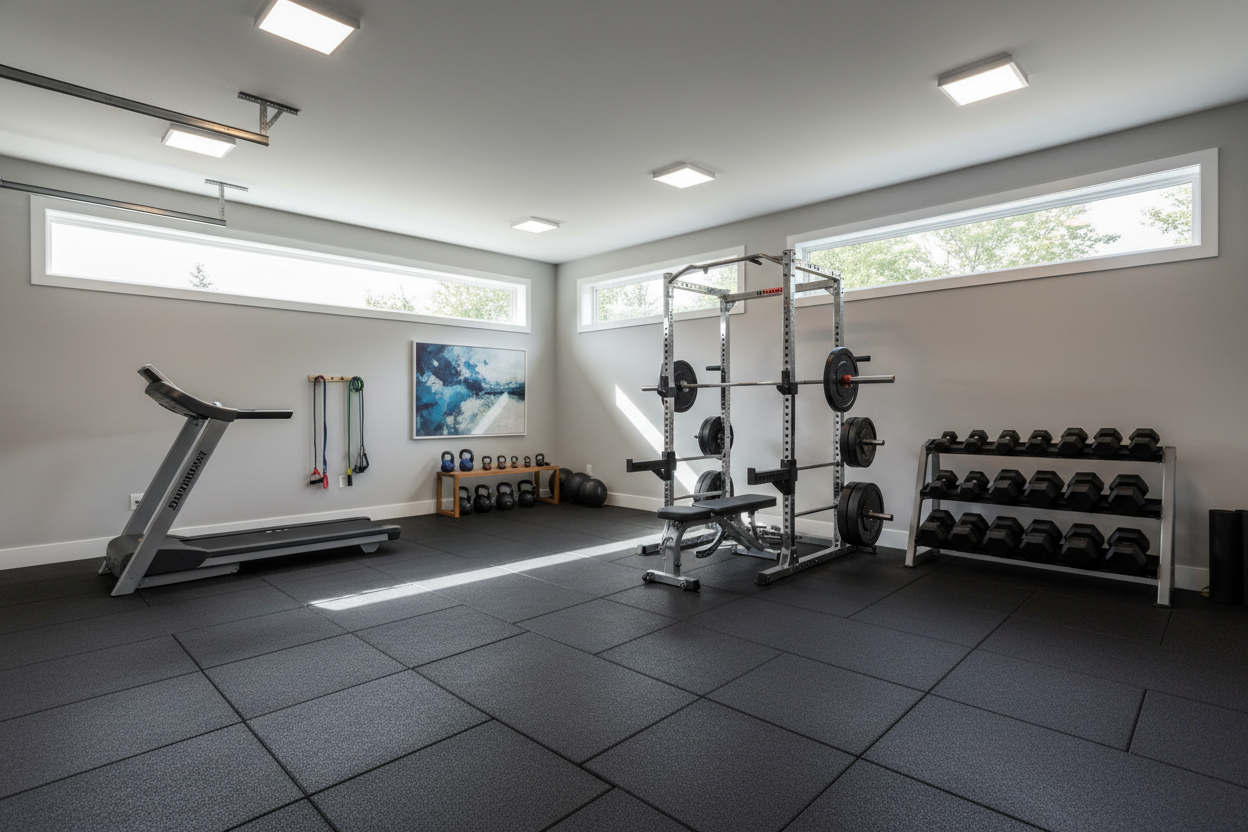
I always recommend upgrading to high-traction gym flooring for home workout setups. You need that friction to aggressively drive through your heels without the fear of your feet migrating. A solid rubber surface doesn't just protect your floor; it protects your spine by giving you a predictable, non-slip base to push against during those ugly, final reps of a push press.
Programming the Protocol Into Your Week
This isn't a daily routine. If you do this right, your shoulders will be smoked for at least 48 hours. I like to insert this chain at the end of a session where I've already been working on a stronger chest with dumbbell and free weight workouts. Your front delts are already warmed up from benching, making this the perfect finisher to polish them off.
Try running this for 3 sets with 2 minutes of rest between chains. Don't rush the rest—you need your central nervous system to recover enough so you don't get sloppy. If you're doing a dedicated shoulder day, you can push it to 4 or 5 sets, but watch your form. The goal is deep fatigue, not a trip to the physical therapist.
How heavy should the dumbbells be for this?
Pick a weight you can lateral raise for about 12-15 reps. By the time you get to the presses and push presses, that same weight will feel like a house. Most guys find that 25lb to 35lb dumbbells are the 'sweet spot' for this specific chain.
Can I do this with adjustable dumbbells?
Absolutely, but don't change the settings mid-set. The whole point is to use the same fixed weight through all three movements to save time and keep the tension on the muscle. If you stop to click a dial, you're losing the metabolic stress that makes this work.
What if my shoulders click during Arnold presses?
If you have impingement issues, swap the Arnold press for a standard neutral-grip overhead press. Keeping your palms facing each other is usually friendlier on the rotator cuff while still allowing you to move the weight after your lateral raises are done.