Good Workouts for Beginners: The Complete Home Training Guide
Starting your fitness journey can feel like navigating a maze. Whether you are staring at an empty garage or a cramped apartment living room, the sheer volume of fitness advice online is overwhelming. You might be wondering how to build muscle without getting hurt, or what gear is actually worth your hard-earned money. Finding good workouts for beginners isn't about copying advanced bodybuilders; it is about mastering the basics in a safe, sustainable way. In this guide, we will break down exactly how to structure your training and what minimal equipment you need to see real results at home.
Key Takeaways
- Focus on fundamental movement patterns: push, pull, squat, and hinge.
- Start with versatile, space-saving equipment like adjustable dumbbells.
- Prioritize form and a full range of motion over lifting heavy weights.
- Commit to 2-3 full-body sessions per week to allow for adequate recovery.
Building Your Foundation: The Movement Patterns
When clients ask us, 'what is a good workout routine for beginners?', our answer always revolves around movement patterns rather than isolating specific muscles. Your body operates as an integrated system, and your home gym routine should reflect that.
The Full-Body Approach
For your first few months, full-body workouts are highly efficient. A standard session should include a squat variation (like a goblet squat), a push (push-ups or dumbbell presses), a pull (dumbbell rows or band pull-aparts), and core work (planks). This structure ensures balanced development and prevents the muscular imbalances that often lead to injury.
Essential Gear for Your Starting Point
You don't need a sprawling, commercial-grade setup to get an effective sweat session. In fact, limiting your equipment initially forces you to focus on technique.
Adjustable Dumbbells and Resistance Bands
If you are working with a tight space—like a spare bedroom or an apartment corner—adjustable dumbbells are the ultimate investment. They replace an entire rack of weights and easily slide under a bed. Pair these with a set of high-quality resistance bands, and you have everything you need. Bands provide continuous tension and are incredible for teaching proper muscle engagement during pulling movements.
Finding the Right Progression
People often wonder, 'what is the best workout routine for beginners?' The truth is, the best routine is the one you can consistently progress. This concept is called progressive overload.
When to Add Weight
Stay with a specific weight until you can perform 3 sets of 10-12 reps with perfect form. Once that feels manageable, it is time to increase the resistance. Don't rush this process. Your tendons and ligaments take longer to adapt to stress than your muscles do.
From Our Gym: Honest Take
When I first started training in my cramped, unfinished basement, I thought I needed a massive functional trainer and an Olympic barbell setup. I ended up buying a cheap, wobbly bench and a basic set of iron dumbbells. Looking back, those dumbbells were all I needed. I spent my first six months doing basic goblet squats, floor presses, and bent-over rows. The one caveat? I wish I had invested in a slightly thicker high-density mat for floor exercises, as the raw concrete was brutal on my knees during planks and mobility work. Keep it simple, master the form, and upgrade your gear only when your strength demands it.
Frequently Asked Questions
Do I need a power rack right away?
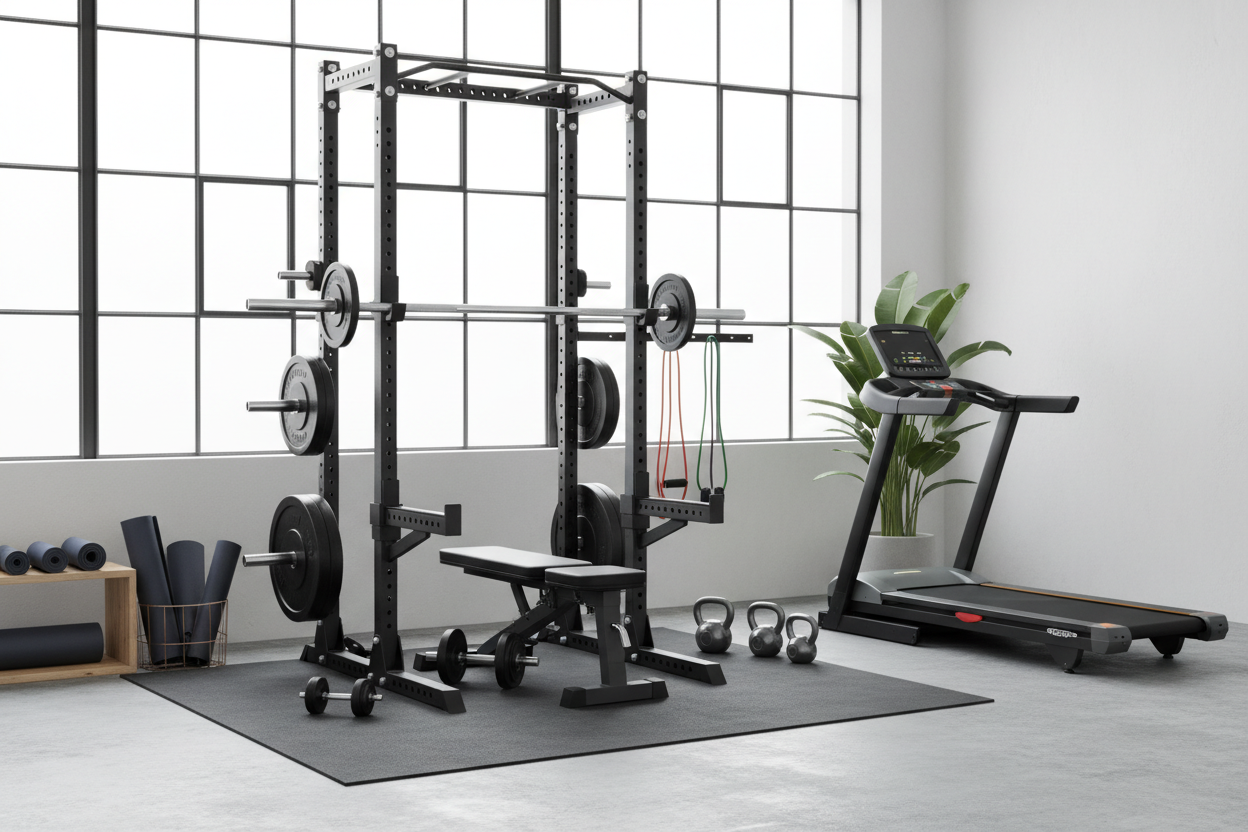
No. While power racks are the centerpiece of advanced home gyms, beginners can make incredible progress for the first 6-12 months using just dumbbells, kettlebells, or resistance bands.
How many days a week should I train?
Aim for 2 to 3 days per week. This frequency allows for at least 48 hours of rest between sessions, which is crucial for muscle recovery and central nervous system adaptation.
How long should a beginner workout last?
A highly effective beginner session can be completed in 30 to 45 minutes. If you are resting appropriately and staying focused, you don't need to spend hours in your home gym.