Gluteal Artery and Posterior Chain Blueprint: Functional Anatomy, Movement Dynamics, and Home Floor Staging
Anatomical Architecture: Understanding the Gluteal Artery and Regional Blood Supply
The human posterior chain relies on an intricate vascular network to sustain movement, force transmission, and muscular endurance. At the center of this vascular pathway is the gluteal artery system, which provides the primary arterial blood supply to the musculature of the pelvis and buttocks. Understanding how these pathways divide and navigate regional structures provides valuable context for training mechanics and functional hip development.
The arterial network primarily branches into two distinct pathways: the superior gluteal artery and the inferior gluteal artery. Originating from the internal iliac artery within the pelvic basin, these vessels exit through the greater sciatic foramen relative to the piriformis muscle. The superior branch emerges above the upper border of the piriformis, dividing into superficial and deep divisions to distribute blood to the upper gluteal region. The inferior branch passes beneath the lower border of the piriformis, coursing downward to support the lower pelvic floor, deep rotators, and the bulk of the larger hip extensors.
Together with their accompanying venous channels, these vessels form an essential delivery network. Dynamic movement patterns demand continuous circulation, making the functional health of surrounding soft tissues critical for unimpeded vascular flow and joint articulation.
Posterior Chain Musculature: Blood Supply and Movement Mechanics
The muscles served by the gluteal vascular network form the cornerstone of upright posture, hip extension, and multi-directional stability. Each muscle group plays a targeted role in the kinetic chain, working in synergy with spinal stabilizers and lower extremity complexes.
- Gluteus Maximus: As the largest muscle in the region, it receives substantial vascular support from both superior and inferior arterial branches. It serves as the primary driver of hip extension and external rotation during compound lifts, sprinting, and vertical propulsion.
- Gluteus Medius and Minimus: Positioned laterally and deep along the ilium, these muscles rely on the deep branch of the superior gluteal artery. They are critical for pelvic stabilization during single-leg stance and control hip abduction and internal rotation.
- Deep Lateral Rotators: Including the piriformis, obturator internus, and gemelli muscles, these structures stabilize the femoral head within the acetabulum, ensuring smooth rotational mechanics under load.
Understanding these muscle groups mirrors the analytical approach used when studying upper-body muscular networks, such as in a comprehensive back workout muscles anatomy guide, reinforcing that balanced muscular development requires attention to both structural recruitment and regional tissue care.
Movement Archetypes for Hip and Glute Conditioning
To engage the posterior compartment effectively, training routines should incorporate movement archetypes that challenge hip mobility, rotational control, and multi-planar strength. Structuring exercises across distinct planes of motion promotes comprehensive tissue engagement.
1. The Hip Hinge
Hinge variations, such as deadlifts and kettlebell swings, emphasize maximal hip flexion and extension with minimal knee displacement. This pattern places significant eccentric demand on the posterior chain, promoting strength along the gluteal and hamstring pathways.
2. Pelvic Elevation and Bridging
Floor-based hip thrusts and glute bridge progressions isolate terminal hip extension without imposing substantial axial spinal loads. These movements allow focused activation of the gluteus maximus while maintaining stable pelvic alignment.
3. Unilateral and Lateral Displacements
Lunges, step-ups, and lateral lunges demand dynamic stability from the gluteus medius and deep rotators. Unilateral exercises help address bilateral strength discrepancies and reinforce balance across the pelvis. Just as lateral stability supports the lower body, complementary upper-body mobility relies on balanced structural integration, as detailed in our shoulder adductor muscles anatomy guide.
Home Gym Floor Staging for Lower-Body Stability and Joint Protection
Executing demanding lower-body exercises requires a dedicated flooring foundation that delivers traction, surface firmness, and joint protection. Staging a home training space with appropriate high-density workout mats ensures that bodyweight, free-weight, and floor-based movements are performed on a supportive foundation.
When planning a home gym floor layout for posterior chain training, consider the following structural staging elements:
- High-Density Base Layer: A dense mat surface prevents foot sinkage during heavy compound movements like squats and deadlifts, ensuring efficient force transfer from the floor through the kinetic chain.
- Non-Slip Texture: Textured surface profiles provide positive grip during dynamic lunges and wide-stance hinges, reducing the risk of footing slippage.
- Subfloor and Joint Cushioning: For kneeling hip mobility work and supine bridging exercises, moderate cushioning reduces direct pressure over bony prominences such as the sacrum and knees without sacrificing stability.
- Zoned Flooring Modular Layouts: Interlocking or large-format mats allow you to define distinct zones for high-load lifting and dedicated bodyweight or mobility training.
Equipment Placement, Mat Care, and Maintenance Frameworks
A well-organized training environment supports safety, equipment longevity, and training consistency. Maintaining your exercise mats and structuring your equipment layout keeps the space functional and clean over time.
Spatial Clearance and Equipment Organization
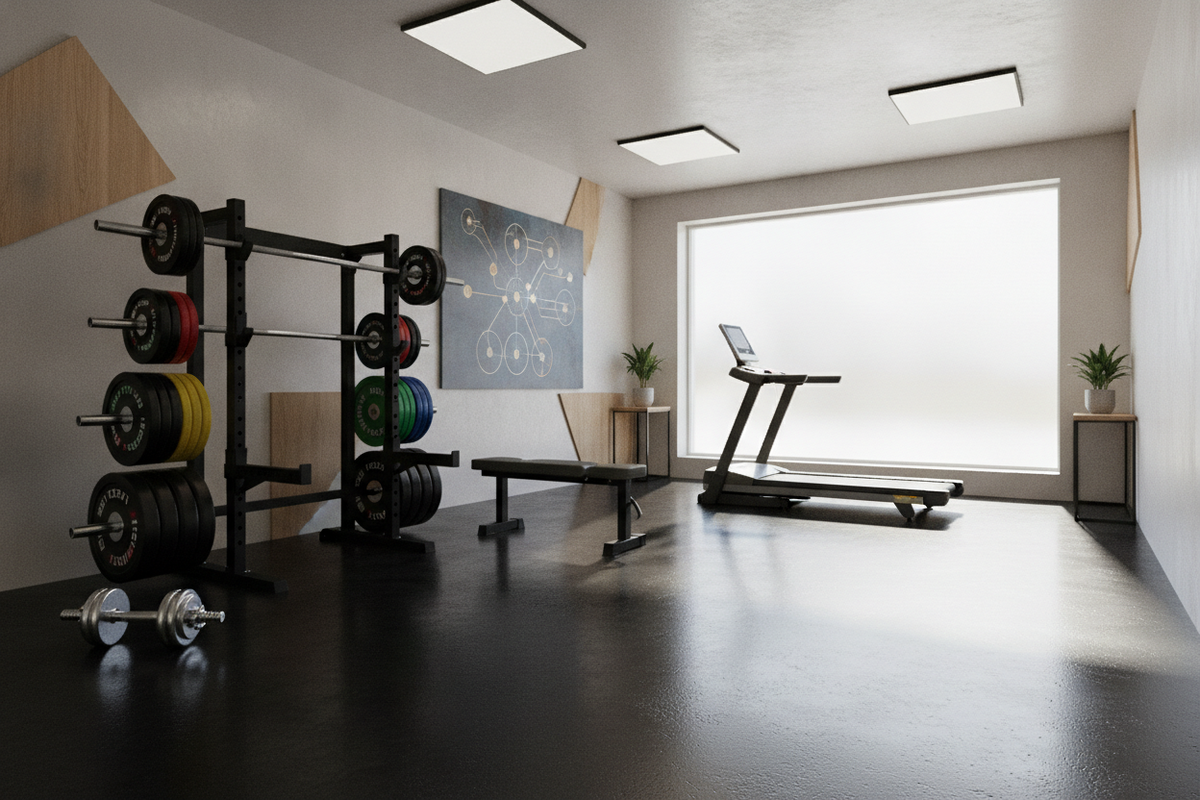
Ensure that heavy equipment, such as barbell racks, benches, and free weights, are placed along stable perimeters or positioned centrally on protective mats. Provide ample clearance around the perimeter of your primary training mat to allow full range of motion during lateral lunges and wide-stance movements without physical obstructions.
Mat Cleaning and Routine Care
Routine hygiene preserves the surface integrity and grip of your workout mats. Wipe down surfaces after training sessions using mild, non-abrasive cleaning solutions to remove sweat, dust, and chalk residue. Avoid harsh chemical agents that can degrade dense rubber or foam compounds over extended periods. Regular sweeping or vacuuming beneath modular mats prevents debris from abrading the subfloor and helps maintain a balanced, stable training surface.