Full Body Kettlebell Workout Darebee: The Complete Training Guide
If you have ever stared at a solitary kettlebell in your living room and wondered how to squeeze a comprehensive training session out of it, you aren't alone. Home gym owners frequently battle limited square footage, budget constraints, and workout plateaus, making minimalist equipment highly appealing. That is exactly where the full body kettlebell workout darebee comes into play.
This accessible, visual-based programming has become a staple for garage gym warriors and apartment dwellers alike. In this guide, we will break down how to optimize your home gym space, select the right equipment, and execute these routines effectively to maximize your strength gains.
Key Takeaways
- A single moderate-weight kettlebell is enough to complete most darebee kettlebell workouts.
- You only need about a 6x6 foot clearance to safely perform swings, cleans, and snatches.
- Cast iron kettlebells with a wide handle are preferred for the two-handed movements common in these routines.
- Progressive overload can be achieved by increasing rep counts or decreasing rest, rather than constantly buying heavier bells.
Optimizing Your Gear for the Darebee Kettlebell Routine
Cast Iron vs. Competition Bells
When diving into a darebee kettlebell workout, the style of your bell matters. Competition kettlebells are uniform in size regardless of weight, which is great for single-arm consistency. However, traditional cast iron bells typically offer a wider handle. Since many visual routines include two-handed goblet squats and heavy swings, the wider grip of a cast iron bell is often more comfortable for the average home gym owner.
Selecting the Ideal Weight Range
You don't need an entire rack of weights. For a standard kettlebell darebee session, we recommend a 16kg (35lb) bell for men and an 8kg to 12kg (18-26lb) bell for women as a starting point. This provides enough resistance for lower-body power movements while remaining manageable for overhead presses.
Space Planning: No Garage Required
Clearance and Flooring
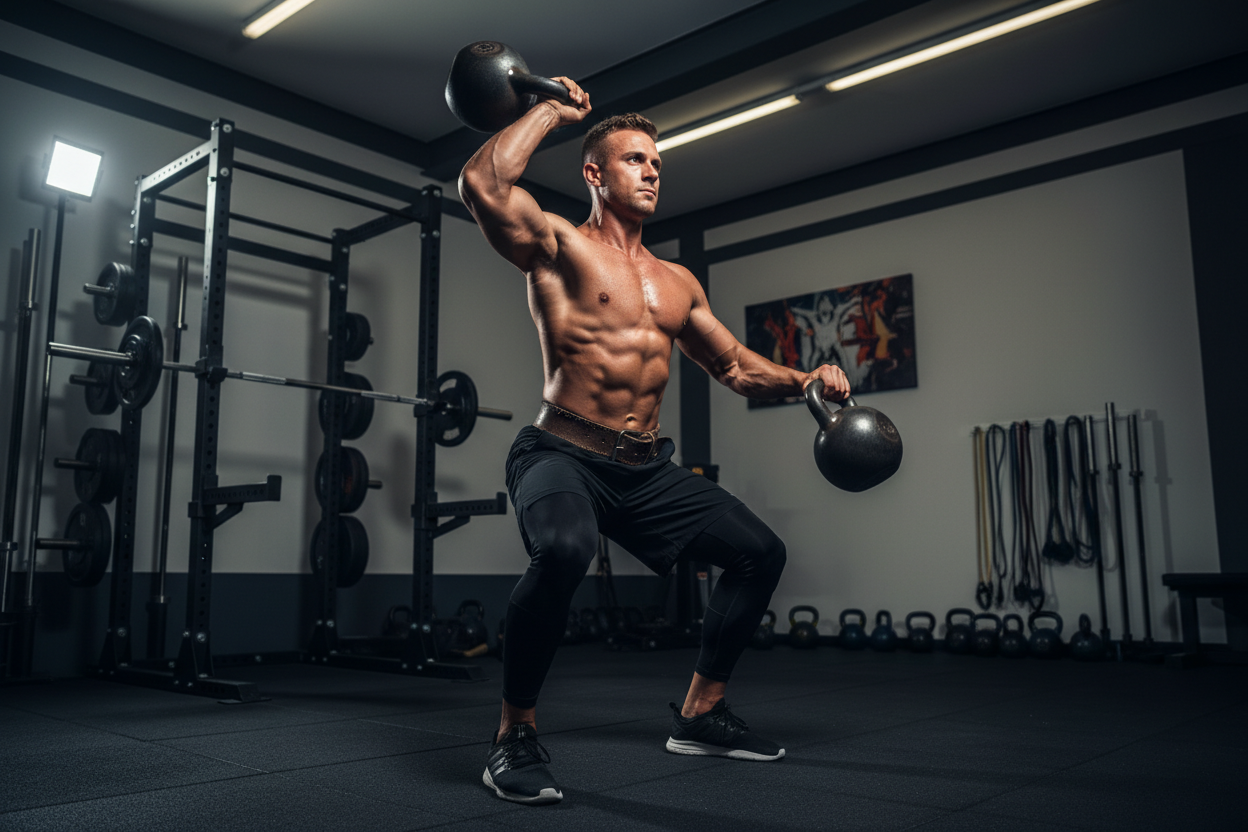
One of the biggest advantages of the darebee gauntlet and similar routines is the minimal footprint. You need a space roughly 6 feet by 6 feet. Most importantly, ensure you have overhead clearance—at least a foot above your fully extended reach—so you don't punch a hole in your basement ceiling during Turkish get-ups or snatches. Invest in a 3/4-inch rubber stall mat to protect your flooring from accidental drops.
From Our Gym: Honest Take
We test a lot of equipment and programming in our facility, and I recently ran through a full month of darebee kettlebell workouts using just a 24kg cast iron bell in a cramped one-car garage. The beauty of this setup is the sheer efficiency. However, a quick tip from my own experience: the visual guides don't mention grip fatigue. By week two, the high-rep swings tore up my hands because my kettlebell had an overly aggressive powder coat. I highly recommend keeping some lifting chalk nearby and investing in a bell with a smooth, machined handle. It makes a world of difference when you are deep into the late rounds of a grueling circuit.
Frequently Asked Questions
Are darebee kettlebell workouts good for beginners?
Absolutely. The visual nature of the programming makes it incredibly easy to follow. Beginners should focus on mastering the hip hinge and starting with a lighter weight before progressing to complex circuits.
How much space do I need for a kettlebell darebee routine?
A 6x6 foot area is the sweet spot. As long as you can swing the bell between your legs and press it overhead without hitting a wall or ceiling, you have enough room.
Is the darebee gauntlet enough to build muscle?
Yes, especially when you focus on time-under-tension and progressive overload. While it won't replace a heavy barbell power rack for absolute max strength, it is highly effective for functional hypertrophy and muscular endurance.