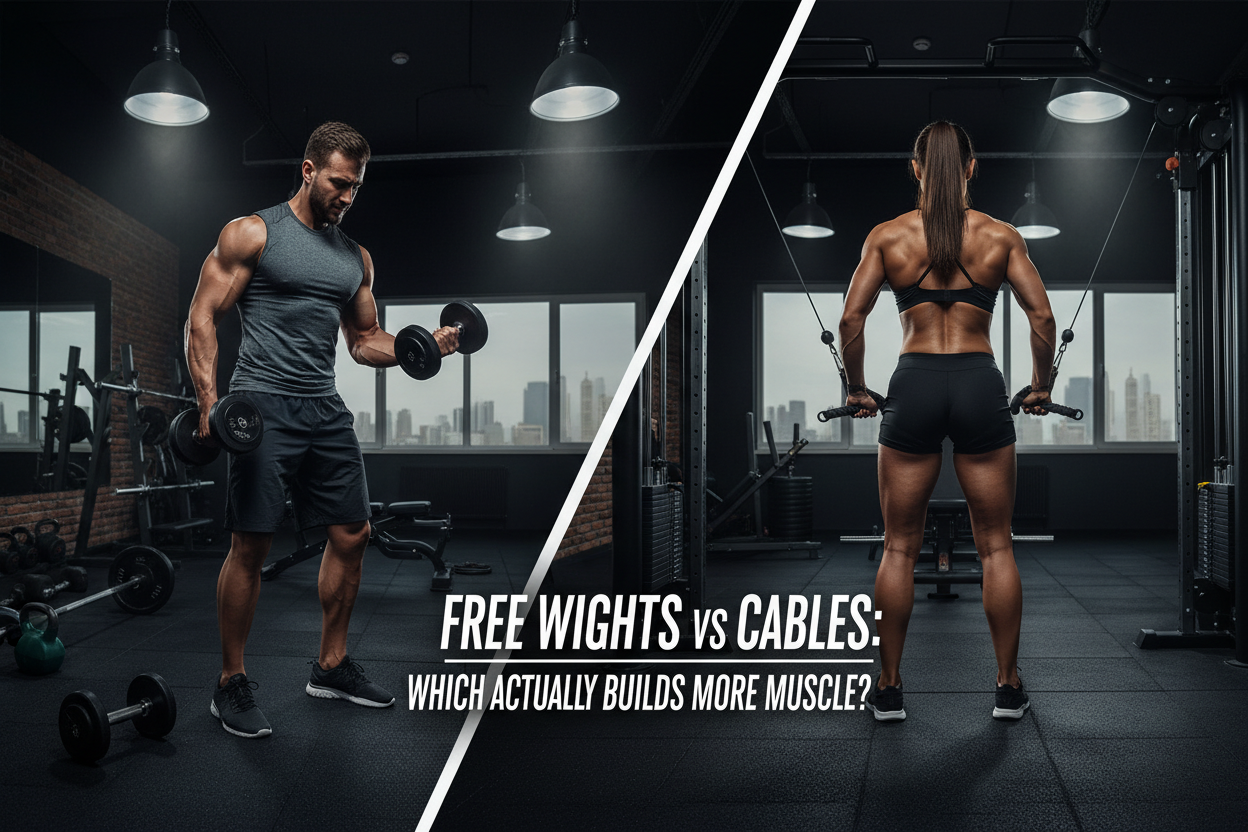
Free Weights vs Cables: Which Actually Builds More Muscle?
Setting up a home gym often leads to one major dilemma: maximizing your workout potential without cluttering your garage or basement. When deciding between free weights vs cables, many lifters wonder which investment will actually yield the best results for their space and budget. Whether you are chasing hypertrophy, functional strength, or just trying to break through a stubborn plateau, understanding how these two training modalities interact with your body is crucial. This guide will help you decide exactly which equipment deserves the prime real estate in your home gym.
Key Takeaways
- Free weights excel at building raw strength and engaging stabilizer muscles.
- Cable machines provide continuous tension throughout the entire range of motion, ideal for hypertrophy.
- Combining both modalities yields the best results, but space constraints often dictate starting with dumbbells or a power rack.
- For home gyms, a functional trainer requires a larger upfront investment but replaces dozens of single-use machines.
The Core Differences in Training Mechanics
Constant Tension vs. Gravity
When comparing a cable vs dumbbell, the most glaring difference is the resistance curve. Free weights rely entirely on gravity. This means at the top or bottom of certain movements (think dumbbell flyes or bicep curls), the tension drops off. The benefits of cable machines shine here: the pulley system provides constant, uniform tension from the start of the rep to the finish. This time under tension is a massive driver for muscle growth.
Stabilizer Muscle Engagement
So, are cables better than free weights? Not necessarily. Free weights force your body to stabilize the load in three-dimensional space. Squatting with a barbell or pressing heavy dumbbells recruits a symphony of core and stabilizer muscles that a guided cable path simply will not trigger to the same degree. If you are wondering if are cable machines as good as free weights, the answer depends entirely on whether your goal is isolation or full-body stabilization.
Home Gym Logistics: Space and Budget
Maximizing Your Footprint
In a North American garage gym, floor space is gold. Dumbbells vs cables is often a debate of footprint. A set of adjustable dumbbells takes up less than two square feet and can slide under a bed. Conversely, a standard functional trainer needs at least a 5x5 footprint and often 80+ inches of vertical clearance, requiring dedicated square footage.
The Investment Factor
When looking at cable machine vs free weights from a budget perspective, free weights usually win the entry-level battle. However, a high-quality dual-pulley cable system offers immense versatility, essentially giving you a commercial gym experience in one corner of your basement.
Hypertrophy and Strength: What Does the Science Say?
Muscle Growth Potential
People often ask, do cable machines build muscle as effectively as iron? Yes. If you are wondering, can you build muscle with cable machines, the answer is a resounding yes. Because they allow for precise angles of resistance, cables are fantastic for isolating specific muscle groups like the side delts, triceps, and lats. That said, for building absolute foundational strength (the 1-rep max), free weights remain the gold standard.
From Our Gym: Honest Take
Let's talk real-world application. I have trained in everything from cramped apartment corners to massive warehouse setups. Last year, we installed a commercial-grade functional trainer alongside our standard power rack. Here is my honest take: While I will never give up my barbell for heavy squats and deadlifts, my joint health has dramatically improved since I shifted 40% of my accessory work to cables. The constant tension on tricep pushdowns and cable lateral raises gives me a pump that dumbbells just cannot match. However, one caveat: cheap cable setups with sticky, non-aluminum pulleys are infuriating. If you are buying a cable machine, do not skimp on the pulley quality, or you will lose that buttery-smooth resistance curve that makes cables worth it in the first place.
Frequently Asked Questions
Are cable machine weights accurate?
Not exactly. The mechanical advantage created by the pulley ratios (often 2:1 or even 4:1) means that lifting 100 lbs on a cable stack might only feel like 50 lbs of actual resistance. Always track your progress based on the specific machine's stack rather than trying to perfectly equate cable weights vs free weights.
What is a disadvantage of cable machines?
The primary disadvantage is their lack of portability, large footprint, and higher upfront cost. Additionally, they do not train core stabilization and balance as intensely as a barbell or heavy dumbbells do.
Are cables better than dumbbells for beginners?
For absolute beginners, cable machines can be safer and more intuitive because the machine guides the path of motion. However, learning proper form with light free weights is crucial for long-term functional strength.
Is a cable machine a good workout on its own?
Absolutely. Are cable machines effective for a full-body routine? Yes. With adjustable heights and various attachments, you can effectively hit every major muscle group—from cable squats and Romanian deadlifts to chest presses and lat pulldowns.